
Yes, a Europe eSIM can work in the UK, but only if its coverage list explicitly includes the United Kingdom. The word “Europe” alone isn't enough to guarantee service after Brexit.
A traveler might land in London, switch off airplane mode, and find that a Europe eSIM installed on their phone shows no data. That doesn't necessarily mean the phone or eSIM is faulty. The plan may not include the UK.
The important distinction is between an eSIM that's technically able to connect and a plan that's commercially allowed to connect. The country list and network arrangements decide whether the service works. Checking those details before departure can prevent a connectivity gap during a multi-country trip.
The Short Answer and Why It Is Not Simple
A traveler arriving in London with a Europe eSIM may expect the phone to connect automatically. If the eSIM shows no data, the first thing to check is whether the plan includes the United Kingdom, not whether the phone has somehow stopped supporting eSIMs.
A Europe eSIM works in the UK only when the provider includes the UK in that plan's coverage and authorizes access to a supported British network. Some plans marketed as “Europe” include Britain; others don't. The label is a product description, not a promise that every destination in Europe is covered.
One label, different country lists
Providers define regional plans in different ways. One “Europe” plan might cover EU and EEA destinations, while another might also include the United Kingdom. A plan called “Europe & UK” or “Europe including the United Kingdom” makes the intended coverage clearer, but the full destination list still deserves a check.
That matters most on an itinerary that crosses between EU countries and the UK. A plan may connect in France and Spain, then fail to provide data in London. The same phone and eSIM can start working again after the traveler returns to a country included in the plan.
A useful mental model: “Europe” is the label on the package. The destination list is the part that tells travelers where the package actually works.
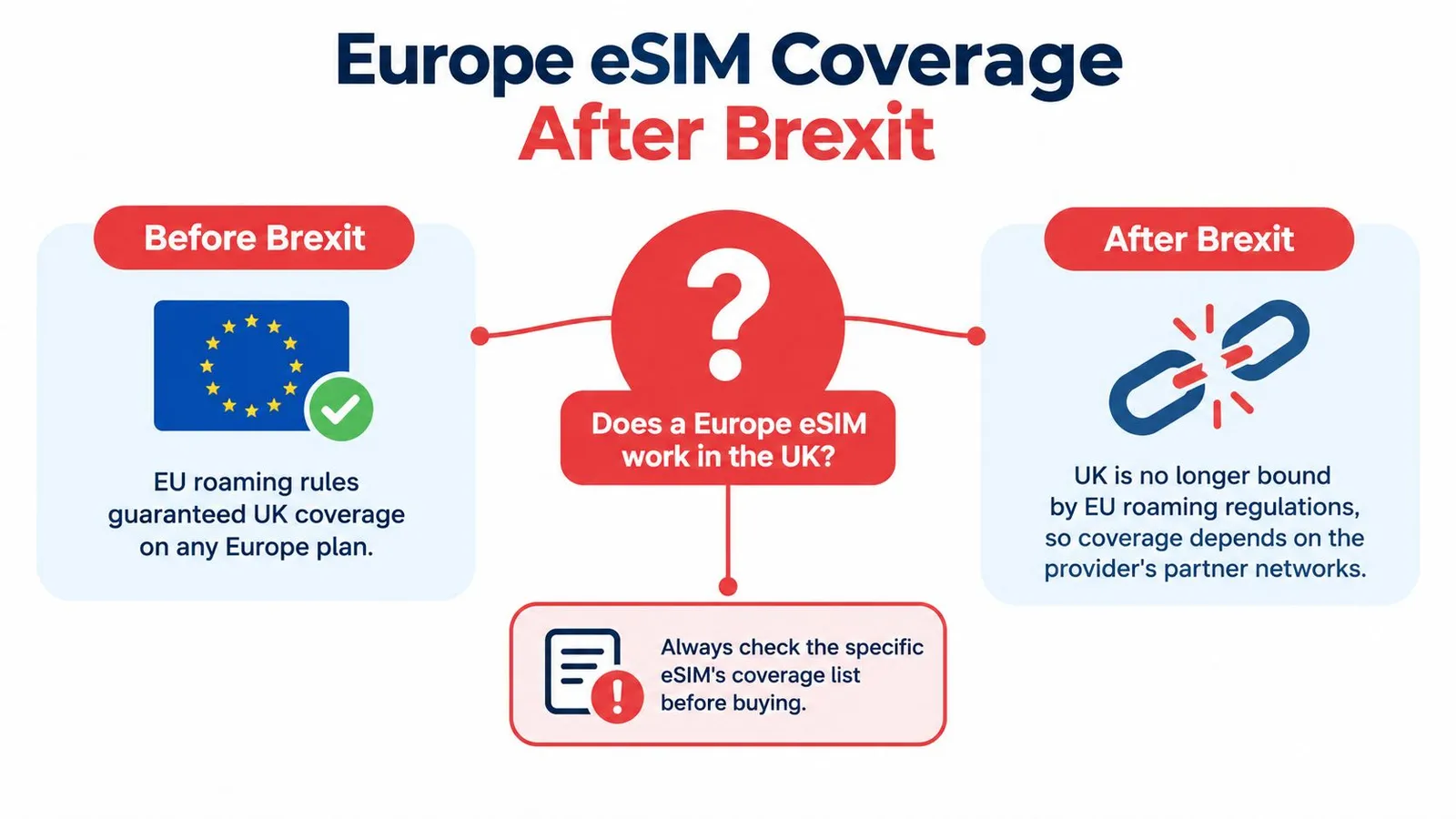
Brexit made that distinction more important because the UK is no longer automatically covered by EU roaming rules. As a result, travelers can't assume that a European plan includes Britain because the UK is geographically part of Europe.
The practical question is therefore not just, “Does a Europe eSIM work in the UK?” It's, “Does this specific plan list the UK, and does it provide service through a supported UK network?” The answers depend on the provider and the plan.
The next steps are straightforward: understand why regional labels can be misleading, learn what roaming does, and check a plan's terms before buying. If the eSIM fails after arrival, a few checks can help distinguish a settings issue from a coverage exclusion.
What Europe Means for eSIM Coverage After Brexit
The key change is legal, not geographic. Before the Brexit transition period ended, EU roaming rules applied across the European Economic Area, which includes EU member states plus Iceland, Liechtenstein, and Norway. The UK stopped being automatically covered by those protections after the transition ended on 31 December 2020. From 1 January 2021, EU “Roam Like at Home” rules no longer guaranteed that a European mobile service would work in the UK without extra charges or a separate provider arrangement (European Commission information on the UK and roaming rules).
That left the UK outside the EU's mandatory roaming framework. A European provider can still offer UK coverage, but it does so through its own commercial terms and network agreements. The UK government also says surcharge-free roaming in EU and EEA countries is no longer guaranteed for UK customers, and providers can set their own policies (UK government guidance on roaming in the EU and EEA).
The plan name isn't the coverage list
A “Europe” plan may include EU and EEA countries but leave out the UK. A plan described as “Europe & UK” or “Europe including the United Kingdom” is a clearer option for travelers crossing between Britain and other European destinations. The safest check is still the plan's actual list of supported countries.
The reverse applies as well. A UK SIM or eSIM might work in EU countries, but surcharge-free roaming isn't a legal guarantee. The provider's terms determine what happens, so travelers should check both coverage and pricing before relying on a plan across borders.
A coverage decision, not an eSIM incompatibility
An eSIM is a digital mobile subscription stored on a compatible device. Brexit didn't make that technology incompatible with UK networks. It changed the assumption that a European plan would automatically have UK roaming rights. A provider now has to choose to include the UK and arrange access through a British network partner.
For a trip that includes several destinations, the Europe eSIM coverage details can help travelers compare a plan's stated footprint with their route. The country list matters more than the broad regional name. When in doubt, travelers should ask the provider to confirm that the specific plan includes UK service, rather than relying on a general description of European coverage.
How eSIM Roaming Works in the UK
An eSIM profile is the digital equivalent of the information a physical SIM card uses to connect a phone to mobile service. Installing the profile adds that subscription to the device, but installation alone doesn't guarantee service in every country.
A regional travel eSIM typically connects through roaming. When the phone arrives in a destination, it looks for a mobile network that the eSIM provider has authorized for that plan. The provider's roaming agreements determine which partner networks are available. The European Commission's roaming questions and answers explain the role of roaming arrangements in cross-border mobile service.
Think of the eSIM as a key
A useful analogy is a key and a set of doors. Installing the eSIM gives the phone the key, but the provider decides which network doors that key can open. If the plan doesn't authorize a UK network, the phone may still have the eSIM installed and active, but it won't be able to use mobile data there.
That's why an eSIM can install successfully and then show no usable data after landing. The installation confirms that the profile was added to the device. It doesn't confirm that the provider's plan includes a roaming partner in the country where the phone is being used.
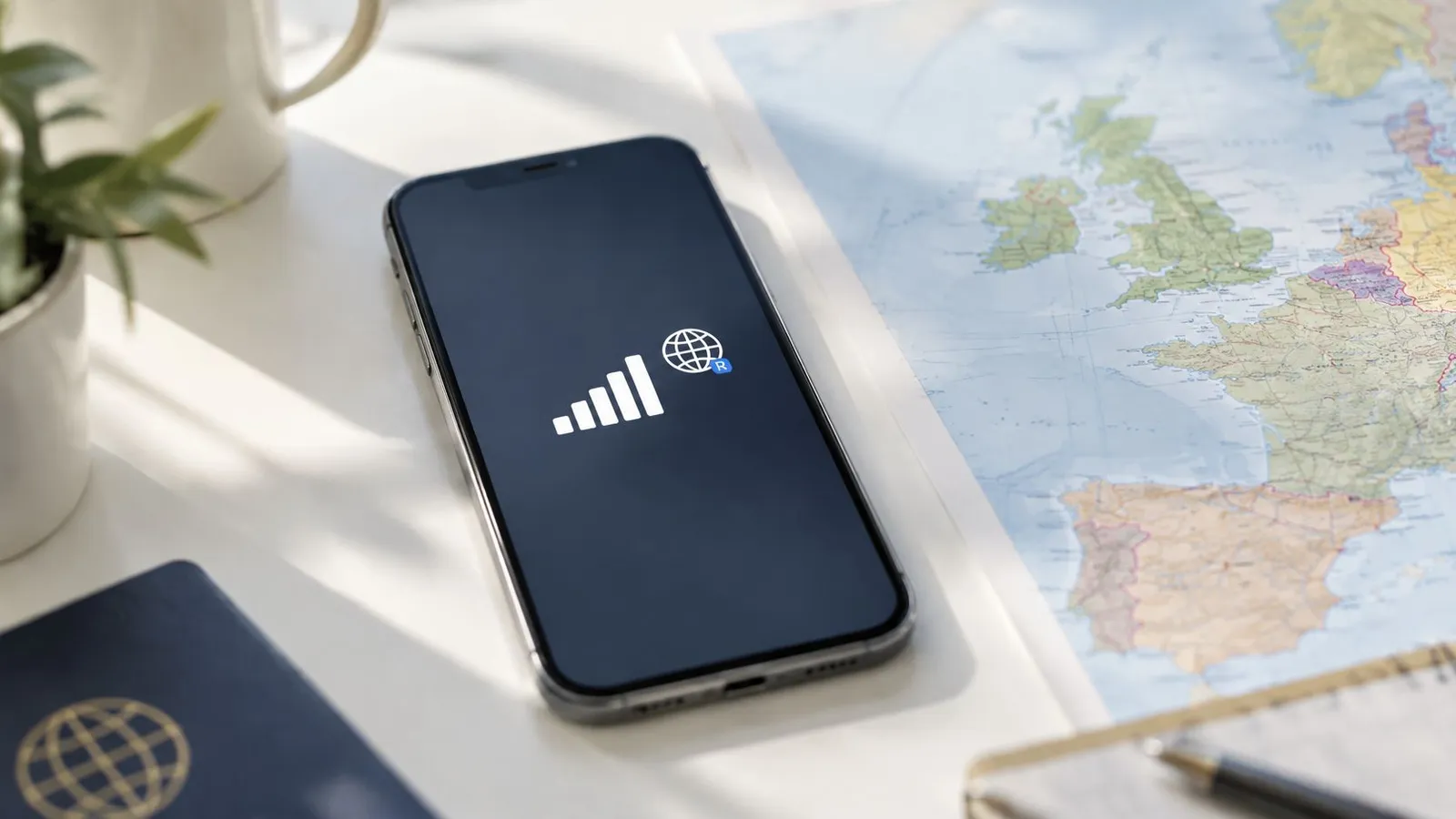
The basics of how an eSIM works are useful for understanding the difference between profile installation and network coverage. Once abroad, the phone must use the travel eSIM for mobile data and follow the provider's instructions for data roaming. Exact settings vary by device and plan.
Data service isn't the same as calls and texts
Many travel eSIMs provide mobile data only. That means apps such as messaging services, maps, and email can work over the connection, but the plan might not provide a regular phone number for conventional calls or SMS. Other plans may include calls and texts, so travelers should check the product details rather than assume all eSIMs offer the same services.
If a phone connects to a UK network but has no data, travelers can check that the travel eSIM is selected for mobile data and that its data-roaming setting is enabled, if the plan requires it. If those settings are correct and the plan excludes the UK, adjusting phone settings won't create coverage. The provider must authorize the destination.
How to Verify a Europe eSIM Will Work in the UK
A quick product-page check can prevent a frustrating arrival. Travelers should look past the plan name and verify the actual conditions that determine whether the eSIM will work in Britain.
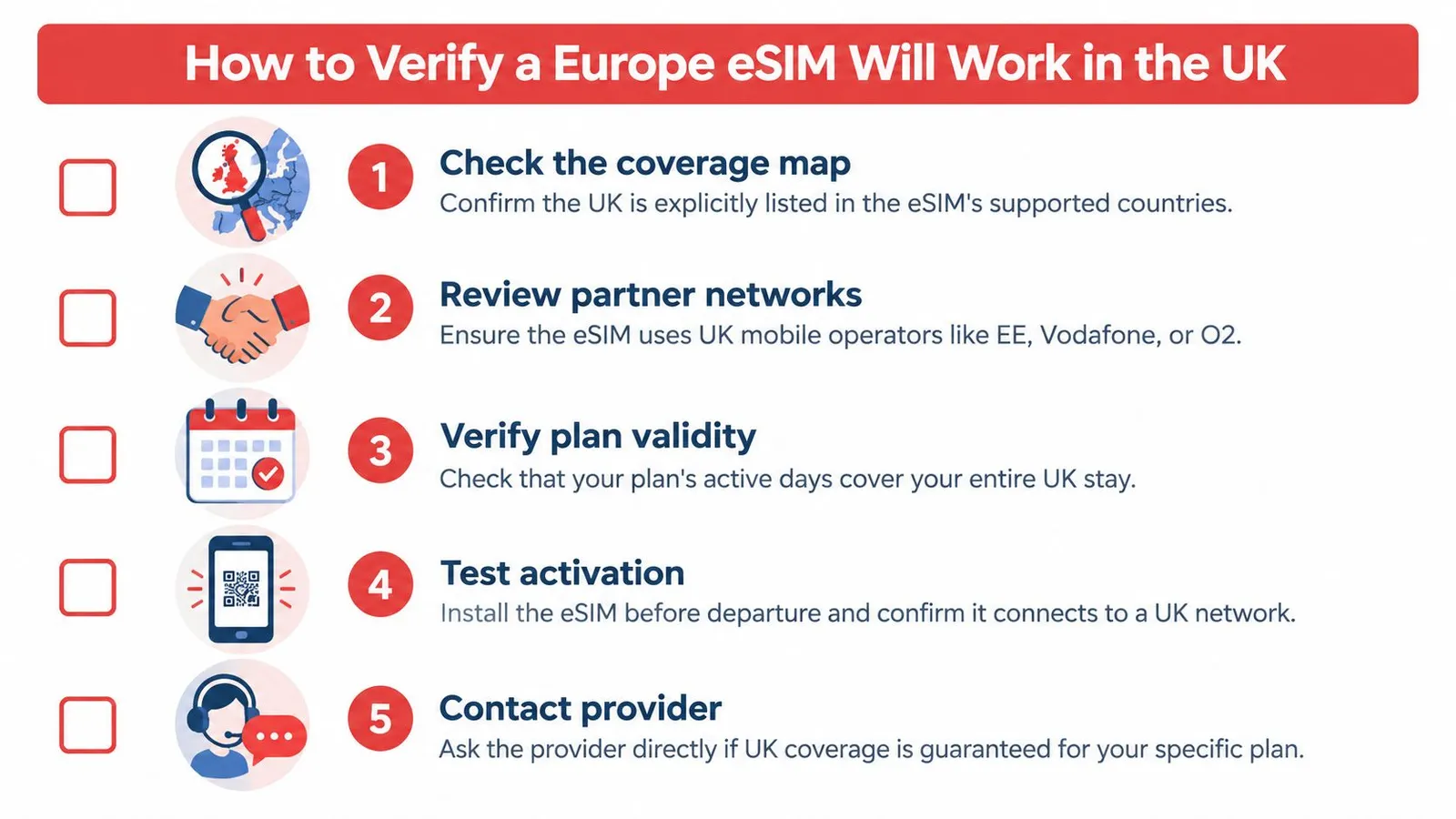
Use this pre-purchase checklist
Find “United Kingdom” in the destination list. “Europe,” “EU,” or “EEA” by itself doesn't establish UK coverage. The country should appear explicitly in the plan's supported destinations.
Check which UK networks the plan can use. Look for the supported British network or networks in the provider's coverage details. Network access can vary by plan, so don't assume that every regional eSIM connects to every UK operator.
Confirm validity and fair-use terms. Check when the plan becomes active, how long it remains valid, and whether any usage conditions apply. The active period should cover the traveler's UK stay, not just the start of a longer trip.
Check whether the plan includes data only or also calls and SMS. A data-only plan may be enough for internet-based messaging and calls, but it won't necessarily provide ordinary voice service or text messages.
Review activation and roaming instructions. Confirm that data roaming should be enabled for the travel eSIM and that the plan's setup rules are understood before departure.
Before booking: If the coverage page isn't clear, ask the provider to confirm UK service for the exact plan being considered. A general answer about “Europe coverage” may not resolve the question.
Check the device and prepare before departure
The phone must support eSIMs and be able to use the chosen service. Travelers can check their device against the provider's eSIM-compatible phone guidance before buying. They should also follow the provider's activation instructions, since installing a profile and starting a plan aren't always the same step.
Installing the eSIM before departure can make it easier to spot setup issues while a reliable internet connection is available. However, travelers shouldn't assume that testing at home proves the plan will register on a UK network. A plan that excludes the UK may install normally but can't provide UK service.
If a plan doesn't list the UK, travelers can choose a different regional plan that explicitly includes Britain or select a UK-specific plan. If there's uncertainty about an add-on or a changed itinerary, the provider can clarify whether the existing eSIM can be topped up or whether another plan is needed.
Common Scenarios and What Can Go Wrong
Consider a route from France to London to Spain. A traveler's Europe-only eSIM works in Paris, stops providing data in London, then connects again in Madrid. The pattern may seem like a technical fault, but the plan's country list could explain it: the provider may include the EU destinations and exclude the UK. A regional label doesn't guarantee coverage across the whole route, as the UK Parliament's briefing on mobile roaming after Brexit notes in its discussion of provider-specific arrangements.
The same gap can disrupt a short business stop. A traveler who relies on mobile data for messages, maps, or work may find that an eSIM works at the start and end of a trip but not during a UK meeting. Checking the destination list before departure is particularly useful when the UK is only one stop in a wider European itinerary.
When the eSIM installs but data doesn't work
A successful installation doesn't establish that a plan covers every destination. If the phone shows a signal but data doesn't load, travelers can check that the correct eSIM is selected for mobile data and review the provider's roaming instructions. If the UK isn't included in the plan, the likely fix is a UK-covered plan or an eligible add-on, not repeated installation.
Families sharing a hotspot should check the plan's tethering terms and confirm that the underlying eSIM has UK coverage. A hotspot can share an active data connection; it can't extend a plan into a country the provider hasn't authorized.
The important distinction: Brexit didn't make European eSIMs technically incompatible with UK networks. It made UK inclusion a provider's commercial choice.
If a plan should include Britain but still won't connect, travelers can restart the phone, check the eSIM's data settings, and follow the provider's troubleshooting steps. They can also use the no signal after landing troubleshooting guide or contact the provider to confirm the plan's network access. If the plan excludes the UK, switching to a UK-specific option is more likely to solve the problem than changing device settings.
Choosing the Right eSIM Plan for UK Travel
A regional eSIM works like a rail pass: it pays off when the journey crosses borders, and it costs more than needed when the trip stays in one place. A traveler spending the whole stay in Britain usually gets simpler value from a UK-specific plan. Someone continuing on to France, Ireland, or the Netherlands benefits from one regional eSIM that lists every stop.
Whichever direction the route takes, three checks belong in every purchase:
- The United Kingdom appears by name in the plan's coverage list.
- The validity period covers the full itinerary, including arrival and departure days.
- The service type matches the trip: data only, or data with calls and SMS.
| Itinerary | Plan type to consider | What to verify |
|---|---|---|
| UK only | UK-specific plan | UK coverage, validity, and whether calls or SMS are included |
| UK plus several European destinations | Europe & UK regional plan | Every destination, partner networks, and cross-border terms |
| Europe trip with a brief UK stop | Either type, depending on the route | Explicit UK inclusion for the stop, not just coverage elsewhere |
For comparison, the Europe & UK eSIM is listed as prepaid travel data with 1 to 30 days of validity, 5G, and instant QR delivery. Its listed starting price is $1.96. Travelers weighing a UK-only visit can set that regional option against a United Kingdom eSIM plan to see which plan type fits the route.
The decision rule stays the same whichever provider sells the plan: Britain must appear explicitly in the coverage list, and the terms must match the itinerary. A confirmed country entry on the product page is worth more than any "Europe" label in the plan name.
Travelers planning a UK-only visit or a multi-country route can compare country-specific and Europe & UK data plans through RedSim. Confirm the United Kingdom appears in the selected plan's coverage before installing the eSIM, so the phone is ready for the itinerary.