
 اليونان
The flights are booked, the hotel confirmation is saved, and the ferry tickets are sitting in an inbox. Then comes the phone-plan decision: a cheap data package, an unlimited offer, or whatever the home carrier charges abroad. They can look interchangeable until a laptop needs connecting or a ferry reaches an island where the chosen network struggles.
The best eSIM for Greece depends on three things: the traveler's existing roaming allowance, the Greek networks behind the package, and the places on the itinerary. Price matters, but only after the plan can handle the trip.
Best Greece eSIM Picks by Trip Type
| Trip type | Plan that fits | Why it fits |
|---|---|---|
| Short Greece-only city break | 1 GB for 7 days, $2.19 | Maps and messaging use little data when video and photo backups stay on Wi-Fi |
| Two weeks with ferries and island stops | 5 GB for 30 days, $6.93 | A starting allowance for maps, selective uploads and occasional calls across a longer trip |
| Heavy remote work or daily video calls | 10 GB for 30 days, $11.40 | More headroom for calls and cloud sync, with top-ups needed if usage runs high |
| Hotspot for a laptop or family devices | Unlimited for 7 days, $19.75 | Shared tethering can drain a capped plan quickly, provided the hotspot terms fit |
| EU or EEA resident | Check home roaming first | Roam-like-at-home rules may already cover Greece |
The prices above are RedSim's Greece list prices. Match the package to the heaviest day, not the average one, since a single ferry afternoon of uploads can drain an allowance that looked comfortable on paper.
A short Athens break can suit the smallest package when navigation, booking confirmations and messages are the main mobile tasks. Photo backups, streaming and app updates should wait for Wi-Fi. A low price stops being useful when the allowance runs out before the return flight.
Match the allowance to the busiest day
For an island-hopping holiday, the middle tier gives more room without paying for unlimited service. Its 30-day validity covers a two-week itinerary, and the balance between cost and capacity suits a trip built around maps, bookings and selective uploads.
Work trips need a different calculation. A larger capped package is the starting point for meeting time, file transfers and laptop use, and an active eSIM can be topped up without a new QR code if usage runs high. For shared connections, the unlimited option belongs on the shortlist only after the traveler checks tethering and fair-use conditions.
A broader shortlist can help when network access or regional coverage matters more than these particular tiers. FruitPunch's guide lets travelers compare top eSIM providers before narrowing the choice by Greek network, allowance and support.
Buying rule: Choose the smallest allowance that fits the trip's heaviest expected usage, with room for a top-up rather than an optimistic assumption that Wi-Fi will always be available.
EU and EEA customers should pause before purchasing. An existing home allowance may already solve the problem without another plan.
Greece eSIM Prices Side by Side
| Plan size | RedSim price | Competitor price |
|---|---|---|
| 1 GB, 7 days | $2.19 | Pocket eSIM $2.49 |
| 5 GB, 30 days | $6.93 | esim.io $7.30 |
| 10 GB, 30 days | $11.40 | Ubigi $12.00 |
| Unlimited, 7 days | $19.75 | Sim Local $20.75 |
Matching data sizes and validity periods makes this comparison useful. Comparing a short starter package against a longer unlimited offer doesn't reveal which provider offers better value for the same job.
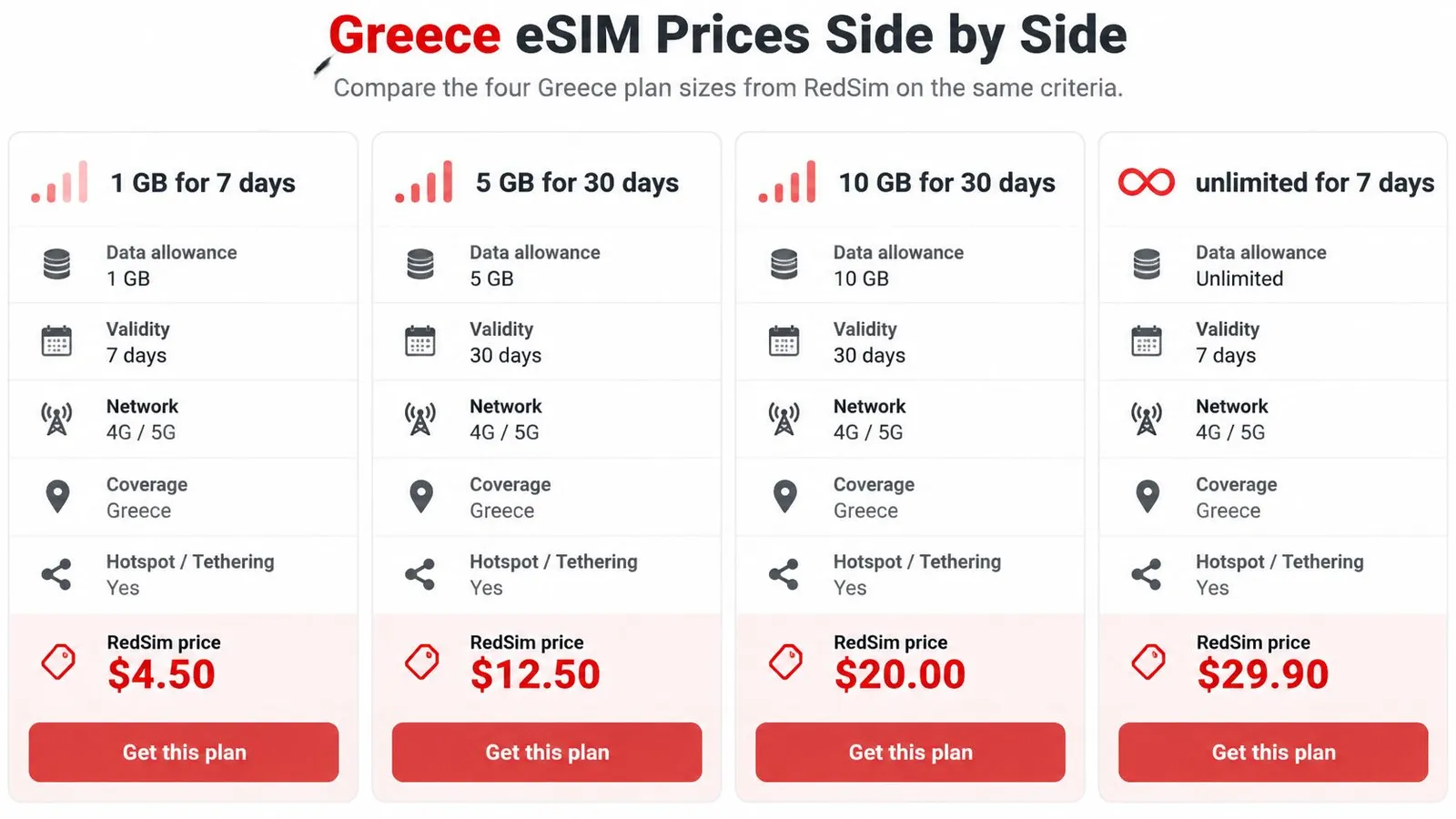
The plan-price comparison provides a starting point for checking equivalent packages. Prices can change, so the checkout total should be confirmed before payment, along with the currency and any selected extras.
Cheap data isn't always the cheapest purchase
The larger capped tiers offer a lower cost per gigabyte than the starter package. That advantage matters only when the traveler uses the additional data. Buying spare capacity that expires unused doesn't reduce the actual holiday bill.
For a traveler checking restaurant directions and ferry emails, a small package can be the sensible choice even when its unit cost is higher. Someone uploading work files needs enough capacity first, then a reasonable price for that capacity.
Unlimited plans require a different comparison. The useful questions concern high-speed access, any slowdown policy, and whether tethered devices receive the same treatment as the phone itself. The word unlimited alone doesn't answer those questions.
The Greece eSIM listing describes prepaid travel data on Nova and Vodafone, with 5G and instant QR delivery. Those network details are more useful for evaluating an island route than a small difference between checkout totals.
- Compare equivalent packages. Match allowance and validity before comparing the price.
- Check practical restrictions. Network access, hotspot terms and top-up availability can outweigh a modest saving.
- Read the activation terms. A package that starts counting down earlier than expected may not cover the full journey.
- Confirm the final purchase. The selected package and checkout price should match the intended trip, not merely the advertised starting offer.
A price table answers what the package costs. It doesn't establish where it will connect or how well it will support a working day.
Which Greek Network Your eSIM Uses
Cosmote recorded 63.2 Mbps Download Speed Experience, against 41.5 Mbps for Vodafone and 36.8 Mbps for Nova, in Opensignal's assessment of Greek mobile networks, based on users measured from October 1 to December 29, 2024. The underlying network is a real selection criterion for video meetings, large downloads and tethering, which is why two Greece eSIMs at the same price can perform differently.
These are user-experience averages, not guaranteed speeds. A national speed result says little about a particular apartment, mountain road or quiet beach. Indoor signal, local congestion, handset compatibility and the provider's roaming agreements all affect the connection.
Which Greek networks a RedSim plan uses is a question to settle on the plan's own listing, because the permitted partners are defined in the package terms rather than implied by the destination name. A traveler prioritizing a specific carrier's performance should confirm which networks the chosen package allows before paying. Access to a second network has to be granted in those terms; the phone detecting a signal on the ground does not entitle it to register.
Check the route, not just the country
Population coverage and geographic coverage answer different questions. A network can serve busy towns well while leaving stretches of coastline, inland terrain or open water without a dependable connection.
The Greek travel connectivity guide identifies Cosmote as having the broadest reach and explains why remote terrain and offshore travel require more caution than city stays. For island-hopping, access to more than one permitted network can matter more than the headline speed of a single partner.
Multi-network access still isn't a guarantee of smooth switching or uninterrupted ferry coverage. The package must permit registration on the alternative network, and there must be a usable signal where the traveler is standing.
Before purchase, the practical checklist is:
- Named Greek networks. Confirm the permitted partners listed for the plan instead of relying on the destination name.
- 5G roaming support. Check whether the package terms include it and whether the handset can use it.
- Alternative-network access. Establish whether another permitted partner is available if the first performs poorly.
- Itinerary coverage. Check accommodation locations, driving routes and smaller island stops, since arrival airports alone give little indication.
The regional coverage information is useful when the itinerary extends beyond Greece into neighboring countries. For critical navigation or tickets, offline copies remain sensible even with a carefully chosen network.
How Much Data a Greece Trip Needs
| Activity | Approximate data use | Plan size that fits |
|---|---|---|
| Maps and messaging, per day | Check the phone's app-level usage, excluding photo and video transfers | 1 GB can cover a light week when downloads and backups stay on Wi-Fi |
| Browsing, email and social media, per day | Measure a typical day with the same autoplay settings | 5 GB is a starting point for a restrained holiday |
| Video calls, per hour | Check consumption during a representative call at the intended quality | 10 GB is the entry tier for call-heavy travel; heavier weeks move up a size |
| Cloud sync, uploads or laptop hotspot, per day | Budget for the actual files, updates and connected devices | 10 GB for 30 days or unlimited for 7 days, subject to usage and terms |
Measure the phone's own meter before trusting activity labels. Messaging text and sending videos sit in different tiers; reading posts and leaving autoplay on do too. A laptop can download updates or synchronize files while its owner is standing in a museum line.
The phone's mobile-data settings give a better baseline than a generic travel estimate. On iPhone, the relevant controls are under Cellular or Mobile Data; on Android, they are usually under Network & Internet or Connections. Reviewing individual apps separates necessary travel use from background consumption.
Fast service still needs enough allowance
Greece recorded 76.4% 5G Availability in Q2 2025 in Ookla's European 5G assessment. High availability still leaves room for crowded cells, indoor loss and ferry gaps; mid-band capacity decides whether a busy square feels fast at noon.
A fast link uploads the same file sooner, and the file size stays the same. That matters when a home plan already includes Greece: the eSIM may only need to cover gaps. If roaming is excluded or expensive, budget as if every map, ticket, call and upload runs on the eSIM. The heaviest day should set the size, since a ferry transfer with navigation, bookings and hotspot sharing weighs more than a quiet hotel evening.
The RedSim plan-sizing guidance turns those measured days into a country, regional or global allowance. A practical sizing process is:
- Measure a demanding day. Include calls, uploads and every device that will share the connection.
- Extend that estimate across the travel period. Split city days, island transfer days and workdays instead of averaging them away.
- Recheck the meter after the first heavy day. Adjust before the next navigation, upload or call spike repeats the demand.
Hotel Wi-Fi can carry backups and updates; keep the mobile allowance sized for the workday spent away from it.
Which RedSim Features Fit Real Trips
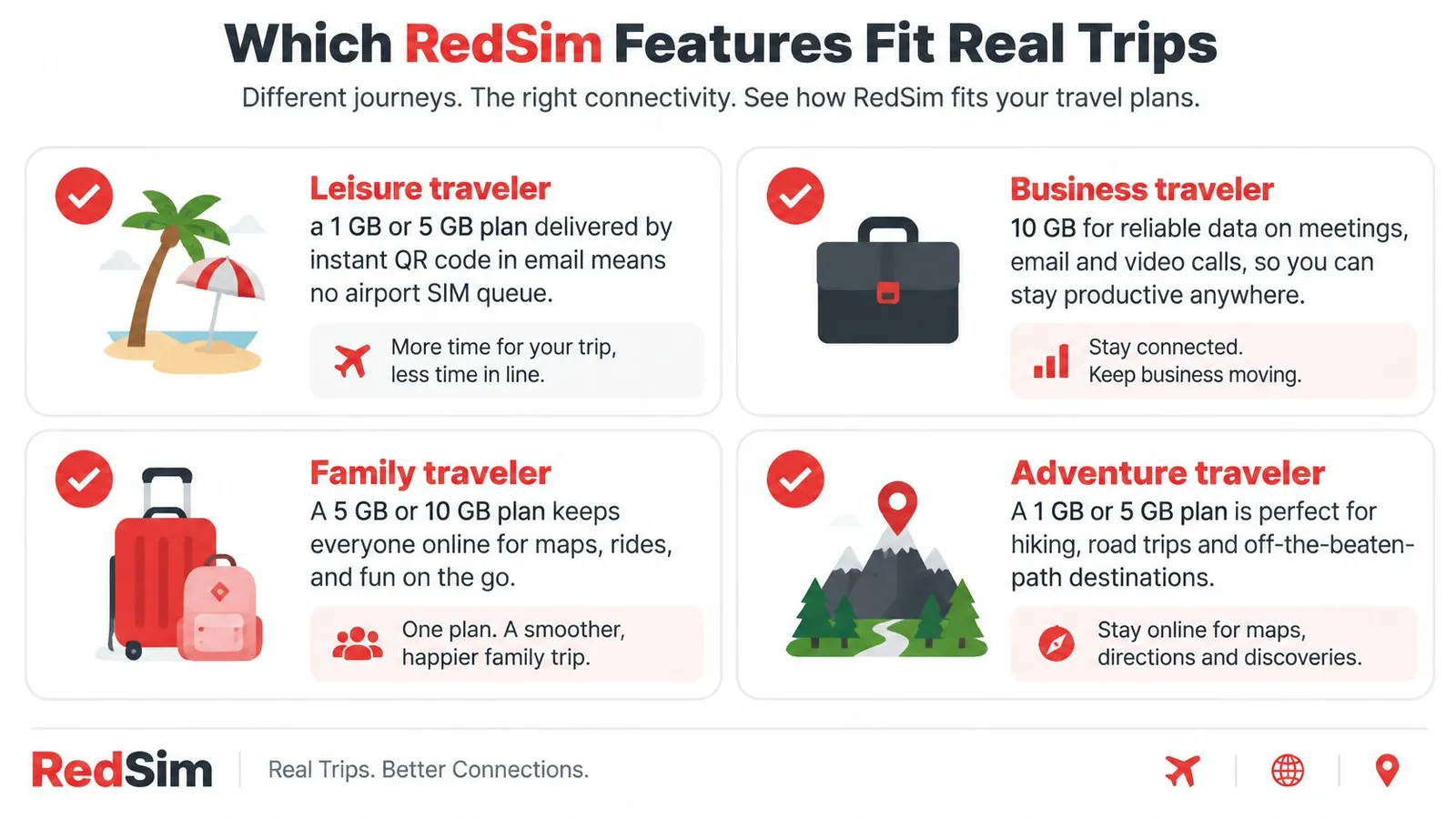
A leisure traveler landing in Athens needs directions, an accommodation message and access to booking confirmations. Instant QR delivery by email lets the traveler prepare the mobile profile before departure instead of making a SIM-shop visit part of arrival day.
For that trip, a small capped package is usually enough. The useful feature is arriving with the purchase and installation already handled.
Whether any plan beats the home carrier still depends on that carrier's roaming terms, so the comparison is worth making before departure rather than in the arrivals hall.
Business travel and longer stays
A business traveler working from a hotel where the Wi-Fi struggles during a meeting has two tools that matter. Hotspot support lets a laptop use the phone's connection, while real-time usage tracking in the app shows whether calls and file transfers are consuming the allowance faster than expected.
A larger capped package or an unlimited option can suit that situation, but neither removes the need to read the specific tethering conditions. A work laptop should also have automatic operating-system downloads and unnecessary cloud synchronization paused while using mobile data.
For a digital nomad extending a stay, top-ups on an active eSIM don't require a new QR code. More data doesn't mean reinstalling the profile, which keeps a capped package workable when the departure date is still uncertain.
Families need a sharing plan
A family using a phone as a hotspot should decide which devices need continuous access. A tablet downloading entertainment and another phone uploading videos can drain the shared allowance while the main phone appears almost idle. Ferry days between islands add to that pressure, since navigation and booking checks tend to cluster around arrival times.
- Reserve access for the hotspot owner. Keep enough battery and data for navigation and bookings.
- Control background activity. Connected devices should pause automatic backups and large updates.
- Keep a top-up available. Evening usage checks prevent a depleted allowance during the next day's outing.
Support and refund terms provide useful backstops. Unused, unactivated eSIMs are refundable in full, and round-the-clock WhatsApp support handles configuration or coverage questions. Eligibility should be checked before installation if cancellation is likely.
For a trip that may change, flexibility can matter more than the lowest purchase price.
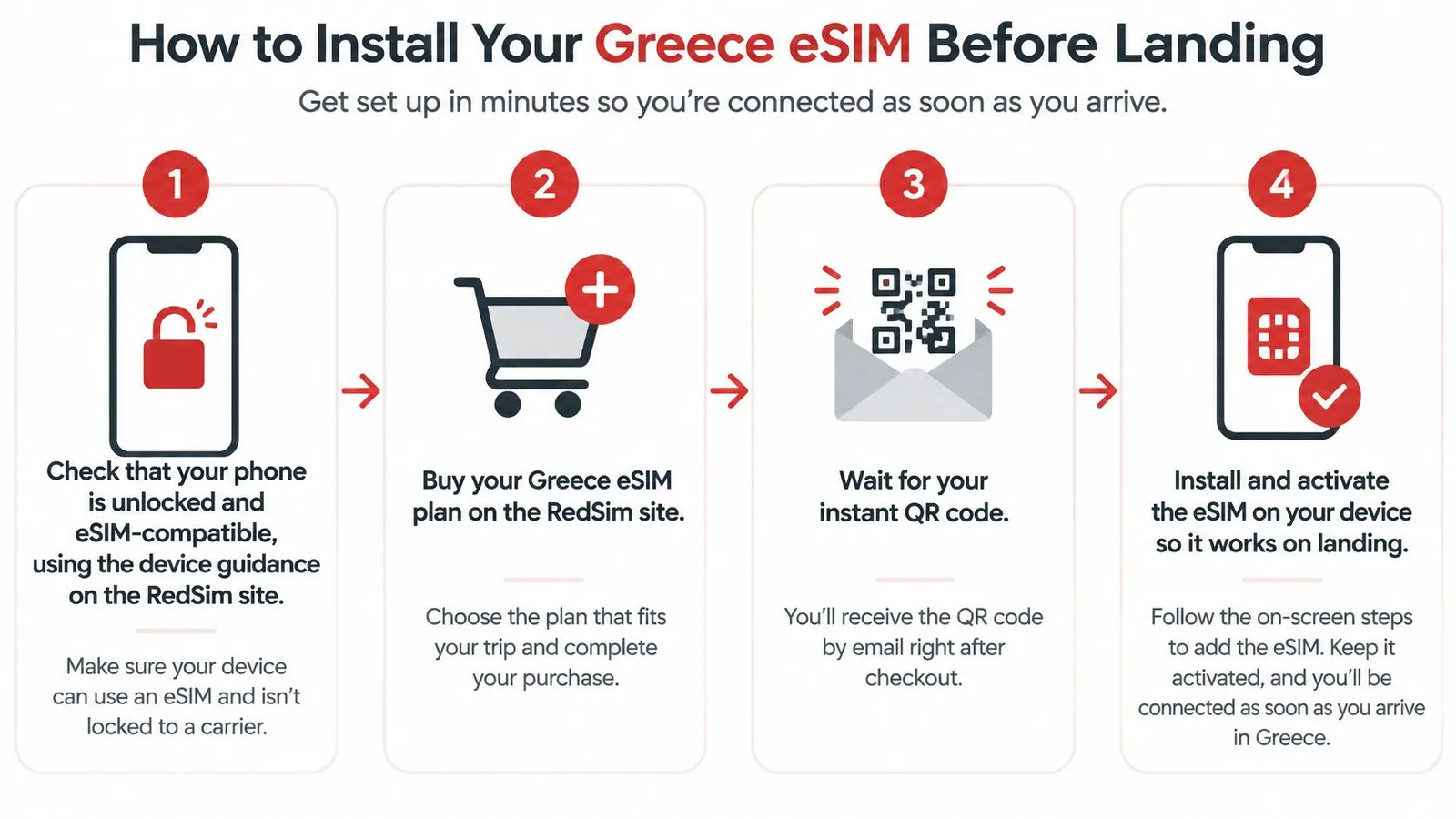
How to Install Your Greece eSIM Before Landing
Installation is easiest with a stable internet connection, access to the purchase email and time to check the settings. Preparing before departure avoids relying on airport Wi-Fi while trying to arrange transport or locate a booking.
The device setup instructions should remain available offline or on another screen. Installation and activation aren't necessarily the same event, so the package's validity-start conditions should be checked before enabling service.
Prepare the phone and profile
Check compatibility and unlocking. The phone must support eSIM and accept another provider's profile. A compatible model can still be carrier-locked, so both conditions matter.
Purchase the chosen package and save the email. The QR code arrives digitally. Displaying it on another device or keeping a printed copy makes scanning easier than trying to scan an image shown on the same phone.
Install through Settings or the app. The phone's Add eSIM or Add Mobile Plan option starts the installation process. Compatible devices can also use the app's direct installation workflow.
Assign data deliberately
Label the new line clearly. A name such as Greece Data makes the profile easy to identify. Set it as the mobile-data line, while retaining the home line for calls or messages if required and supported.
Check roaming and switching settings. Enable data roaming on the travel line when the package instructions require it. Disable automatic mobile-data switching if it could route traffic through the home subscription.
Verify service after landing. Check for a Greek network name and a mobile-data indicator, then open a webpage with Wi-Fi disabled. If service fails, confirm the selected data line and required settings before contacting support.
The common mistake is leaving the home subscription selected for data. A successfully installed profile doesn't prevent home-carrier roaming charges if the phone continues using the wrong line.
Success means more than a signal icon: a webpage loads through the intended travel line, and the home subscription isn't supplying mobile data.
Do You Need a Greece eSIM at All
A traveler with an adequate home roaming allowance may not need another purchase. EU and EEA customers generally benefit from roam-like-at-home rules in Greece, subject to their operator's fair-use policy, as explained by the Greece destination connectivity guide.
For someone arriving from Germany or France, checking the included roaming allowance is the sensible first move. The relevant details are the amount of usable data, any fair-use restrictions and whether the allowance supports the planned tethering.
Travelers from the UK, US, Switzerland and other markets shouldn't assume the same treatment. Their carrier's international add-on may compete with a travel package, particularly when it includes services the traveler needs. A local Greek SIM is another option worth comparing when local voice service matters.
Apply the decision rules in order
The explanation of how eSIM works helps clarify the technology, but the purchase decision is mostly about the contract and itinerary.
- Home market. Establish what Greece already costs on the existing subscription.
- Trip length. Match validity to the entire period when service will be needed.
- Data intensity. Separate occasional travel administration from meetings, uploads and streaming.
- Tethering needs. Include laptop and family-device consumption in the estimate.
- Border crossings. Check every destination explicitly rather than assuming a European label includes it.
Turkey, Albania, North Macedonia, Serbia, Montenegro, Bosnia and the UK shouldn't be treated as automatic extensions of Greek domestic-rate coverage. A regional plan must list the intended destination.
Check the coastline as well as the border
Ferry routes and islands near Turkey can expose a phone to foreign networks. If an unexpected operator appears, the traveler should check the permitted network list and select an allowed Greek partner manually when necessary.
Before paying, the final checks are straightforward: match network access to the island route, confirm hotspot permission, and verify coverage for every country reached by ferry or land. For non-EU and non-EEA visitors seeking predictable data costs, a travel eSIM can be compelling; for customers with sufficient included roaming, buying nothing may be the better answer.
The next practical step is to compare the middle capped tiers against measured usage, then choose the allowance that fits the trip with spare capacity rather than selecting solely by headline price.
RedSim offers prepaid travel data for Greece, with digital delivery, active-plan top-ups and app-based usage tracking. Visit RedSim to compare the Greece packages, confirm the networks and hotspot terms, and choose an allowance that fits the complete itinerary.
 ألمانيا

 اليابان