
A traveler landing in Milan, then crossing into Austria, then ending the week in Croatia, does not need a vague “Europe plan.” They need data that keeps working without a SIM swap, a fresh install, or a surprise billing headache. The best eSIM for Europe depends on the route, not the marketing, and the smartest comparison starts with itinerary shape, because EU roaming rules, border crossings, and tethering habits all change the value of a plan.
Europe is also a strange market for eSIMs. Within the EU, many travelers can still rely on Roam Like at Home rules, which the European Commission says were prolonged until 2032 and generally let travelers pay domestic rates for calls, texts, and data while abroad in another EU country European Commission roaming rules. But once the trip leaves that protection, or crosses into mixed routes with non-EU stops, the economics change fast. That is why live destination pages matter more than stale comparison charts, especially for plans built around per-GB transparency.
1. Europe & UK eSIM
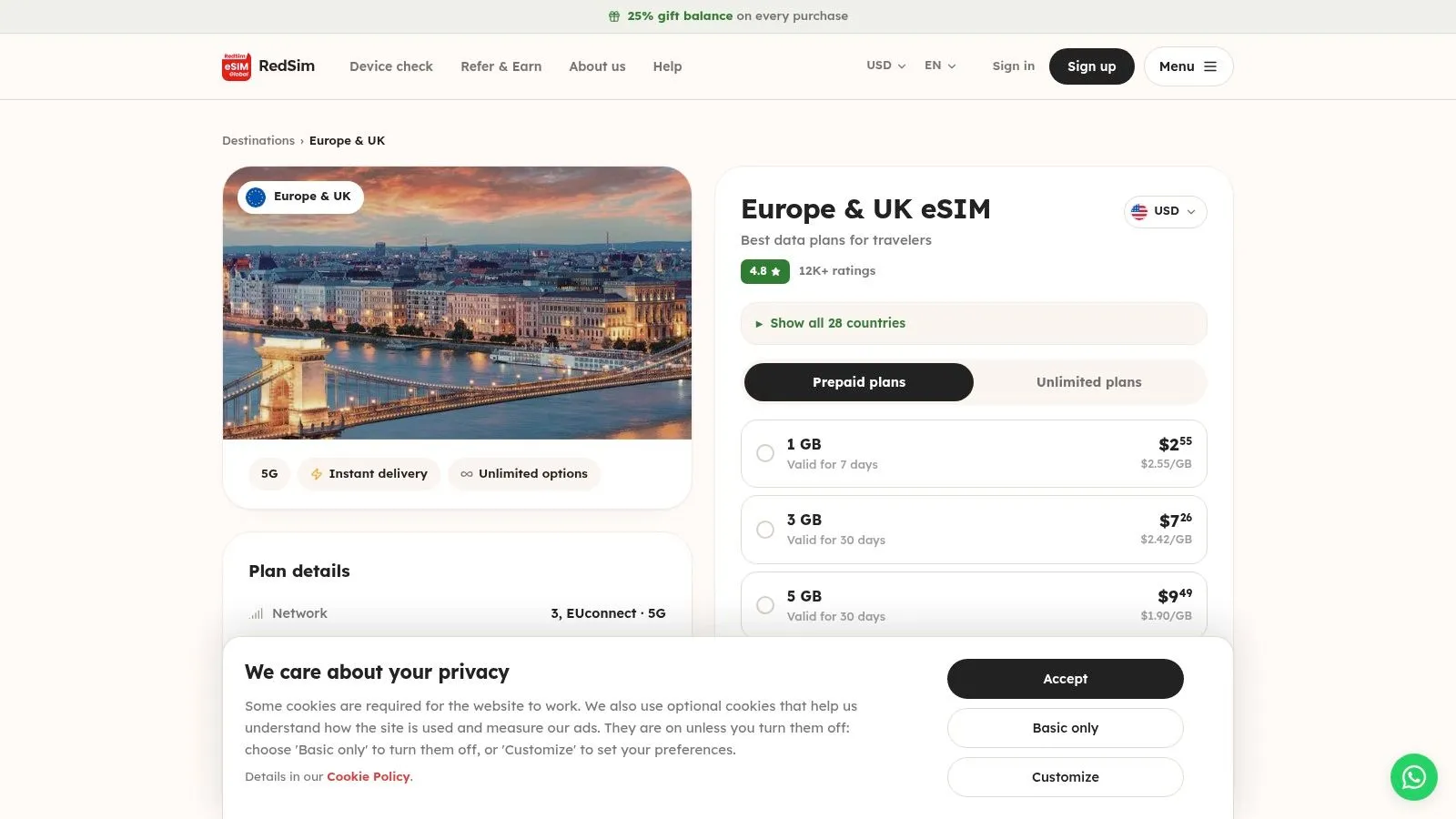
The Europe & UK eSIM fits the most common travel pattern in Europe, a trip that stays mostly inside the region and needs a clean handoff between countries. RedSim's regional setup is straightforward, it's prepaid travel data, available for 1 to 30 days, with 5G and instant QR delivery shown on the product page. The live plan page also shows price per GB under the headline price, which is the right way to compare Europe plans because the cost of travel data is easier to judge on a unit basis than by sticker price alone.
That matters because EU travel behavior is highly sensitive to where the traveler goes. One 2026 travel report found only 19.9% of European travelers used eSIMs within the EU, but adoption rose to 44.8% when they traveled beyond the EU, a sign that regional eSIMs become much more relevant once domestic roaming protections fall away Holafly market report. For a border-hopping route that still stays mostly in Europe and the UK, the regional plan is the practical middle ground between relying on home-roaming rules and buying a global plan that may be broader than needed.
Practical rule: Choose this kind of plan when the itinerary is mostly Europe plus the UK, and the goal is continuity, not chasing the lowest headline number.
Why this plan makes sense for common Europe trips
The main strength is simplicity. A traveler can install once, keep the same plan active, and move across borders without changing the setup every time the train crosses into a new country. That is especially useful for business travelers, family trips, and short leisure routes where the phone is doing normal travel work, maps, messaging, translation, and hotspotting for a laptop.
The trade-off is scope. A regional plan is a good fit only if the trip mostly matches the region it was built for. If the route includes many extra countries outside Europe, or the traveler needs one package for a much wider journey, the region-specific plan can stop being the best value even if the per-GB cost looks attractive at first glance.
What to check before buying
- Route fit: Confirm the countries on the itinerary sit inside the regional coverage.
- Trip length: Use the live page to match the duration to the trip, since RedSim lists 1 to 30 days on this plan.
- Usage style: Heavy maps, social posting, and laptop tethering make the price per GB view more useful than the headline entry price.
- Support needs: RedSim's broader service setup includes digital delivery and active support, which matters if activation needs help after landing.
For travelers who want a Europe-first plan and prefer to avoid border-by-border confusion, this is the safest first stop.
2. Europe Plus eSIM
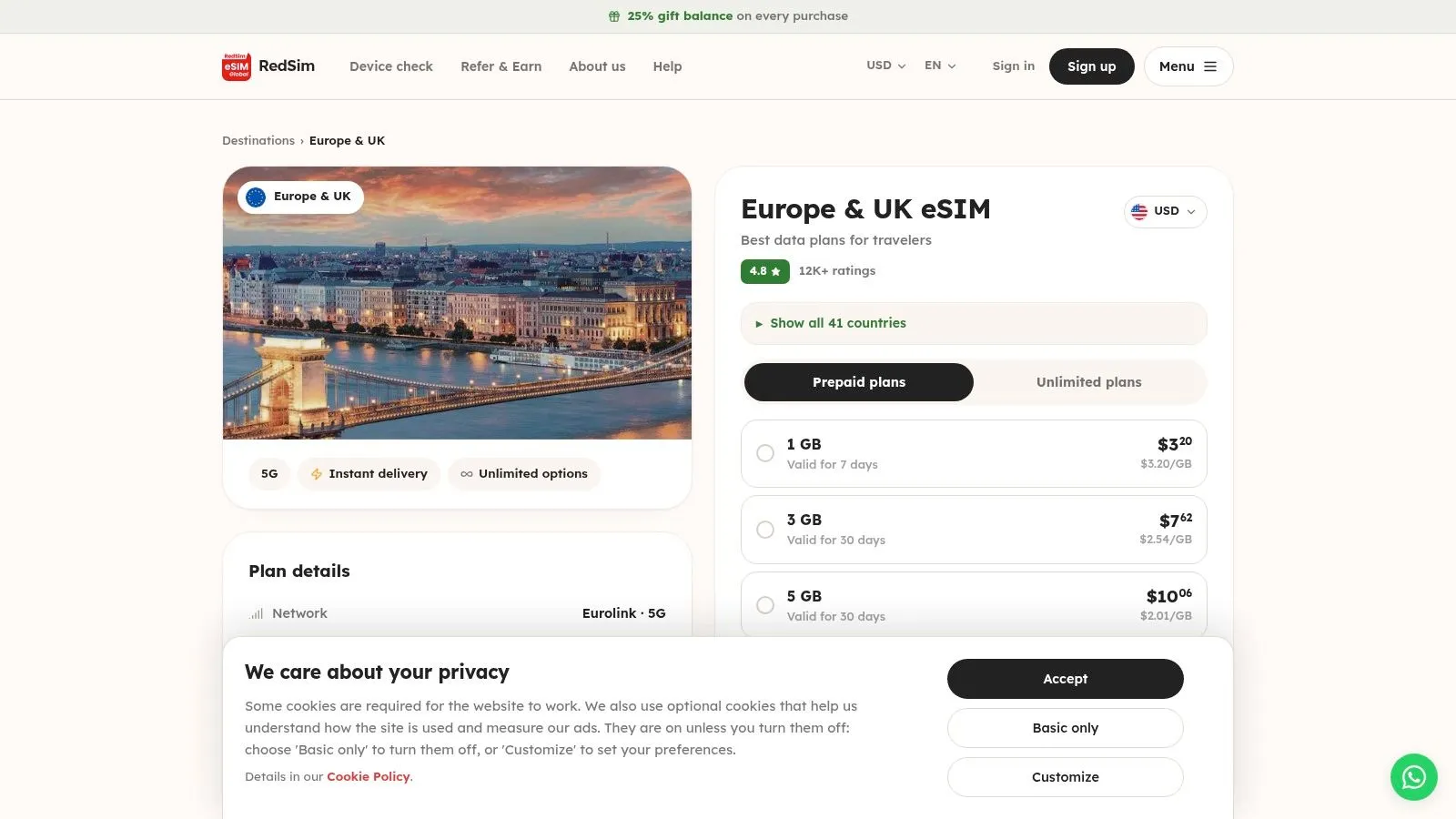
Europe Plus eSIM is the stronger choice when the route stretches past the usual EU core and the traveler wants broader continental reach. RedSim lists it as a 41-country regional option with 3 to 30 days, 5G, and instant QR delivery. That extra scope matters because the most useful “Europe” plan is not always the cheapest one, it is the one that survives the actual trip without forcing a second purchase halfway through.
The live page also exposes price per GB, which helps separate a broad-but-expensive plan from a broad-but-efficient one. That comparison style is more important than it sounds, because Europe eSIM pricing is often presented as an entry price first, then buried conditions second. The better question is whether the plan still makes sense once the traveler values coverage continuity, border handovers, and the cost of avoiding a mid-trip reconfiguration.
Why 41-country coverage changes the decision
This plan is built for travelers who do not want to think in EU versus non-EU buckets every time the itinerary changes. It suits routes that pick up extra countries, side trips, or open-ended regional movement better than a narrower Europe-only package. If the trip is shaped like “France, Belgium, Netherlands, Germany,” the wider footprint can be a cleaner answer than trying to stitch together multiple country eSIMs.
That said, broader coverage does not automatically mean better value. A traveler staying in one country for most of the trip will often get less benefit from the wider footprint than someone taking trains, flights, and ferries across several borders. The right plan follows movement, not ambition.
Decision point: If the itinerary looks unpredictable, a wider regional plan usually beats a pile of country-specific installs.
The practical trade-off
A broader Europe plan reduces friction, but it can also hide laziness in buying behavior. Some travelers overpay for scope they never use, then assume all regional plans are overpriced. The better approach is to match the plan to the route shape, because a 41-country pass only earns its keep when those extra destinations are realistically in play.
This is also where travel style matters. Families and small teams often care more about consistency than squeezing every cent out of headline pricing. The value is not just the data, it is the elimination of setup churn, support calls, and the risk of reaching a border with no working connection.
3. United Arab Emirates eSIM
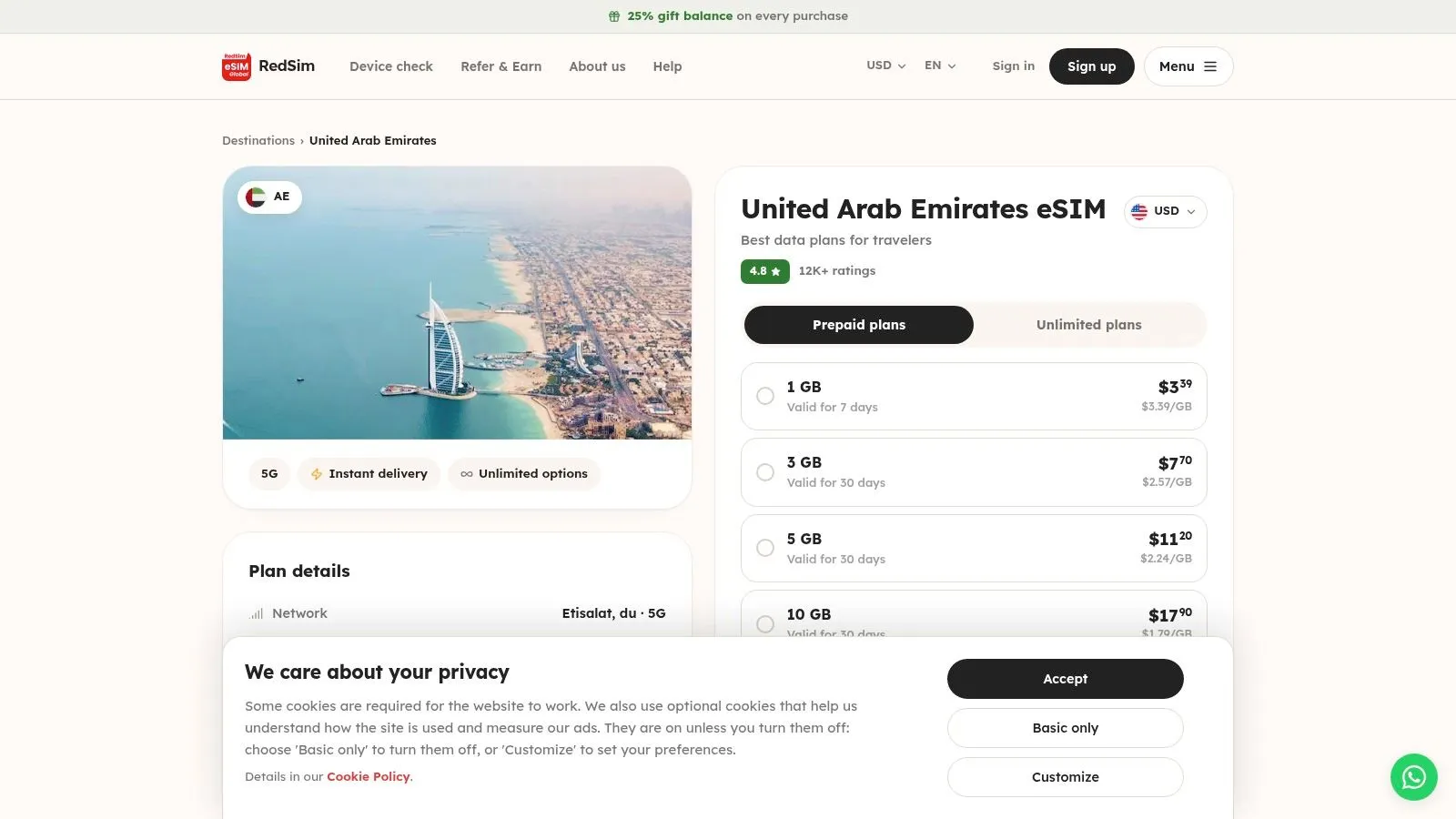
The United Arab Emirates eSIM is not a Europe plan, and that is exactly why it belongs in a Europe comparison. Trips often start with Europe, then swing through a non-European hub, and that middle leg changes the right choice. RedSim lists this country plan as prepaid travel data on du and Etisalat, with 1 to 30 days, 5G, and instant QR delivery, which makes it the cleaner pick when the Europe leg is only one part of a broader stopover-heavy route.
RedSim Middle East travel setup
That distinction matters because many buyers overfocus on the first country and forget the transit country. A traveler connecting through Dubai on the way to Europe, or returning through the UAE after a European trip, may need a country-specific solution for that leg instead of forcing a Europe regional plan into a route it was never designed to cover. The result is usually better fit, less waste, and fewer support headaches at arrival.
Where a country plan wins
A country eSIM is the right move when the traveler spends most of the trip in one place. It is also useful when the airport layover is long enough that reliable mobile data really matters, but the rest of the itinerary does not justify a wider regional package. In those cases, the country plan gives tighter alignment between cost and use.
The same logic applies in reverse for Europe travel. A regional Europe eSIM can look convenient, but if the trip is really one-country plus one transit hub, the broader package may be more than needed. That is why itinerary shape should come before the purchase button.
Practical rule: If one country dominates the trip, buy a country plan first and treat everything else as an exception.
Why this belongs in a Europe shortlist
Europe travel rarely happens in isolation anymore. Business itineraries often route through hubs outside the continent, and family vacations often bolt on a Middle East stop before or after Europe. In those cases, the right comparison is not “regional versus regional,” it is “what keeps data simple across the whole trip.”
The UAE plan is a reminder that the best eSIM for Europe is not always a Europe eSIM. Sometimes the smartest answer is a country-specific plan for the leg that would otherwise break the trip's connectivity pattern.
4. Global eSIM
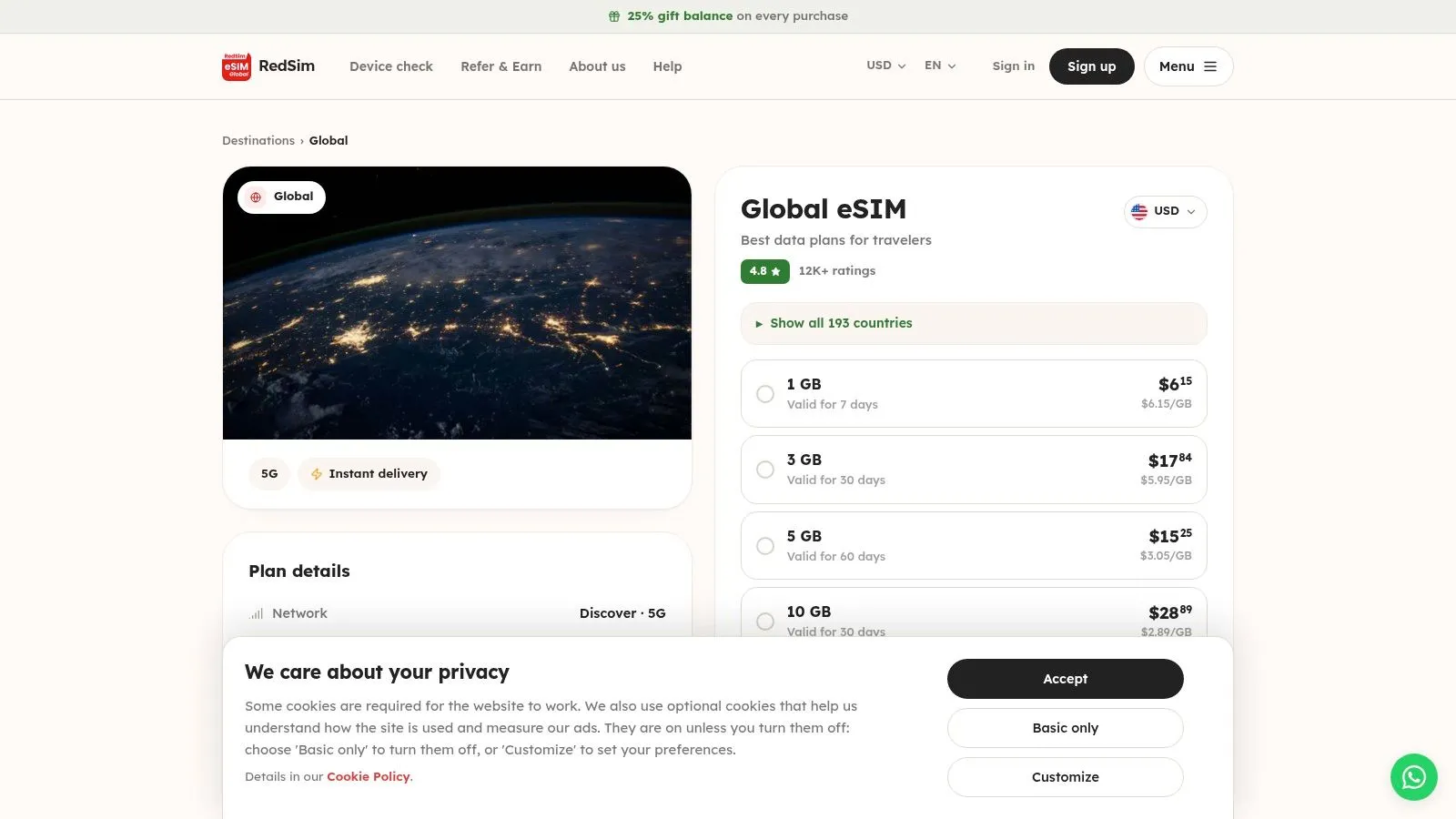
Global eSIM is the right comparison point for trips where Europe is only one segment in a much larger itinerary. RedSim lists it with 7 to 60 days, 5G, and instant QR delivery, which gives it enough duration headroom for longer, multi-stop travel. The important shift here is not just geography, it is planning logic, because global coverage is valuable when the traveler wants one setup that survives multiple borders across multiple regions.
That broader scope lines up with a larger travel trend. The Europe eSIM market is already commercially meaningful, with one 2026 estimate putting the region at USD 1.84 billion in 2026, projected to reach USD 2.35 billion by 2031 at a 5.04% CAGR Mordor Intelligence. That growth does not mean every traveler needs global coverage, but it does show how much room there is for people who want one plan that keeps pace with complicated trips.
When global beats regional
Global makes the most sense when Europe is one chapter in a longer route, not the whole story. A digital nomad moving from Europe to Asia, or a business traveler stringing together several continents, will usually get more value from one plan than from piecing together separate regional purchases. The practical gain is fewer installs, fewer activation moments, and fewer chances for a handoff problem at a new border.
It also helps when the traveler does not want to think about geography while moving. That is a real convenience benefit, but it comes with a cost discipline problem. Global plans can be easy to justify emotionally and hard to justify economically if the trip stays largely within Europe.
The hidden trade-off
Global coverage solves uncertainty, but it can hide inefficiency. Travelers often overbuy because the route “might” expand, then spend the trip carrying unused capacity. A Europe-first route with no non-European side trips usually does not need global scope, especially if the regional plan already fits the countries involved.
The cleaner question is simple. Does the traveler need continuity across continents, or just across Europe? If it is the second, regional usually wins on fit. If it is the first, global is the least disruptive option.
5. United States eSIM
United States eSIM belongs in this roundup because many Europe trips end up looking transatlantic, not purely European. RedSim lists it as prepaid travel data on Verizon and AT&T, with 1 to 30 days, 5G, and instant QR delivery. If the trip includes Europe first and the U.S. afterward, a country plan for the American leg can be a cleaner answer than stretching a Europe package into a new continent.
RedSim North America travel setup
This is another reminder that the best esim for europe is often really the best eSIM for a route that starts in Europe. Travelers who treat the Europe leg and the U.S. leg separately usually get more precise control over cost and coverage. That matters for families, remote workers, and travel coordinators who need to keep one segment from bloating the budget for the entire trip.
Why a country plan still matters in a Europe comparison
The U.S. plan is useful here because it shows the boundary of regional logic. A Europe regional plan works well when the trip stays inside the European footprint. Once the trip becomes transatlantic, the traveler should stop forcing a regional Europe choice to do a global job.
That is especially true for longer trips with a hard handoff between regions. A traveler can use a Europe plan until departure, then switch to a country-specific U.S. plan on arrival. That sequence is often cleaner than trying to find one oversized plan that is acceptable everywhere but optimal nowhere.
Practical rule: Separate the trip by region when the borders are real, not just inconvenient.
Who should think this way
Frequent flyers, small corporate teams, and long-haul leisure travelers benefit most from split-region planning. They gain better visibility into what each leg really needs, and they avoid paying for coverage that does nothing on the ground. The result is less waste and fewer assumptions.
This also fits the way travel data use is changing. Independent market reporting says the average leisure traveler using an eSIM in 2025 consumed about 8.4GB per trip, concentrated in navigation, social media, and translation apps DataIntelo travel market report. That kind of usage pattern makes exact itinerary fit more useful than oversized bundles.
Top 5 eSIMs for Europe, Quick Comparison
| Plan | Implementation complexity | Resource requirements | Expected outcomes | Ideal use cases | Key advantages |
|---|---|---|---|---|---|
| Europe & UK eSIM | Very low, instant QR install | eSIM-capable device, internet to activate; short-term plans (1–30 days) | Affordable regional data; 1GB ~ $1.96–$2.55 (7d) | Short trips within Europe & UK | Low cost, 5G, first‑party product, instant delivery |
| Europe Plus eSIM (41 countries) | Very low, instant QR install | eSIM device; coverage across 41 European countries | Broad multi-country regional data; 1GB ~ $3.20 (7d) | Multi-country European itineraries | Wider country coverage, 5G, easy setup |
| United Arab Emirates eSIM | Very low, instant QR install | eSIM device; uses du & Etisalat networks | Reliable UAE local data; 1GB ~ $2.95–$3.39 (7d) | Travel or short business trips within UAE | Local carrier access, 5G, competitive pricing |
| Global eSIM | Low, instant QR, may require profile selection | eSIM device; supports many roaming networks; longer validity (7–60 days) | Worldwide coverage with higher per‑GB cost; 1GB ~ $6.15 (7d) | Multi-continent trips or frequent international travelers | Global reach, longer validity, single-profile convenience |
| United States eSIM | Very low, instant QR install | eSIM device; uses Verizon & AT&T networks | Reliable US local data; 1GB ~ $2.00–$2.62 (7d) | Travel within the United States | Local carrier access, 5G, affordable price |
Match the Plan to Every Border
The right decision starts with the route, not the brand name. Choose the Europe & UK eSIM for a qualifying regional trip that stays mostly inside that footprint, because it gives a clean fit for common Europe travel and keeps the comparison grounded in live price per GB details on the product page. Choose Europe Plus when the itinerary really benefits from 41-country reach, especially if the trip crosses more borders than a standard Europe route and you want one plan instead of two or three.
Pick a country eSIM when the trip centers on one destination. That is the stronger choice when one country dominates the stay, or when a non-European stopover like the UAE or the U.S. needs its own data solution. Choose Global when Europe is only one part of a wider journey, especially if the traveler is moving across continents and wants one digital setup to carry the trip without interruption.
The best comparison is not just coverage, it is how the plan fits real travel behavior. EU roaming rules still matter, because Roam Like at Home can make some intra-EU use cases less urgent European Commission roaming rules, but once the itinerary moves beyond that protected zone, a dedicated eSIM becomes easier to justify. The smartest move is to check the live destination page, confirm device compatibility before departure, install before boarding, and use top-ups on an active eSIM instead of replacing it mid-trip when data runs low.
RedSim gives travelers country, regional, and global eSIM options built for real trips, not generic bundles. For Europe planning, that means choosing the right coverage scope, checking the live price-per-GB details, and avoiding border-day surprises. Visit RedSim to compare the current Europe, regional, and global plans before the next trip starts.


 Japan
Japan