

A Europe eSIM starts at $2.69 for 1 GB over 7 days, while 5 GB for 30 days costs $10.94 and 10 GB for 30 days costs $14.25. A 7-day unlimited plan costs $20.34.
Those are RedSim's Europe regional prices, not a universal market rate. The more important question is whether a traveler needs to pay for another connection at all: the European Commission's roaming history records the introduction of Roam Like at Home on 15 June 2017, allowing eligible subscribers traveling within the EU to use mobile services at domestic prices.
For everyone else, the useful comparison is total trip cost, including coverage gaps, extra devices and top-ups. A cheap package isn't a bargain if it expires halfway through the holiday or leaves a border crossing uncovered.
Europe eSIM Prices at Every Data Size
Regional pricing clusters around four sizes. RedSim lists 1 GB for 7 days at $2.69, 5 GB for 30 days at $10.94, 10 GB for 30 days at $14.25, and unlimited data for 7 days at $20.34. The wider Europe+ eSIM (41 countries) lists 1 GB for 7 days at $3.36, 5 GB for 30 days at $13.68, 10 GB for 30 days at $17.81, and unlimited data for 7 days at $22.27.
| Plan | Data | Validity | Price (USD) |
|---|---|---|---|
| Europe regional eSIM | 1 GB | 7 days | $2.69 |
| Europe regional eSIM | 5 GB | 30 days | $10.94 |
| Europe regional eSIM | 10 GB | 30 days | $14.25 |
| Europe regional eSIM | Unlimited | 7 days | $20.34 |
| Europe+ eSIM (41 countries) | 1 GB | 7 days | $3.36 |
| Europe+ eSIM (41 countries) | 5 GB | 30 days | $13.68 |
| Europe+ eSIM (41 countries) | 10 GB | 30 days | $17.81 |
| Europe+ eSIM (41 countries) | Unlimited | 7 days | $22.27 |
The cheapest allowance suits messaging, occasional searches and access to bookings. Larger fixed-data packages leave more room for everyday browsing without paying for unlimited access.
Validity sets the deadline for using the allowance. A heavy user can exhaust a 30-day package in the first week.
How these prices compare with the market
The Expatica Europe eSIM comparison places 10 GB, 30-day regional packages at approximately €20–€32 across four providers, with separate comparisons listing 1 GB, 30-day plans and 20–50 GB regional packages in higher bands. Package contents differ by destinations, call support and speed policies, so compare the checkout currency and inclusions before judging value.
Before choosing an allowance, inspect the package description:
- Unlimited conditions: Check whether a fair-use policy reduces speeds after heavy usage.
- Calls and texts: A data allowance does not automatically include ordinary mobile calls or SMS.
- Country coverage: The word Europe does not establish whether every stop on an itinerary is included.
For cruise departures, mobile data belongs alongside payment preparation rather than replacing it. EC Minibus's payment advice for Southampton cruise passengers is a useful companion resource when arranging access to bookings, transport and payments around the port.
Budget rule: A light week can fit the entry-level package, while a moderate month can fit a fixed allowance. Streaming or remote work usually needs a larger allowance or a per-day calculation.
Country, Regional and Global Plans Side by Side
A single-country plan looks cheap until you add a second SIM for the next stop. Judge the choice on total trip cost, plus cost per device-day if you tether or share.
| Scope | 1 GB, 7 days | 5 GB, 30 days | 10 GB, 30 days |
|---|---|---|---|
| Germany | $2.19 | $6.93 | $11.87 |
| Italy | $2.19 | $6.93 | $11.40 |
| Spain | $2.19 | $6.93 | $9.00 |
| France | $2.19 | $6.93 | $9.70 |
| Greece | $2.19 | $6.93 | $11.40 |
| Asia regional | $2.89 | $10.94 | $18.24 |
| Middle East regional | $6.16 | $15.25 | $28.95 |
| Global | $6.64 | $25.38 | $38.00 |
All prices are in USD. A country package fits a holiday spent entirely in one destination. Regional coverage fits a route that crosses borders, while global coverage fits a journey that crosses regions.
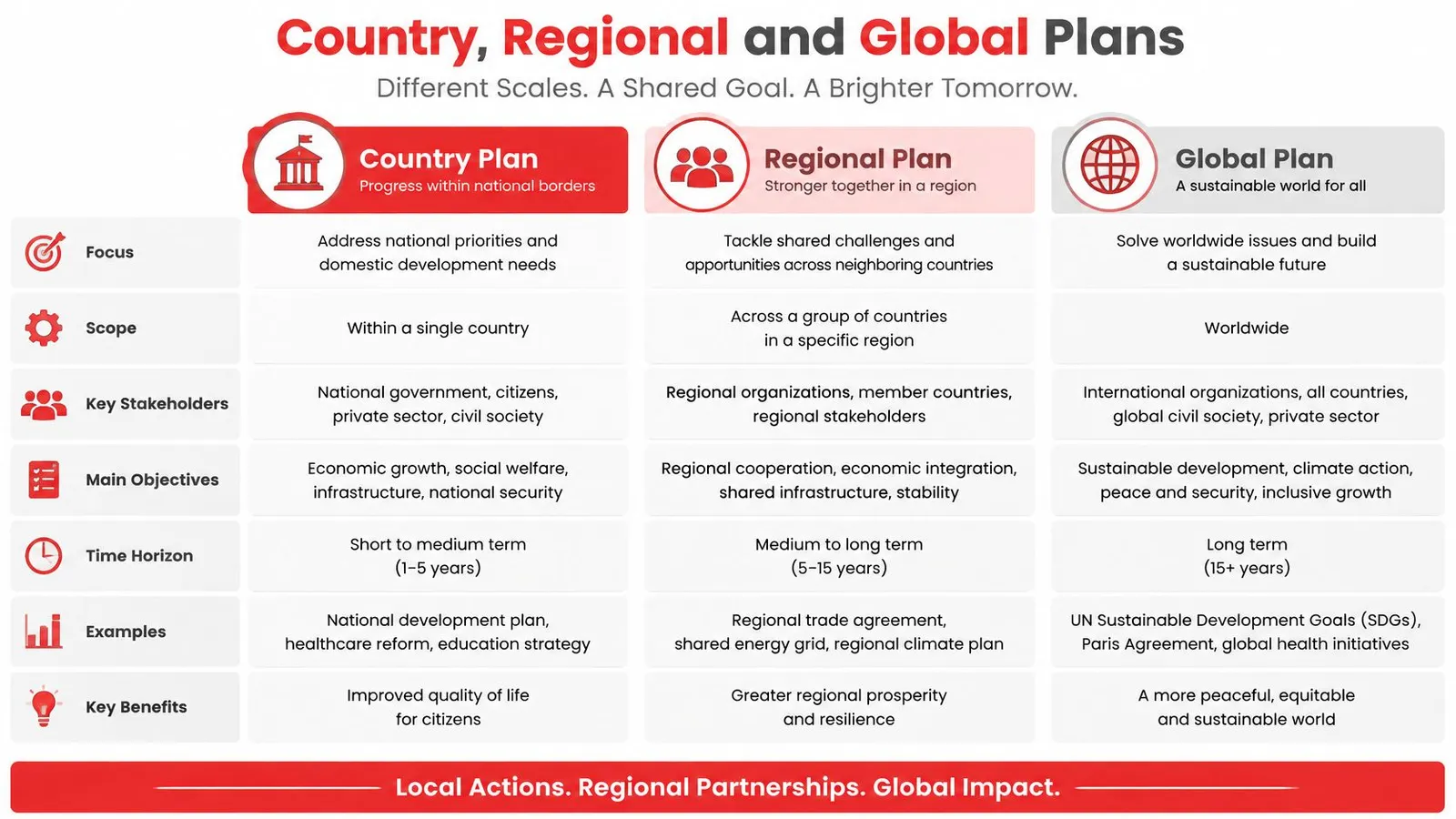
An Italy and Spain comparison
Consider a traveler visiting Italy and Spain. Buying the listed country packages with 10 GB each costs $11.40 + $9.00 = $20.40, compared with $14.25 for the Europe regional 10 GB package.
The regional package costs less upfront, but the comparison needs an important qualification: the separate packages provide more total data. The regional option wins only if its shared allowance is enough for the entire route.
A lower bill and a lower price per included gigabyte aren't always the same thing. For a single-destination stay, country coverage avoids paying for access the traveler will not use. For a moving itinerary, a regional allowance avoids leaving unused data stranded in the first country.
Write out each border crossing, including overnight stops and side trips, then check that list against the Europe destination list. A France plus Italy train trip still needs a separate answer for a Switzerland day trip.
Add the country packages needed for the route, then compare that total with a regional package that provides enough usable data.
What Sets the Price of a Europe eSIM
The main price drivers are allowance, usable duration and geographic scope. Features then determine whether an apparently cheaper package can do the job.
A practical comparison ranks those factors in this order:
- Data allowance comes first. Messaging and bookings require a different budget from laptop tethering. Buying excess capacity lowers the advertised cost per gigabyte but can increase the amount paid for data that expires unused.
- Validity must cover the itinerary. A short package that needs replacing before the return flight should be compared with the total cost of those replacements, not with a longer package's purchase price alone.
- Coverage must match every destination. A route through France and Switzerland needs explicit coverage for both. The Europe coverage information is more useful than assuming neighboring countries receive identical treatment.
- Speed conditions affect usefulness. A package that remains connected after a fair-use threshold might still become unsuitable for video meetings or large uploads.
- Sharing and replenishment change the economics. Hotspot access can serve a laptop or companion's phone, while an active-profile top-up avoids installing another eSIM.
- Calls, SMS and compatibility remain separate checks. A data-only plan won't replace every function of a home number, and an incompatible or carrier-locked phone makes even a cheap package unusable.
Calculate usable value
Price per included GB is the package price divided by its allowance. Price per travel day is the total connectivity bill divided by the days the traveler needs service.
Those measures answer different questions. The first helps compare similarly sized fixed allowances; the second exposes the cost of short validity, replacements and unused subscription days.
Activation terms deserve separate attention. The deadline for installing or activating a package isn't necessarily the same as the period during which service remains usable.
An unlimited package can't be compared fairly through a nominal price-per-GB calculation. Its useful measures are daily cost, high-speed conditions and whether its sharing rules support the intended devices.
When an eSIM Beats Your Home Roaming Plan
Many EU-based travelers need no additional eSIM. Existing roaming benefits should be checked before shopping for another allowance.
The Mobile Ecosystem Forum's roaming overview reports that 50% of European consumers used their usual mobile-operator plan while traveling in 2025, up from roughly one-third in 2022. A separate travel package isn't the default choice for everyone.
The decision should follow this order:
- Check included roaming. Confirm whether the home subscription allows domestic-rate service in the destinations on the itinerary.
- Read the fair-use allowance. Identify the roaming data entitlement and what the carrier charges after it runs out.
- Inspect geographic exclusions. The United Kingdom, Switzerland, Turkey and Balkan destinations shouldn't be treated as one interchangeable roaming zone.
- Compare the complete bill. Include hotspot restrictions, ordinary calls, SMS and any charges triggered by keeping the home line active.
Two travelers, different answers
An eligible EU subscriber visiting Italy and Spain may already have sufficient service. Buying a separate allowance would add cost without solving a problem.
A visitor from the United States traveling to Germany should inspect the home carrier's international benefits instead of assuming either free roaming or an expensive daily charge. A prepaid package becomes attractive when it supplies the needed service for less than that carrier's actual trip cost.
The Europe eSIM comparison can help evaluate alternatives after those home-plan checks. The decision isn't just which product has the cheapest gigabytes.
The cheapest connection may already be in the phone. A new package earns its place only when it lowers the bill, fills a coverage gap or provides a useful separate allowance.
How Much Data Your Trip Really Needs
Trip length alone is a weak sizing tool. A traveler sending messages from cafés can use less mobile data than someone spending a short visit on video calls and cloud uploads.
The European Commission's roaming guidance explains that operators can apply fair-use data limits to unlimited or unusually cheap domestic plans. A home subscription labeled unlimited therefore shouldn't be treated as an unrestricted travel allowance.
Estimate from the phone, not from a generic average
- List the activities. Include maps, messaging, social media, video calls, photo backups and laptop use.
- Inspect actual consumption. The phone's mobile-data settings show which apps consume data. A representative day provides a better starting point than guessing consumption for each app.
- Adjust for travel habits. Add expected navigation and booking searches, then allow spare capacity for delays or unexpected work.
- Choose above the estimate. The smallest package that comfortably covers expected use is more useful than the cheapest package available.
Light smartphone use can fit a modest allowance. Regular media use needs more room, while tethering a laptop requires careful monitoring because updates and background synchronization can consume data without an obvious prompt.
A shared family calculation
For a hypothetical family of four sharing the listed Europe regional package during a 14-day holiday, the calculation is:
$14.25 ÷ 4 connected devices ÷ 14 days = approximately $0.25 per connected device-day.
That is a cost illustration, not a claim that the allowance will satisfy the family. Each person draws from the same pool, and the hotspot must be available whenever the others need access.
- Check sharing practicality: A companion away from the hotspot phone won't have that connection.
- Control background traffic: Pause automatic backups and large downloads on mobile data.
- Plan replenishment: Active-profile top-ups avoid replacing the installation if consumption exceeds the estimate.
What Solo Trips, Families and Long Stays Cost
Total trip cost tells the story better than a single package price. A solo traveler pays for one set of days. A family pays per device day. A 30 day stay pays either for one larger allowance or for several short plans stacked together.
| Scenario | Suggested plan | Estimated cost (USD) |
|---|---|---|
| Solo 7-day city break, light use | Europe 1 GB, 7 days | $2.69 |
| Solo 7-day trip, heavy maps and video calls | Europe unlimited, 7 days | $20.34 |
| Solo 30-day stay, moderate use | Europe 10 GB, 30 days | $14.25 |
| Family of four, 14 days, each on 5 GB | Four Europe 5 GB, 30 days plans | $43.76 |
| Family of four, 14 days, one shared hotspot | One Europe 10 GB, 30 days plan | $14.25 |
| Long stay, 30 days, wider coverage | Europe+ 10 GB, 30 days | $17.81 |
These are package-budget scenarios; actual consumption will vary. The heavy use row assumes the unlimited package speed conditions suit the traveler calls.
Solo breaks and working trips
A week of maps, messaging and hotel Wi-Fi for the rest fits the $2.69 tier for many light users. Daily video calls change the calculation completely. Then the $20.34 unlimited week can cost less per working day than buying extra fixed data twice.
For a month, compare one $14.25 allowance against four weekly unlimited charges. I recommend fixed data when work runs on accommodation internet and the phone handles navigation, bookings and calls. Budget the apartment connection separately. A phone plan does not replace it.
Families and longer routes
Separate allowances keep every phone online away from the group. The shared row costs less in total, with less combined data and a practical limit. Everyone stays within range of the host phone.
Long stays carry home costs too. Pet care for a 30 day absence belongs in the same budget as the $17.81 wider coverage row, and Global Pet Sitter's 2026 house sitter rate guide gives a starting point for that part of the calculation alongside rent, transport and connectivity.
Destination mix matters too: DriftEuropa's 2026 travel-eSIM panel reports a median of $1.27 per GB and a mean of $2.09 across 43 countries, illustrating why a single international average isn't a reliable itinerary quote.
For journeys extending beyond Europe, the global eSIM option merits comparison with separate regional purchases. Wider coverage is useful only if it covers destinations the traveler plans to visit.
Ways to Lower Your Europe eSIM Bill
Four weeks on rolling 7-day unlimited Europe passes costs $20.34 per week, or about $81 for the month. A single 10 GB plan for 30 days costs $14.25 and covers a typical sightseeing trip with maps, messaging and hotel Wi-Fi for the rest. That gap is where trip math beats package price.
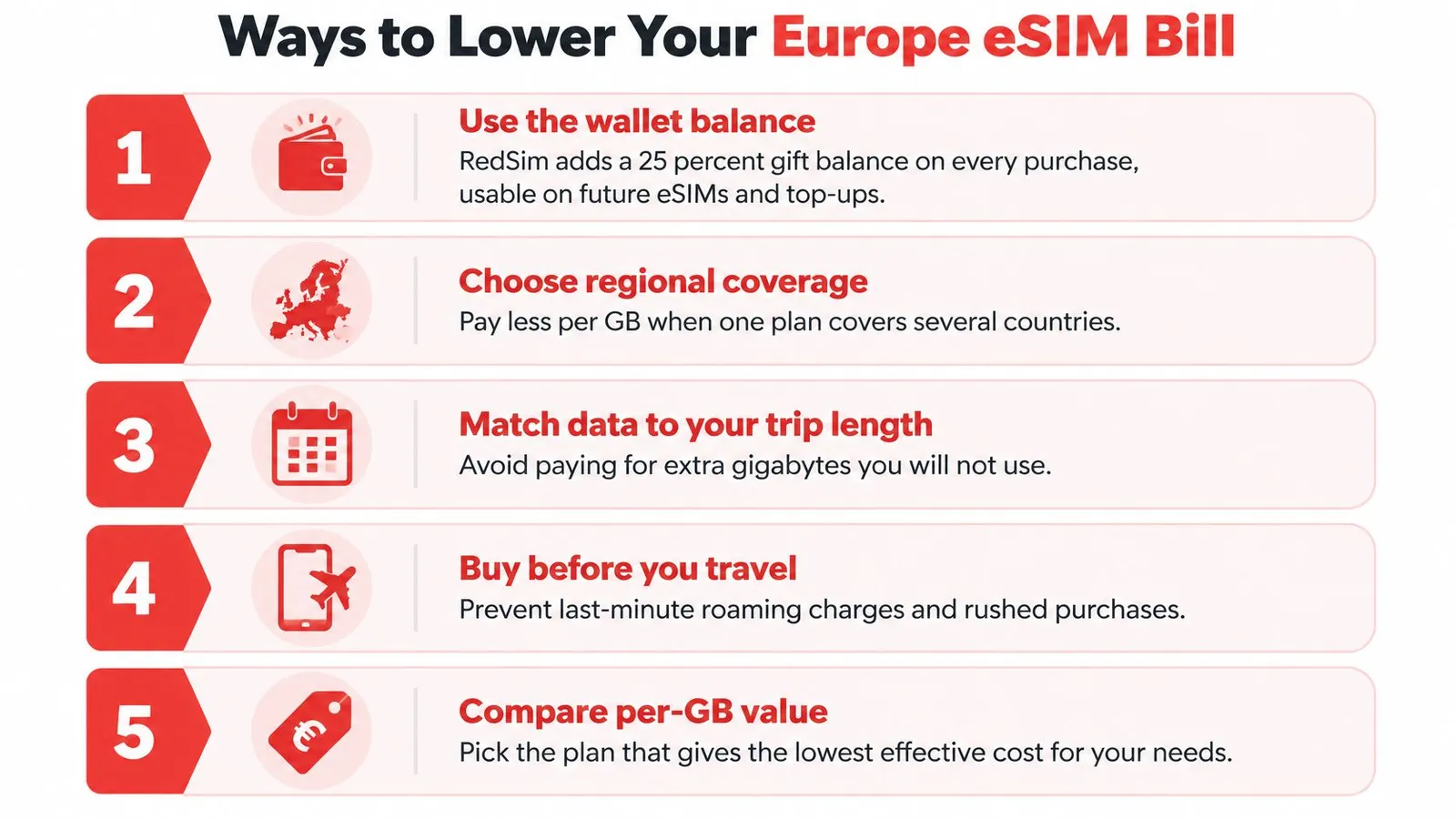
Start with cost per device-day. A solo traveler divides the package price by trip days. A group divides the combined total for every phone that needs its own connection. Hotspot sharing lowers the bill only when the group stays close together and total use fits one allowance.
Use the pricing mechanics after route and usage are set. RedSim adds 25% gift balance on every purchase. Wallet credit applies to future purchases only, not to the current bill. Invited customers receive a 20% discount, while the referrer receives 40% of the order value in wallet credit. Check checkout terms before assuming incentives combine.
Buy usable capacity and protect the purchase. In-app usage tracking shows whether a top-up is needed, and the guide to choosing the right data plan helps match allowance to trip length before payment. Unused eSIMs that have not been installed or activated are refundable in full, so confirming dates and destinations first avoids paying for the wrong coverage.
Savings check: Wallet credit has value only when it replaces a future purchase the traveler would otherwise make.
I recommend judging the cheapest suitable option by total trip cost, with no avoidable replacements, extra coverage or unused heavy-use days.
Pick Your Europe eSIM Plan Before You Fly
Buying before departure leaves time to resolve compatibility and installation questions over a reliable internet connection. Email delivery also means the installation details can be saved before the airport routine begins.
The Europe & UK eSIM is an option for a regional route, but its destination list should still be matched to every stop. A broader package only helps when the additional destinations are relevant.
Prepare the phone and installation details
Confirm eSIM support and that the carrier is not restricted before paying. Save the QR code and setup instructions offline, preferably with the QR available on another screen so the phone can scan it.
Installation and activation aren't always the same event. Follow the package's activation policy rather than assuming installation can never start validity, and avoid deleting an installed profile during troubleshooting.
RedSim provides installation through device Settings or its app, plus round-the-clock WhatsApp support. Before landing, the home line's data-roaming setting should be checked to prevent unintended use.
For broader itinerary preparation, travel insights from Prime Journal can sit alongside flight details, accommodation confirmations and the connectivity checklist.
- Compatibility confirmed: The phone supports eSIM and isn't carrier-locked.
- Route checked: Every required destination appears in the package coverage.
- Allowance selected: Expected usage and sharing needs fit the purchase.
- Instructions saved: The QR code and activation steps are accessible offline.
- Data line prepared: The travel profile will handle mobile data at the destination.
The next action is straightforward: select the suitable package, complete the purchase and save its installation details before departure.
RedSim offers country, regional and global travel-data plans with digital installation and active-plan top-ups. Travelers can visit RedSim to match coverage and allowance to their itinerary, compare the total trip cost and save the QR code before flying.