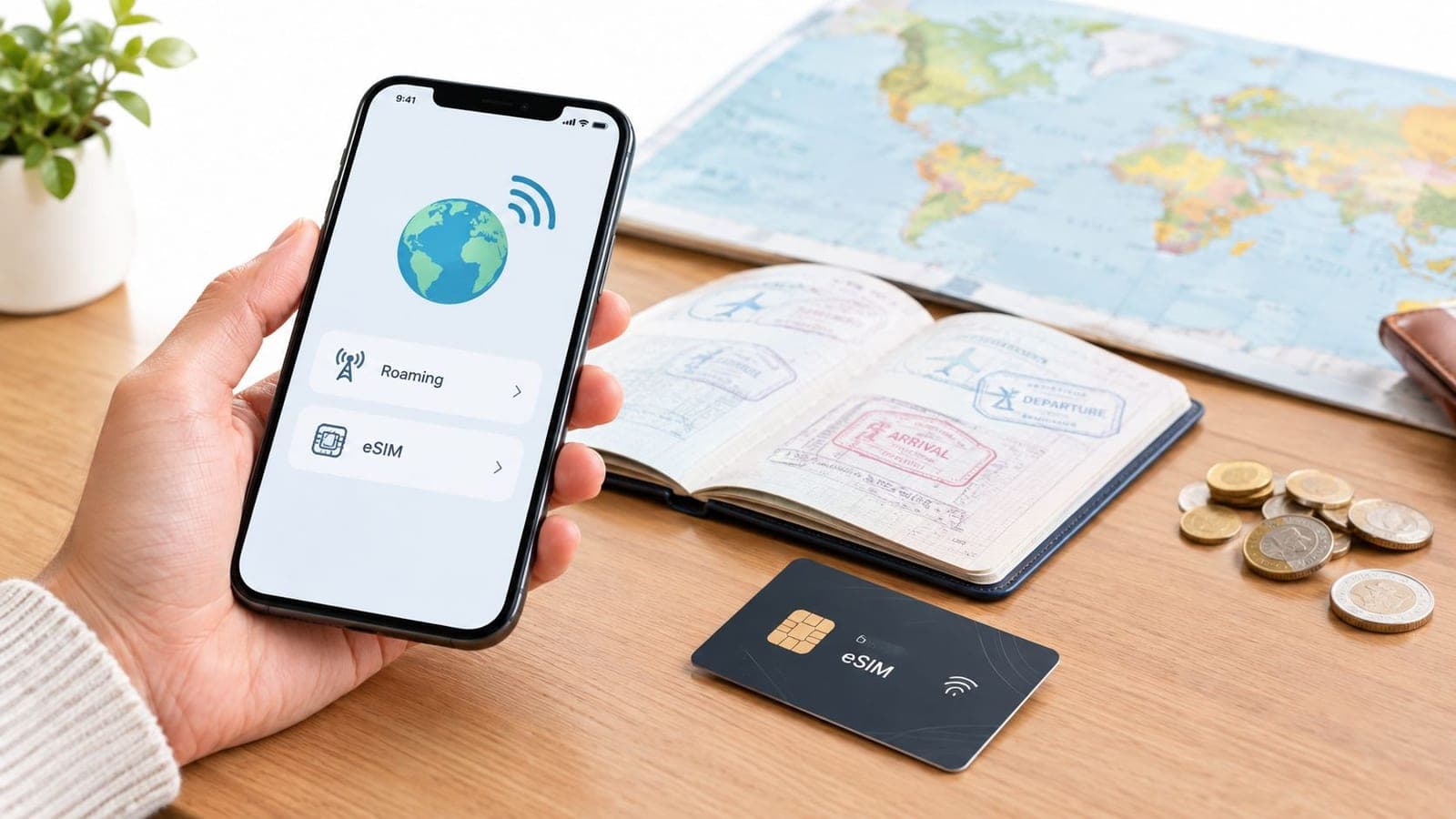

A traveler lands in Paris, taxi waiting, hotel address ready, but the phone still has airplane mode on and there's no local plastic SIM to insert. A Europe eSIM can get that phone online without a trip to a mobile shop, but it doesn't connect to a separate “European” network. It gives the phone a digital way to use participating local networks, provided the device and plan support them.
The practical question isn't only how the technology works. It's whether a travel eSIM adds anything to the traveler's existing plan, which countries it covers, and how to keep a home number available while using travel data.
What a Europe eSIM Does
At Lisbon airport, a dual-SIM phone can show two lines: “Home” for calls and texts, and “Portugal data” for maps. The second line is an eSIM profile: a programmable set of subscriber credentials stored in the phone rather than on a removable card. Once active, it lets the handset authenticate to a partner mobile network under the rules of the purchased plan.
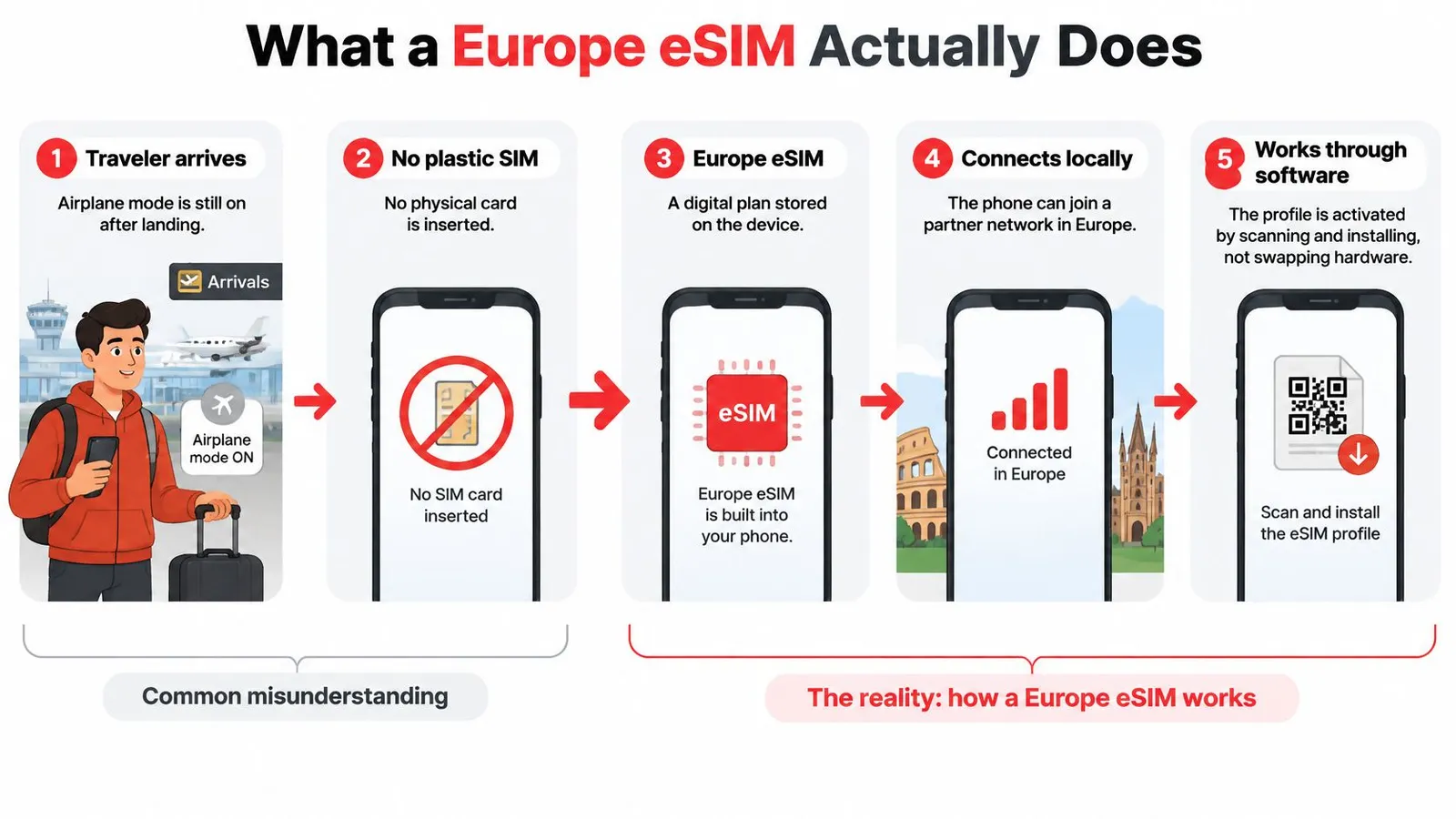
The eSIM is a provisioning layer; coverage still comes from local operators and from roaming agreements that reach the traveler's destination. A regional plan can carry one profile across several included countries, yet a dead zone stays a dead zone if no partner network serves it.
The home number can stay in the phone
On a dual-SIM device, line settings decide which SIM handles data and which remains reachable for calls or SMS. A traveler can route mobile data to the Europe eSIM while keeping the home line active for bank codes, airline messages, or family calls. That split is the useful configuration for many trips: travel data for the apps, home identity for inbound contact.
For EU and EEA residents, the comparison starts with Roam Like at Home, which covers many users through 2032, so a paid Europe eSIM may add little on a routine intra-EU trip. The UK sits outside that regime, and visitors from elsewhere may face home-carrier roaming fees, so the value depends on residency, carrier terms, and itinerary more than on the novelty of eSIM.
Adoption is broad enough that compatibility is the practical check. In its December 2025 assessment, GSMA Intelligence's eSIM report reported that 73% of mobile network operators in its panel had launched commercial smartphone eSIM service, across an average panel of 11 countries that included France, Germany, Italy, Spain, and the United Kingdom.
Before buying, confirm three things: the phone supports eSIM and isn't carrier-restricted, the plan lists the countries on the route, and the home SIM can remain available for voice or texts where needed.
How a Europe eSIM Gets Installed
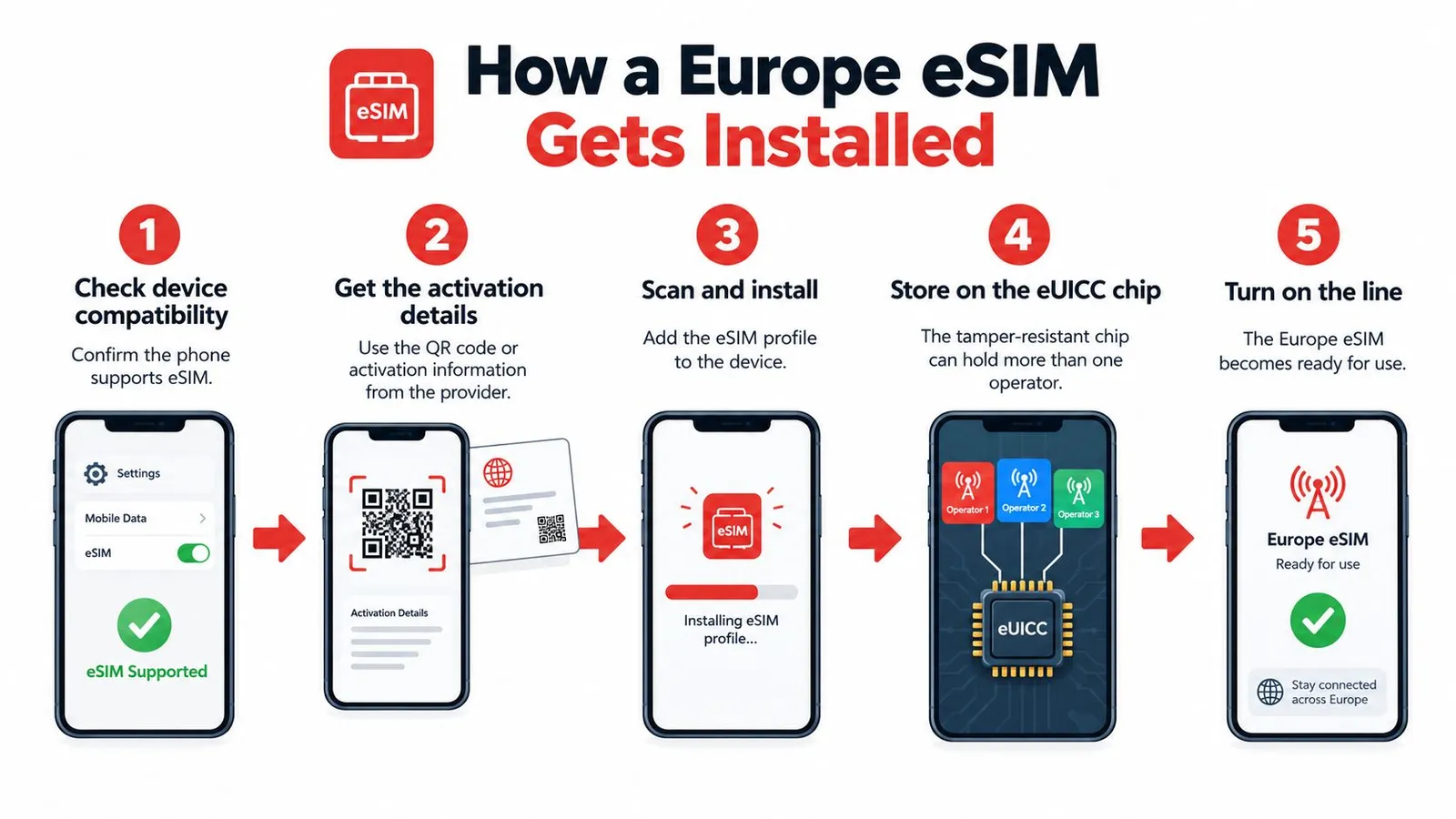
The digital profile lives on the phone's embedded Universal Integrated Circuit Card, or eUICC. This is a tamper-resistant secure element that can store multiple operator profiles. The active profile supplies the credentials the phone needs to authenticate to a mobile network, much as a removable SIM does.
Installing the profile involves a secure exchange between the phone and the operator's provisioning service. The phone's Local Profile Assistant contacts the operator's Subscription Manager–Data Preparation service, usually with activation information from a QR code or app. The request is authenticated, an encrypted profile is delivered, and the phone's assistant installs it on the eUICC. The sensitive subscriber credentials are provisioned over the air rather than printed on a card.
Choose an activation route
With a QR code, the traveler connects to Wi-Fi, opens the phone's eSIM settings, and scans the code. The code is an activation method, not the plan itself. If the camera can't scan it, some devices and providers allow manual entry of the activation details.
With one-click installation, a compatible phone receives the activation information through an app, so there's no camera scan. Both methods add the operator profile to the device. For device-specific instructions, follow a phone eSIM setup guide.
The most reliable time to install is before departure, while a known Wi-Fi connection is available. Keep the home SIM in place if calls or texts on the usual number still matter, then select the travel eSIM as the mobile-data line.
Confirm the plan and phone fit the trip
Installation alone doesn't guarantee service in every country on an itinerary. Before buying, check that the plan includes each destination and the networks it uses. The phone also needs to be carrier-free and support the relevant cellular bands. Hotspot sharing is another separate check: it depends on the plan's terms, not merely on whether the phone has a hotspot setting.
After these checks, the profile is on the device and selected for data. What happens at the next border depends on the plan's country coverage and the partner network available there.
How Networks Switch Across Borders
A traveler rides the train from Paris to Barcelona on a France-only plan. Data works until the border, then stops. Nothing broke: the profile is still installed and the phone still has signal bars to chase. The plan never included Spain, so no Spanish partner network will accept it.
That same crossing looks different on a regional plan covering both countries. The profile already holds the subscription credentials, and the plan's terms list which partner networks it may join in each country. Crossing into Spain, the phone registers with an available partner network using the same profile. No new download, no plastic SIM swap, no setting to flip at the border.
Plan terms decide more than geography. They set the validity window, hotspot access, and supported networks, and a data plan doesn't automatically include voice calling or a local number. The label "Europe" also deserves a check, since coverage lists vary and a plan may skip a country the traveler assumed was covered. The United Kingdom is a common surprise, because it sits outside the EU's roaming regime. Comparing the itinerary against a Europe coverage and country list beats trusting the label alone.
The phone's settings still matter at the crossing. With several lines installed, only the line selected for mobile data carries traffic, so a phone can show signal yet pass no data until the right line is chosen. Registration can also take a moment while the phone finds the partner network, and coverage still depends on local radio conditions.
When service drops at a border, the size of the data allowance is rarely the reason. How much data a plan includes, and whether hotspot sharing draws on that same allocation, is a separate question handled in the plan-choice section below.
Who Should Buy a Europe eSIM
The United Kingdom is the trap in a Europe itinerary: it sits outside the EU roaming regime, so a home plan that works in France or Spain can behave differently after a train or flight to London. Treat the UK as a separate coverage question, even when the rest of the route stays inside the EU and EEA.
For many EU and EEA residents, Roam Like at Home already does the job on ordinary trips. It lets eligible residents use domestic mobile allowances for periodic travel across the EU plus Iceland, Liechtenstein, and Norway, subject to fair-use conditions. Under Regulation (EU) 2022/612, the framework is scheduled to remain in force through June 2032, subject to later amendment. Operators can still review usage when roaming dominates use, and capped surcharges can follow.
Three travel situations call for different checks
- EU or EEA resident with a suitable home plan: Ordinary travel within the covered area may already be included. Check the plan's allowance and fair-use terms before paying for another data line, because a regional eSIM could add cost without solving a problem.
- Visitor from the United States, Canada, Asia, or elsewhere: A travel eSIM can offer a predictable data allowance when the home operator excludes Europe, charges heavily for roaming, or provides too little data for the trip.
- Route that leaves the EU and EEA framework: Check every stop separately. A plan described as “Europe” should never be assumed to include the UK or other destinations outside the same rules.
A useful setup is often home number plus travel data: keep the usual SIM active for calls and login codes, then add a prepaid eSIM for maps, messaging, and browsing. That matters because the European Commission's roaming guidance notes that some eSIM-based travel solutions can require a number change, which can complicate incoming calls or verification texts. Many travel data plans supply data only, so confirm eSIM support on a device compatibility list before deciding which line stays reachable.
How to Choose a Europe Data Plan
Start with the route, not the plan name. A stay in one country may call for a country-specific option; a trip across several included countries may suit a regional plan. If the itinerary includes the UK or destinations beyond a narrower footprint, compare the actual country list rather than trusting the label on the plan.
| Trip shape | Plan type | Known starting price | Best used when |
|---|---|---|---|
| One country | Single-country plan | Varies by destination | The itinerary stays within one country |
| Several countries, including the UK | Europe & UK regional plan | From $1.96 | The listed countries match the route |
| Wider regional route | Europe Plus, covering 41 countries | From $3.20 | The itinerary needs the broader listed footprint |
The Europe & UK eSIM is a prepaid travel data option with instant QR delivery. A regional name still doesn't define coverage, so match the listed countries against each stop instead of assuming two "Europe" plans cover the same destinations.
Before comparing prices, decide whether a paid plan is needed at all. EU and EEA residents whose home plans fall under Roam Like at Home, which runs through 2032, may already have the trip covered, and the right purchase could be none. For everyone else, the first filter is geography; the second is data volume.
Match allowance to use and trip length
An allowance works like a fuel tank: the plan runs until the gigabytes or the validity period ends, whichever comes first. Travelers commonly compare 5 GB, 10 GB, and 20 GB allowances, with validity ranging from short trips up to 30 days. Maps, messages, and web browsing tend to need less data than frequent video or large uploads.
Hotspot use draws from the same tank, so connecting a laptop burns through the allowance faster than phone-only use. A traveler who plans to work from the road should size the plan for the laptop's consumption, not just the phone's.
Check the setup and support details
Once the route and allowance fit, look at how the plan behaves during the trip. RedSim delivers the eSIM by QR code, installs through device settings or its iOS and Android apps, and supports one-click installation on compatible phones. Active eSIMs can be topped up without a new QR code, unused and unactivated eSIMs are eligible for full refunds, and plans include hotspot support with real-time usage tracking. For a structured comparison by route and usage, the plan selection guide walks through the options.
One practical arrangement resolves the phone-number trade-off: keep the home SIM active for calls and texts, and set the travel eSIM as the mobile data line in the phone's settings.

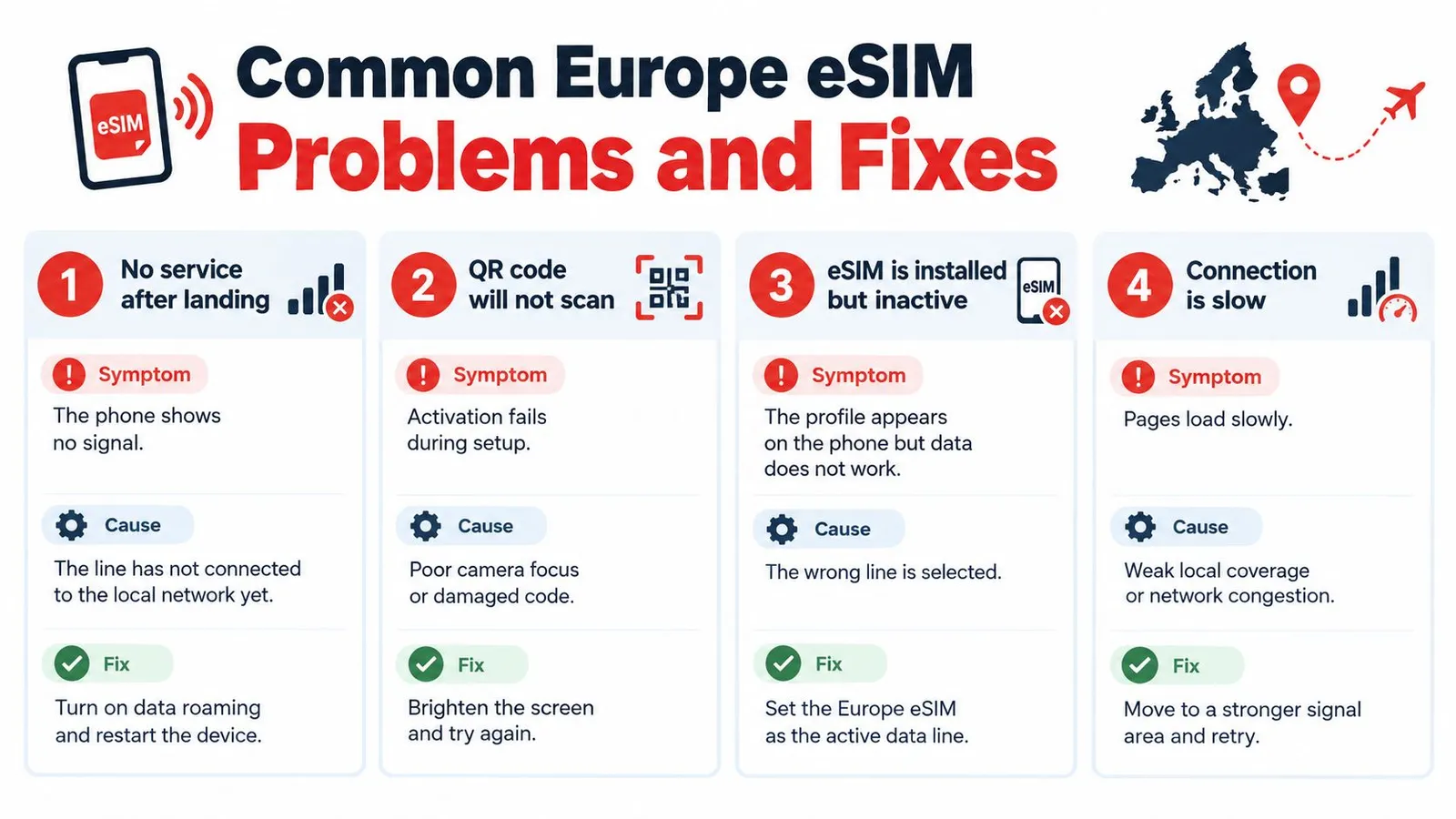
Common Europe eSIM Problems and Fixes
When a travel eSIM doesn't work, the cause is often a setting or coverage mismatch rather than a failed profile. Diagnose the symptom first, then change one thing at a time.
No service after landing
Symptom: The phone shows no usable signal. Possible causes: The profile wasn't installed, the home line is still selected for mobile data, or data roaming is off for the travel line. Fix: Confirm the eSIM appears in the phone's line settings, select it for mobile data, turn on data roaming for that line if the plan requires it, and restart the device. If the phone still can't register, check the provider's instructions and country coverage.
The QR code won't scan
Symptom: Setup stalls when the camera tries to read the code. Cause: The camera can't focus, or the code is difficult to read on the screen. Fix: Open the code on another screen or printout, increase the display brightness, and try again over Wi-Fi. Manual activation details or one-click installation on a compatible phone may be alternatives.
Data stops working after a border crossing
Symptom: The phone had data before entering another country, but now it doesn't. Cause: The new country may not be included in the plan. Fix: Check the plan's country list and validity, then check the phone's selected data line. For a no-signal problem that persists after those checks, follow a no-service troubleshooting guide.
Calls, hotspot, or data become a problem
A missing local number is expected with many data-only plans. Keep the primary line active for calls, SMS, and login codes if the phone supports that setup, and check whether the home operator charges for roaming voice or texts.
If hotspot sharing fails, check both the phone's tethering settings and the plan's hotspot rules. If data runs out mid-trip, top up the active eSIM where available instead of installing a second profile. If the itinerary changes before installation, an unused, unactivated eSIM can qualify for a full refund. When the profile is installed but still can't connect, contact support through the provider's available WhatsApp or email channel.
Get Connected Before You Land
Before buying a Europe eSIM, check what your home plan already covers. Roam Like at Home lets many EU and EEA residents use their domestic plans across the EU and EEA through 2032, subject to their provider's terms. The UK is outside this regime, so check UK coverage separately.
For a resident already covered by home roaming, a travel eSIM may add little for trips within the EU and EEA. For a route that includes the UK or other countries beyond that coverage, compare your home plan's roaming charges with the price and country coverage of a travel data plan. The practical setup may be both: keep the home number for calls and texts, and add a travel eSIM for data where it offers a clear benefit.
If you need hotspot access, include the devices that will share the connection when estimating how much data to buy. A laptop or another phone draws from the same allowance.
Check your route and home-plan terms first. If a travel line fills a gap, compare its listed coverage with your stops before departure. RedSim offers Europe and Europe & UK eSIM plans; review the included countries and plan conditions at RedSim.