AT&T charges $12 per line per day for land and air travel and $20 per line per day at sea, with a $120 maximum per line per billing cycle for standard land or air charges. The right choice depends on whether the trip is short and covered, or long, data-heavy, multi-country, or cruise-based.
The anxiety usually starts after landing. A traveler checks a map, sends one message, or answers a quick call, then spends the rest of the holiday wondering whether that tiny action just triggered a painful bill. AT&T's International Day Pass makes the rules more predictable than traditional pay-per-use roaming, but predictable doesn't mean inexpensive.
The useful question isn't just whether AT&T roaming works. It's whether the carrier's daily pricing fits the itinerary better than a prepaid eSIM. A short city break in an included destination may justify the convenience. A longer trip, a mixed land-and-sea itinerary, or travel outside the pass footprint deserves a closer comparison.
| Travel situation | AT&T cost structure | Practical judgment |
|---|---|---|
| Land or air, one primary line | $12 per 24-hour period of use | Convenient for short trips |
| Additional line on the same account | $6 per day on the same calendar day | Useful for families sharing an account |
| Land or air billing ceiling | $120 per line per billing cycle | Limits recurring daily charges |
| Cruise or other at-sea use | $20 per line per day of use | Expensive for daily cruise connectivity |
| Destination outside the pass footprint | Pay-per-use rates apply | Verify eligibility before departure |
What AT&T Roaming Charges Actually Look Like
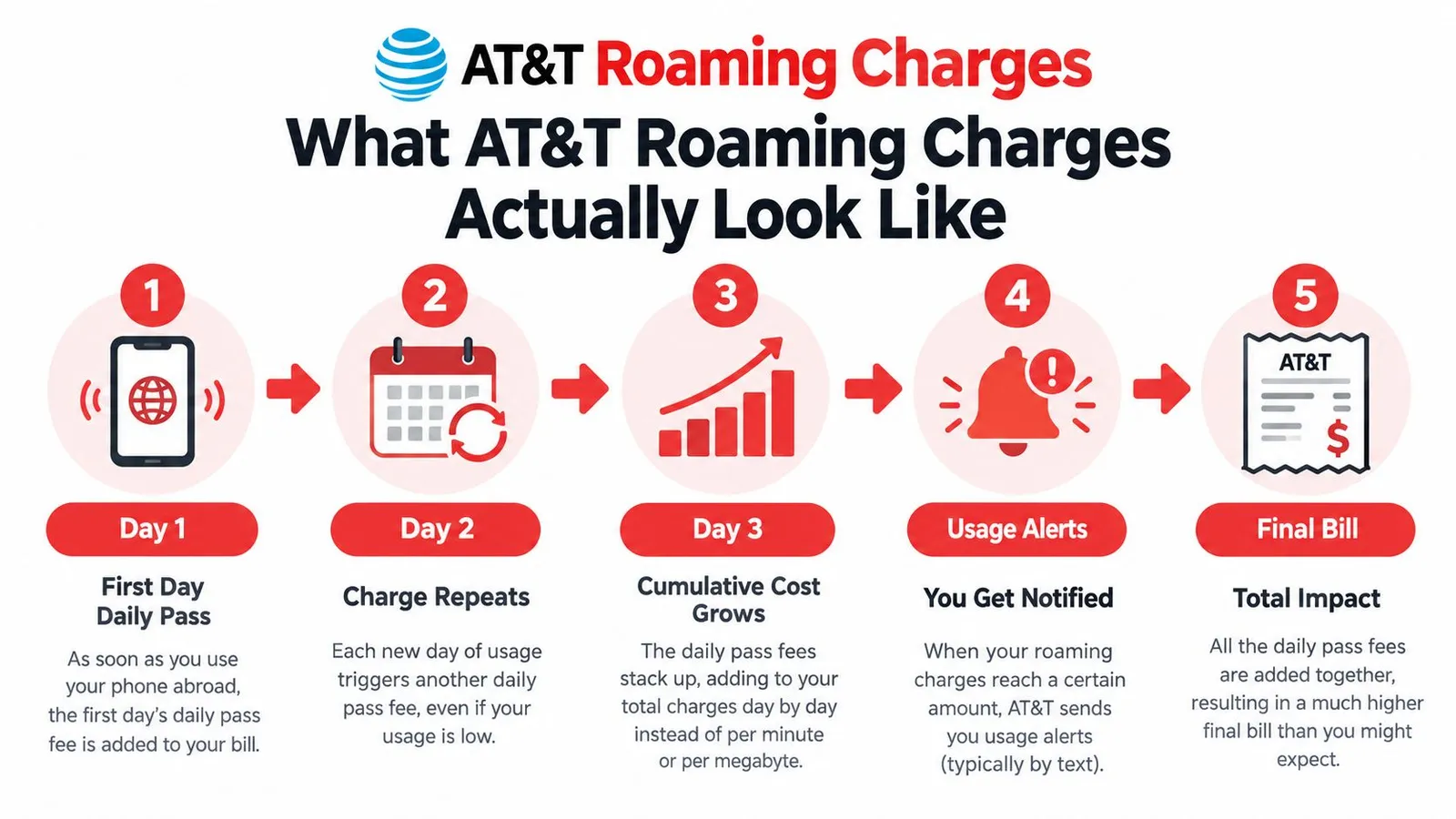
Checking a phone bill after an overseas trip can feel like opening a sealed envelope with bad news inside. The traveler may remember using the phone only for directions and a few texts, yet the bill reflects the day rather than the amount of data consumed. That difference explains most confusion around AT&T roaming charges.
AT&T's International Day Pass launched on January 27, 2017, as a move away from international usage billed separately by minute, message, or megabyte. The original pass covered more than 100 countries and charged $10 for each 24-hour period of qualifying use, allowing customers to use the talk, text, and data allowances from their domestic plan in included destinations. Tech Times' report on the original launch documents that shift.
Consider a traveler who lands in an included destination and sends an outgoing text while waiting for luggage. That first qualifying action starts the daily period. A map search, call, or additional data use later that day generally falls under the same active-use window, but using the phone again on another day can create another fee.
The bill follows active-use days
The original model was designed around days of use, not the total length of the vacation. Someone who kept the phone in airplane mode for a full day wouldn't generally trigger a new daily charge, while a single qualifying action could activate the charge for that day.
That structure helps on a carefully managed short trip, but it can punish travelers who use cellular service casually every morning. A traveler who uses the phone on three separate days would generally incur three daily charges, while a traveler who avoids covered services on a particular day would not trigger that day's fee.
Practical rule: Treat every day of cellular use as a budget decision, even if the actual phone activity lasts only a few seconds.
Travelers comparing this model with a prepaid option can review United States eSIM alternatives before departure. The key distinction is simple: AT&T ties cost to qualifying use days, while an eSIM usually ties cost to a purchased data allowance and validity period.
AT&T International Day Pass Pricing and Limits
The current land and air rate is $12 per line for each 24-hour period of use. An additional line on the same account costs $6 per day when used on the same calendar day, which can make one account more practical for couples or families than buying separate carrier add-ons.
AT&T also limits recurring land and air fees to 10 daily charges per line during a billing period. At the standard rate, that creates a maximum of $120 per line per billing cycle for those charges. A 10-day trip can therefore reach $120 for one primary line before taxes or usage outside the included terms. The current AT&T International Day Pass pricing confirms both the daily rate and the cap.
The rate changed from the original $10 daily price to $12 in May 2024, a 20% increase. That change matters because the pass can look reasonable for a few active-use days but become a substantial line item when a traveler uses cellular service throughout a longer itinerary.
The 24-hour rule matters
The first use of data, an outgoing text, or a call in an included destination activates the pass. Visiting multiple included destinations during the same 24-hour period still results in one daily fee, not a new charge at every border crossing.
This makes the pass particularly easy to understand for a short multi-country route. It doesn't make the pass automatically cheap for an extended trip, especially when a fixed prepaid data bundle could cover the same journey without a carrier fee each active day. Travelers can compare eSIM plan prices against the projected AT&T total before buying.
Cruise pricing follows a separate rule. At sea, AT&T charges $20 per line per day, including a day when the device is used both on land and at sea. There isn't a stated monthly cap for cruise-related daily fees, and the additional-line discount doesn't apply at sea.
Budget warning: A seven-day cruise with one line used every day reaches $140 before taxes and any non-covered charges, compared with $84 for seven land or air days at the standard rate. AT&T's roaming terms set out this separate maritime treatment.
When Roaming Costs More than Land Rates
Cruise connectivity is where many travelers make the wrong assumption. They see International Day Pass and expect one consistent price everywhere, but AT&T separates terrestrial travel from maritime use. The ship's cellular network operates under a different pricing tier, and the daily amount rises accordingly.
The first data session, outgoing text, or call at sea activates the $20 daily charge per line. There's no multi-line discount for that use and no stated monthly cap on cruise fees. A land day that overlaps with at-sea usage also falls into the at-sea rule for that day, so a port visit doesn't necessarily protect the traveler from the higher charge.
Check the itinerary before switching on cellular
A mixed itinerary needs more than a country list. It needs a day-by-day view of where the phone will connect.
- Mark ship days separately. Don't place cruise dates inside the land and air budget. They use the maritime rate when the device connects at sea.
- Verify every destination. Use AT&T's included-destination information before departure. A destination outside the International Day Pass footprint can fall back to pay-per-use roaming.
- Review call destinations. A call from an included country to a non-included country can create a separate international long-distance charge.
- Control automatic connections. Airplane mode, Wi-Fi, and disabled data roaming prevent accidental cellular activity while the traveler decides what to use.
- Check the account after travel. AT&T applies daily fees to the bill, so the final review should distinguish land, air, sea, and non-covered usage.
The FCC consumer guidance on international roaming warns that international roaming prices can vary by country and foreign network. That makes automatic roaming a poor default for remote destinations, ferries, and border areas where the phone may register on a network the traveler didn't intend to use.
How to Check Eligibility and Manage Your Plan
The safest setup happens before departure, not at the airport gate. The traveler should sign in to the AT&T account, confirm that International Day Pass is available for the line, and check every country, airline, and cruise segment on the itinerary.
AT&T can add the pass automatically when a smartphone arrives in an included destination and qualifying use begins. That convenience removes setup friction, but it also means a traveler who wants strict cost control must manage the phone settings before landing.
A practical pre-trip checklist
- Confirm the destination list: Check that each country and relevant ship or airline is included.
- Review line settings: Decide whether AT&T should handle mobile data or whether a travel eSIM should become the data line.
- Disable automatic roaming: Keep data roaming off until the destination and pricing are confirmed.
- Protect Wi-Fi calling: Wi-Fi calls to places other than the United States can trigger a daily fee, so travelers should review Wi-Fi Calling before departure.
- Check background activity: App refresh, cloud backups, and automatic updates can qualify as data use.
- Save support details: If service fails, restarting the phone and checking airplane mode and data roaming can solve common connection problems.
An eSIM adds a separate compatibility question. The phone must be compatible and support eSIM functionality, so travelers should use this eSIM compatibility guide before purchasing a plan.
Multiple included destinations in one 24-hour period remain covered by one daily fee, but another qualifying use after that period can start a new day. Travelers who want to avoid that second charge should stop cellular use before the window ends, then use airplane mode with Wi-Fi and disable background data.
AT&T Roaming vs RedSim eSIM Alternatives
The decision becomes clearer when the trip is scored against four practical factors: duration, destination coverage, data intensity, and setup tolerance. AT&T wins on continuity. The existing number stays in place, domestic plan allowances remain central, and there's no separate data account to manage.
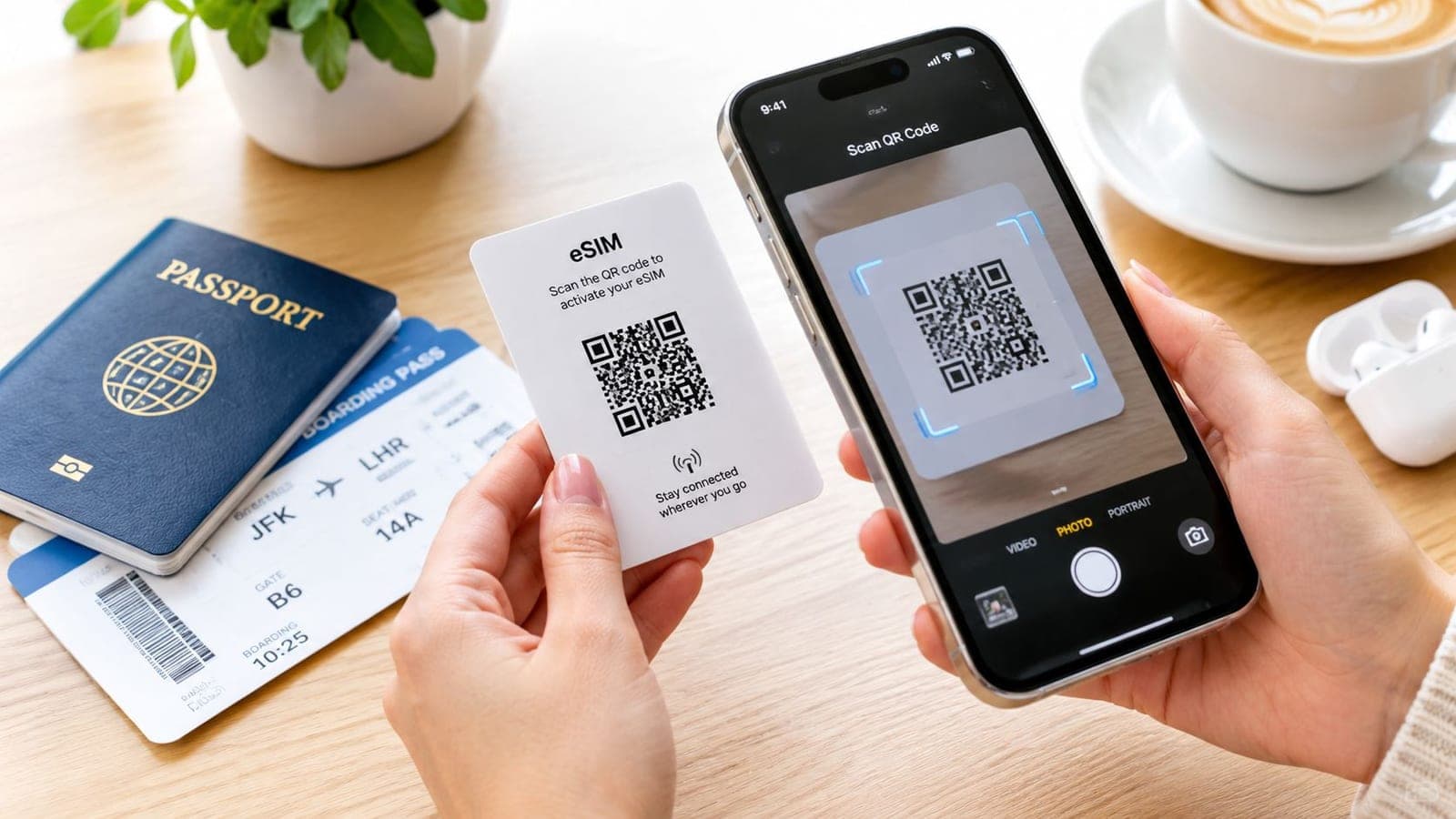
An eSIM wins when the traveler wants a prepaid data budget that doesn't depend on how many days the carrier line is used. RedSim offers country-specific, regional, and global data plans, with delivery by QR code or one-click installation in its app, plus WhatsApp and email support. Those features suit travelers crossing borders or sharing data through a hotspot.
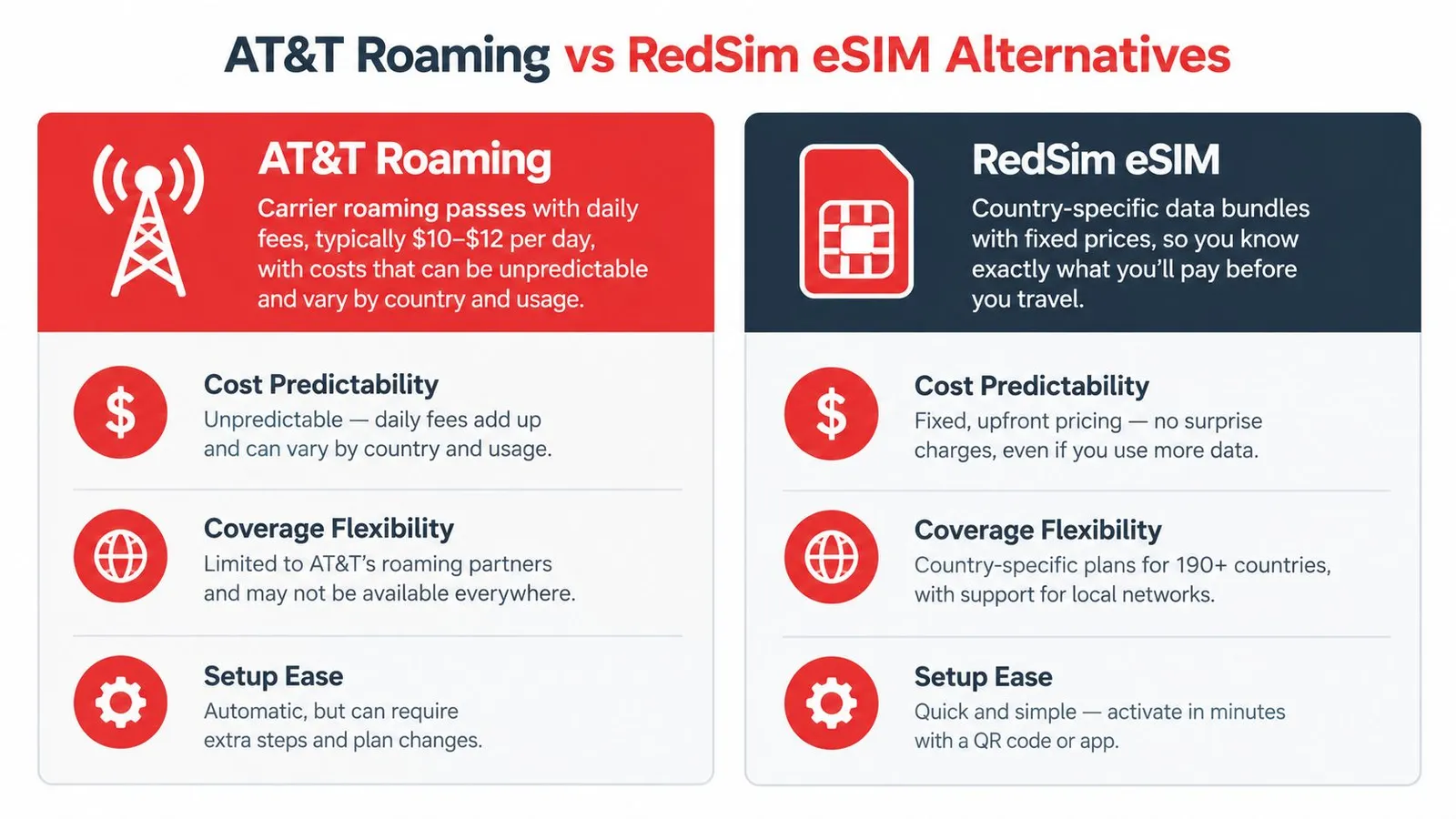
The decision boundary
| Traveler profile | More sensible starting point | Reason |
|---|---|---|
| Short trip in a confirmed included destination | AT&T International Day Pass | Minimal setup and the primary number remains active |
| Longer land-based itinerary | Country or regional eSIM | Avoids stacking a daily carrier fee across many active days |
| Several countries in one region | Regional eSIM | One data plan can serve the route without changing SIMs at borders |
| Cruise with daily connectivity needs | Compare carefully, usually eSIM or ship Wi-Fi | At-sea pricing has no stated monthly cap |
| Business traveler needing the AT&T number | Dual-SIM setup | AT&T can remain available while another line handles data |
| Heavy hotspot user | Check eSIM terms and AT&T allowance | Data-sharing needs may make a prepaid bundle more predictable |
The choice isn't just “carrier versus eSIM.” A compatible dual-SIM phone can keep the AT&T line available for calls and texts while routing data through the travel eSIM. That arrangement preserves access to the regular number without forcing every laptop session or map search onto the carrier's daily fee.
Travelers should also check refund and top-up terms before purchase. Unactivated eSIMs may be refundable under the provider's policy, while active plans can often be topped up, but those conditions must be confirmed before payment.
For a direct side-by-side starting point, travelers can review international connectivity options and then compare the exact destination footprint, data allowance, hotspot rules, and validity period with the AT&T itinerary.
How to Avoid Roaming Fees While Traveling
The cheapest roaming day is the day the phone never activates cellular service. Travelers don't need to abandon the AT&T line to reduce accidental charges, but they do need to stop background processes from making the decision for them.
Start with the phone settings before takeoff. Turn off data roaming on the AT&T line until the traveler has confirmed the destination, and disable automatic app refresh, cloud photo syncing, and operating-system downloads over cellular. A phone can consume data without a visible action from its owner.
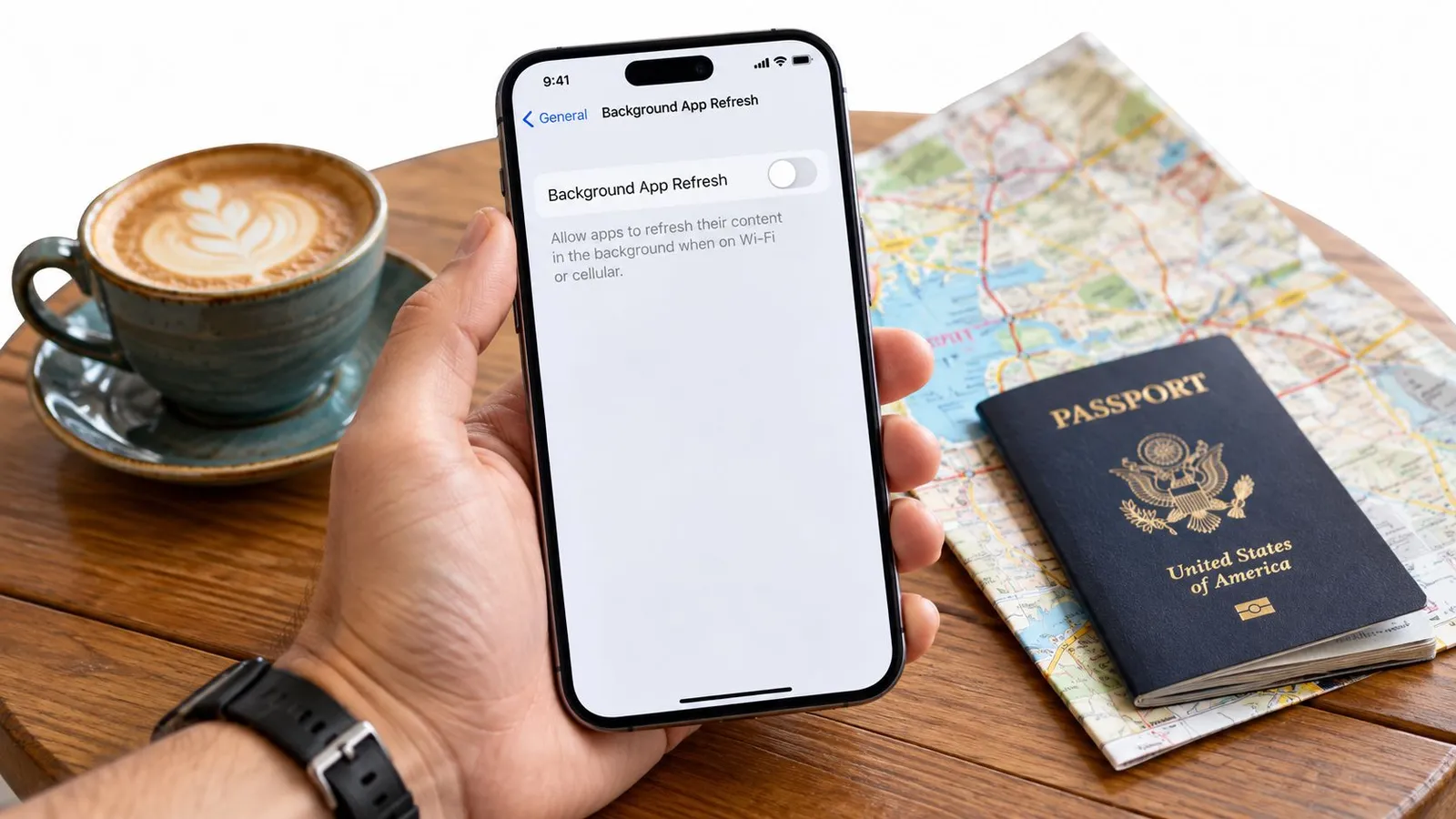
Reduce the triggers
- Use Wi-Fi for heavy tasks: Upload photos, download shows, and update large apps at a trusted hotel or café connection.
- Prefer messaging apps: Text-based messaging over Wi-Fi avoids unnecessary cellular calls when the recipient uses the same service.
- Limit background data: Disable refresh for social, shopping, video, and cloud-storage apps that don't need live updates.
- Watch hotspot behavior: Connect a laptop only when necessary. One forgotten laptop backup can consume far more data than a phone's maps.
- Set usage alerts: AT&T account alerts and phone-level data warnings make unusual activity easier to spot.
- Use airplane mode deliberately: On a cruise or in a non-covered destination, airplane mode with Wi-Fi is safer than assuming the phone will choose the right network.
A traveler using a separate data eSIM should set it as the mobile-data line and keep AT&T data roaming disabled. The AT&T line can remain available for carefully managed calls or texts, but any qualifying use may still activate the carrier's daily fee.
For multi-country trips, a global eSIM option can be worth comparing with separate country plans. The right choice depends on the route and the plan's coverage, not on the label alone.
Choosing the Right Connectivity Plan for Your Trip
The best plan follows the itinerary, not the traveler's loyalty to a carrier. A short trip in a confirmed International Day Pass destination favors AT&T because the setup is simple and one qualifying day covers the next 24 hours. The carrier also makes sense for a traveler who needs the existing number active and doesn't want to manage dual-SIM settings.
A longer land trip changes the calculation. Once cellular use becomes routine across many days, the daily fee can approach the land and air ceiling, while a prepaid country or regional eSIM offers a separate cost structure. A traveler who crosses several included countries in one region should compare one regional bundle against the projected AT&T active-use days.
Use this four-question test
- How many days will the phone use cellular service? Count expected active-use days, not just nights away.
- Does the itinerary include a cruise or at-sea segment? Put those days in a separate budget because the maritime rate is higher and has no stated monthly cap.
- Will the phone need heavy data or hotspot access? Compare the domestic allowance, eSIM data amount, tethering rules, and top-up process.
- Does the traveler need the AT&T number continuously? If yes, a dual-SIM arrangement may preserve the number while moving data to a separate plan.
Coverage gaps deserve priority over small price differences. A destination outside the pass footprint can trigger pay-per-use rates, and a call to a non-included country can add international long-distance charges. That risk makes destination verification mandatory before departure.
Final travel rule: Use AT&T for simplicity when the trip is short and covered. Compare an eSIM for longer, multi-country, data-heavy, or cruise travel, and never assume land pricing applies at sea.
Before boarding, the traveler should save the destination list, confirm device compatibility, install any eSIM over Wi-Fi, set the preferred data line, and disable automatic roaming on AT&T. After returning, the bill should be checked against the actual days of cellular use, with land, air, sea, and non-covered charges separated.
RedSim offers country, regional, and global travel eSIM data plans with digital delivery, app installation, hotspot support, and usage management. Travelers comparing AT&T roaming charges with a prepaid alternative can visit RedSim to check coverage and choose a plan before departure.

 China
China