

A traveler moving from Japan to Thailand, then Singapore and Malaysia, needs data that keeps working after each border crossing. Buying and replacing physical SIM cards adds airport queues, compatibility questions, and another chance to lose connectivity when maps, messages, or booking details matter most. An eSIM can remove much of that friction, but the best eSIM for Asia travel depends on the route, not just the lowest displayed price.
This comparison weighs coverage scope, listed starting price, validity, network details where supplied, setup, and practical limitations. Country plans suit focused trips, regional plans suit multi-country Asian itineraries, and global plans make more sense when the route extends beyond Asia. Prices and availability can change, so travelers should verify the live offer before purchase and confirm that the phone supports eSIM service.
1. Asia eSIM
A route from Japan to Thailand, Singapore, and Malaysia puts regional coverage ahead of a country-only plan. RedSim's Asia eSIM is listed from $2.97, and its displayed entry option provides 1GB for 7 days at $2.97. The catalog describes prepaid travel data, validity options from 3 to 30 days, 5G, and instant QR delivery.
For a compact multi-country itinerary, one regional product can be easier to assess than buying a separate plan at every border. Travelers visiting Japan and Thailand can also compare it with the Thailand eSIM plan for a single-country stay, while a Singapore and Malaysia route may favor regional coverage if both destinations are included. The decisive check is the live coverage list. The supplied catalog snapshot does not specify which countries are covered.
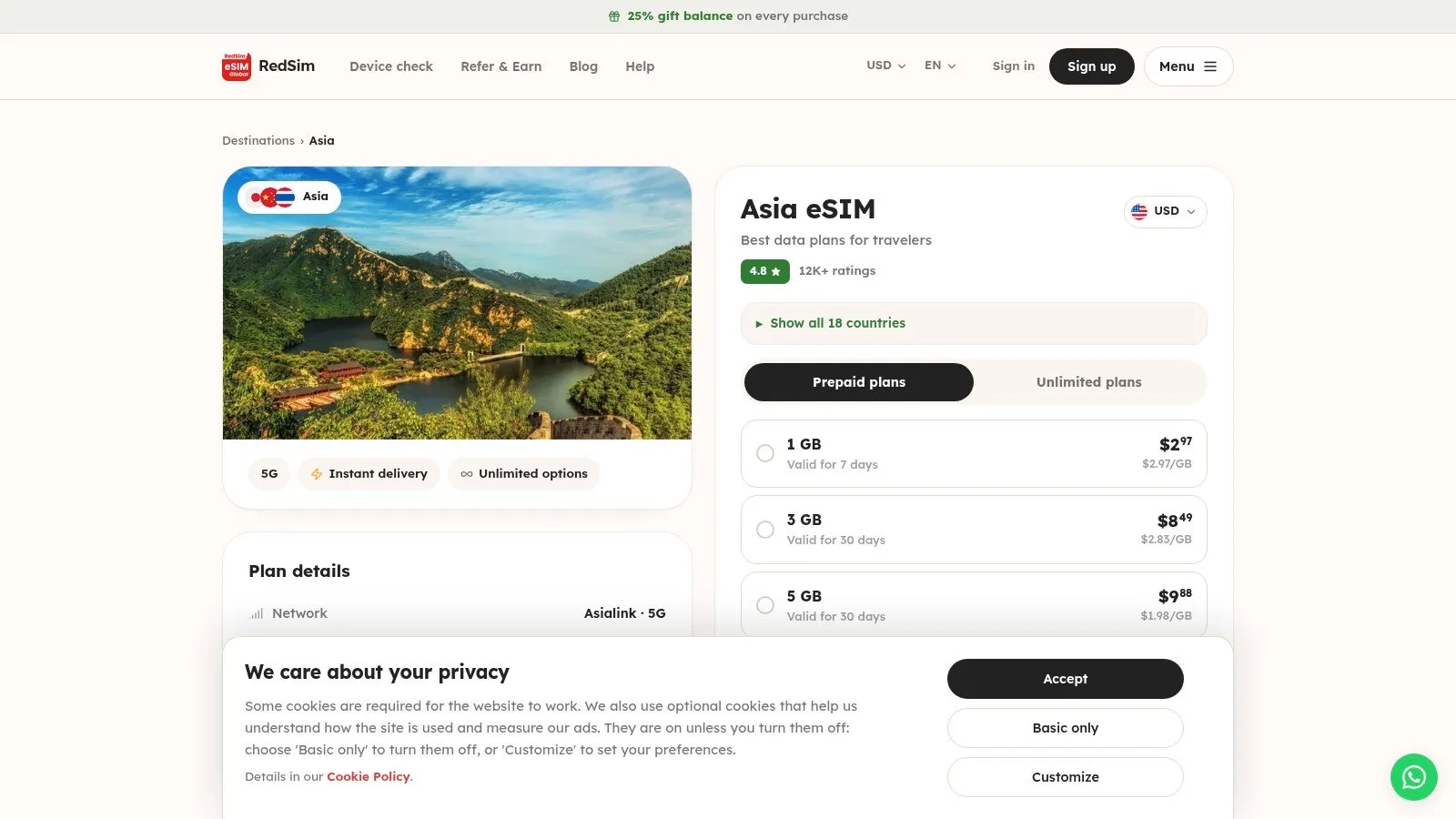
Best fit for border-crossing itineraries
Asia's eSIM market is expanding. GSMA Intelligence projects APAC eSIM penetration to rise from 2% in 2023 to 9% in 2025 and 78% by 2030. That trend makes device support and destination coverage more relevant than the convenience of avoiding a physical SIM alone.
A regional plan can also reduce repeated setup. A low-priced country plan may require another purchase, installation, and network change at each stop. With a regional option, travelers can install before departure and keep the same digital SIM while moving between included destinations.
Practical rule: Check the route country by country, especially if it includes mainland China, Hong Kong, Taiwan, or less commonly listed destinations.
Limitations to check before purchase
The supplied plan details confirm 5G, instant QR delivery, prepaid data, and 3 to 30 day validity. They do not identify the underlying networks, hotspot policy, data allowances beyond the displayed entry option, or China-specific access conditions. Those details affect suitability for remote work, family travel, and tethering.
The GSMA material also shows that eSIM adoption differs across markets, so handset compatibility remains the first check. For an itinerary contained within Asia, this plan has the clearest regional fit among the listed options, provided its current coverage list matches every stop. A country-specific plan may still be more suitable for a single destination or a trip requiring known local network details.
2. Global eSIM
A route from Europe to Japan, onward through Southeast Asia, and back via the United States crosses several regional plans. In that situation, RedSim's Global eSIM offers one broader plan category instead of requiring separate Asia, regional, or country products. It starts at $6.15, with the displayed entry option providing 1GB for 7 days at $6.15. The catalog lists prepaid travel data, validity from 7 to 60 days, 5G, and instant QR delivery.
This option fits multi-region itineraries first. It may reduce installation and plan changes when the route crosses regional boundaries, although broader coverage can mean paying for destinations the traveler never visits. For an itinerary confined to Asia, the Asia plan has a closer route fit. The global plan becomes more defensible when the schedule includes another region or remains subject to change.
Travelers unfamiliar with embedded connectivity can review what an eSIM is and how it works before comparing plan coverage. The practical question is not merely whether a global plan includes more countries. It is whether that wider footprint replaces enough separate purchases to justify its cost and setup advantages.
The Asia-Pacific eSIM market is expanding, according to Mordor Intelligence estimates the Asia-Pacific eSIM market at USD 2.18 billion in 2025, rising to USD 2.44 billion by 2030. That market direction supports considering digital connectivity for cross-border travel, but it does not confirm this plan's network access in every destination. Coverage must still be checked country by country.
Best fit for multi-region travel
The Global eSIM suits business travelers with changing schedules, digital nomads combining work trips, and families whose journey includes a stop outside Asia before returning home. Its 7 to 60 day validity range can also suit longer routes, allowing the selected duration to be compared with the actual travel dates rather than replacing the plan at each regional transition.
Where the global option can lose
A global plan may include coverage an Asia-only itinerary never uses. For travel limited to Japan, Thailand, Singapore, and Malaysia, a regional plan is easier to justify because its scope follows the route more closely. A country-specific option may be preferable when the trip stays in one destination and local network details matter more than regional continuity.
The Korean traveler survey cited by Fizen found that 36% of overseas travelers used a travel eSIM, compared with 34% using carrier roaming, while eSIM users recorded 79% satisfaction, ahead of local SIM cards at 64% and roaming or pocket Wi-Fi at 58%. The same survey identifies low rates, data allowance, and simple activation as leading purchase drivers. These findings support checking the plan's data allowance, top-up rules, and included destinations before payment.
The supplied details confirm 5G, QR delivery, prepaid data, and the listed price and validity range. They do not confirm specific networks, hotspot sharing, or country-by-country coverage, so those omissions matter for work-dependent travel.
3. Europe & UK eSIM
The Europe and UK plan is a specialist choice for an itinerary that only briefly touches Asia or combines Asia with Europe. RedSim lists its Europe & UK eSIM from $1.96, while the displayed 1GB for 7 days option is listed at $2.55. The catalog describes prepaid travel data, validity from 1 to 30 days, 5G, and instant QR delivery.
For a traveler whose main journey runs through France, Italy, Germany, Spain, or the United Kingdom, this plan has a clear route fit. It can also work as one component of a larger journey, but it shouldn't be selected merely because its listed starting price is lower than the Asia and Global entries. The relevant question is whether the traveler needs Europe and the UK, not whether the first displayed amount looks attractive.
Best fit for Europe-first routes
A Europe-first itinerary might include a short Asian extension after the main trip. In that case, this plan could cover the European leg while a separate Asia plan handles the Asian stops. That creates more setup work, but it can be rational when the traveler wants plans closely matched to each region rather than paying for broader global coverage.
The validity window is one of its practical strengths. With options from 1 to 30 days, the plan can suit a short European stop or a longer stay, assuming the chosen duration matches the actual travel dates. Travelers should also confirm when validity begins, because installing an eSIM before departure and activating it on arrival can have different consequences depending on the provider's rules.
RedSim's guidance on choosing the right plan should be checked alongside the live offer, particularly when a trip combines multiple regional products.
Why it ranks below Asia plans for Asian trips
This is not the right default for a route centered on Asia. The supplied product information doesn't list Asian coverage for this plan, so travelers shouldn't infer that a European regional product will continue working after landing in Japan, Thailand, or Singapore. A country-specific Asian plan or the Asia regional option is more directly aligned with those destinations.
APAC travel demand is expanding quickly. One industry report describes Asia-Pacific as the fastest-growing travel eSIM region, with 42% year-over-year growth and 28% year-over-year adoption increases in Southeast Asia. The implication is straightforward: travelers should select a plan built around the actual Asian route rather than assuming a plan designed for another region will provide equivalent coverage.
This option makes sense for Europe and UK coverage, not as a substitute for an Asia plan. Its 1 to 30 day window and QR delivery are useful, but they don't overcome the central limitation of regional scope.
4. United States eSIM
The United States eSIM is the clearest country-specific choice in this list. RedSim lists the United States eSIM from $2.00, with the displayed 1GB for 7 days option priced at $2.62. The supplied details specify prepaid travel data on Verizon and AT&T, validity from 1 to 30 days, 5G, and instant QR delivery.
For an Asia trip with a United States stop before or after the main itinerary, a country plan can be more precise than a global product. It gives the traveler a focused option for the United States while a separate Asia plan covers the Asian portion. That approach requires planning two activations, but it may better reflect a route with distinct regional needs.
Best fit for a United States extension
This plan suits a traveler visiting New York, Los Angeles, or another United States destination around an Asian journey. It also fits business travelers who need a dependable United States connection before continuing to Asia, provided the device and local coverage requirements are satisfied.
The network information is unusually clear in the supplied snapshot. Data is listed on Verizon and AT&T, which gives the buyer concrete network names to investigate. Travelers should still verify the current terms, because network access, speed conditions, hotspot rules, and activation requirements can vary by plan.
A country eSIM can also simplify troubleshooting. If service fails in the United States, the traveler has a narrower coverage question than with a global plan. That doesn't guarantee better performance, but it makes the product's intended use easier to understand.
Why it isn't an Asia solution
Nothing in the supplied product details establishes coverage in Japan, Thailand, Singapore, Malaysia, China, or other Asian destinations. The United States plan therefore shouldn't be used as the primary answer to a search for the best eSIM for Asia travel. Its value comes from route segmentation, not regional breadth.
Device support remains essential. RedSim's compatible-device guidance should be checked before purchase, especially for travelers carrying older phones, region-specific models, or devices with carrier restrictions. A QR code can arrive instantly, but it cannot make an incompatible handset connect.
The practical recommendation is simple. Choose this plan for a United States leg, pair it with an Asia option when the trip crosses regions, and avoid treating a low starting price as evidence of wider coverage.
5. Japan eSIM
A traveler staying only in Japan has a different requirement from someone crossing several Asian borders. Japan is the only country-specific option in the supplied list, so it offers focused coverage rather than the wider reach of the Asia plan. RedSim lists the Japan eSIM from $2.05, while the displayed 1GB for 7 days option costs $3.39. The catalog specifies prepaid travel data on au and SoftBank, validity from 1 to 30 days, 5G, and instant QR delivery.
That itinerary fit matters more than treating every eSIM as interchangeable. A traveler visiting Tokyo, Kyoto, and other domestic destinations can avoid paying for regional coverage that will not be used. The named networks also provide a clearer starting point for checking service conditions before purchase.
Best fit for Japan-only travel
Japan's role in Asian travel makes a country plan relevant for single-country trips. Earlier market evidence shows that eSIM adoption varies across Asia, so travelers should assess the destination and route rather than assume that one regional product will perform identically everywhere.
For a Japan-only itinerary, check the handset first, then match the validity period to the trip and assess whether the data allowance covers maps, messaging, translation, and bookings. The supplied product notes confirm the duration range and network access. They do not specify hotspot support, top-ups, or voice and SMS availability, so those features require separate verification.
The 1 to 30 day window covers both short holidays and longer stays. Install the eSIM over Wi-Fi and follow the provider's activation instructions before departure, rather than waiting until an airport connection is needed. Travelers can review the Japan eSIM download instructions during preparation.
When a regional plan is better
The Japan plan becomes less suitable when the route continues to Thailand, Singapore, Malaysia, or another Asian destination. A traveler would need a second plan for those legs. A regional Asia eSIM may reduce setup work if it explicitly includes every country on the itinerary.
Regional demand also explains why country and multi-country plans deserve separate comparisons. Asia-Pacific represents a major part of the travel eSIM market, but that market position does not make every regional product the better choice. The practical rule is route-based: choose Japan for a Japan-only trip, and compare Asia coverage when border crossings are central to the journey. Global coverage becomes more relevant only when the itinerary extends beyond Asia.
Top 5 eSIMs for Asia Travel, Comparison
| Product | Setup complexity | Resource requirements | Expected outcomes | Ideal use cases | Key advantages |
|---|---|---|---|---|---|
| Asia eSIM | Low, instant QR, quick activation | eSIM-capable device; regional Asian networks; 3–30 day plans | Prepaid data, 5G where available; from $2.97 (1GB/7d) | Short regional trips across multiple Asian countries | Low starting price; publisher first-party; instant delivery |
| Global eSIM | Low, instant QR, simple activation | eSIM device; broader international network access; 7–60 day plans | Prepaid data, 5G; from $6.15 (1GB/7d); wider country coverage | Multi-country/multi-region travel across several continents | Wide coverage and flexible durations; instant delivery |
| Europe & UK eSIM | Low, instant QR activation | eSIM device; Europe & UK networks; 1–30 day plans | Prepaid data, 5G; from $1.96 (1GB/7d $2.55) | Short stays and travel across Europe and the UK | Very low starting price; tailored Europe/UK coverage |
| United States eSIM | Low, instant QR, carrier-supported activation | eSIM-capable device; Verizon and AT&T network access; 1–30 day plans | Prepaid data on carrier networks, 5G; from $2.00 (1GB/7d $2.62) | Travel within the United States needing reliable carrier service | Carrier-grade networks (Verizon/AT&T); competitive pricing |
| Japan eSIM | Low, instant QR, carrier-supported activation | eSIM device; au and SoftBank network access; 1–30 day plans | Prepaid data on local carriers, 5G; from $2.05 (1GB/7d $3.39) | Travel within Japan requiring local carrier reliability | Local carrier access (au/SoftBank); reliable in-country performance |
Choose Before You Fly
The selection process can stay simple if the traveler starts with the route rather than the brand name. A single-country itinerary points toward a country plan, so Japan-focused travel fits the Japan eSIM more naturally than a regional product. A journey across several Asian destinations points toward the Asia eSIM, provided the live coverage list includes every stop and the plan's validity matches the trip.
A global option belongs in a different category. It makes sense when the itinerary extends beyond Asia, such as a Europe, Asia, and United States journey, or when the traveler values one broader plan over separate regional activations. It's less compelling for a trip contained entirely within Asia if the extra coverage doesn't serve a practical purpose.
The market is moving toward broader eSIM use, but that doesn't remove the need for route-level checking. Holafly's 2026 report, as summarized by Gizmodo, says planned eSIM use rose from 19.0% in 2025 to 28.1% in 2026, while 76.5% cited easy activation and 28.6% cited avoiding roaming fees. That gap matters. Activation is only the beginning, and travelers should investigate cross-border continuity, data allowances, top-ups, hotspot sharing, and restrictions that may affect work apps or messaging.
Before departure, each traveler should:
- Match validity to the full trip: Don't assume a short entry option will cover the final travel day.
- Confirm device compatibility: Check that the phone supports eSIM service.
- Install with stable Wi-Fi: QR delivery is useful, but installation still depends on a working connection and compatible handset.
- Review practical usage rules: Hotspot sharing, top-ups, network selection, and China-related conditions can change the best choice.
- Keep a backup plan: Save activation instructions and support details before leaving home.
RedSim's catalog offers the relevant comparison points here, including Asia and Global eSIM options alongside country plans. The Asia choice is the natural starting point for multi-country travel within the region, while the Global option belongs on routes that continue beyond Asia. Travelers should verify live pricing, coverage, and terms before checkout.
RedSim offers country, regional, and global travel data plans with instant QR delivery, so travelers can match connectivity to a Japan-only trip, a broader Asia itinerary, or a multi-region journey. Visit RedSim before departure to compare the available plan structure, confirm device compatibility, and prepare the selected eSIM before landing.
Crafted with the Outrank tool