

You're through passport control at Charles de Gaulle, your bag's still on the belt, and you need maps, a train time, and your hotel address right now. Airport Wi-Fi's slow, your home carrier's roaming warning just arrived by text, and buying a physical SIM means finding a shop before you've even left the terminal. An eSIM installed before departure removes that scramble. The phone connects on landing, your home number stays in place for texts, and data runs on a prepaid plan you picked to fit the trip. In 2024, 91% of people aged 12 and over in France owned a smartphone, according to France's Digital Barometer published by Société Numérique, so mobile access underpins everyday travel there. The five plans below are framed by traveler type, from a short Paris break to a multi-continent route, so readers can match a plan to the itinerary in seconds.
1. France eSIM
This is the pick for a short city break or a France-only holiday, the traveler landing in Paris, taking a train to Lyon, finishing in Marseille, and never crossing a border. A country plan keeps things simple. There's no paying for coverage in countries the trip never touches, and setup happens once at home.
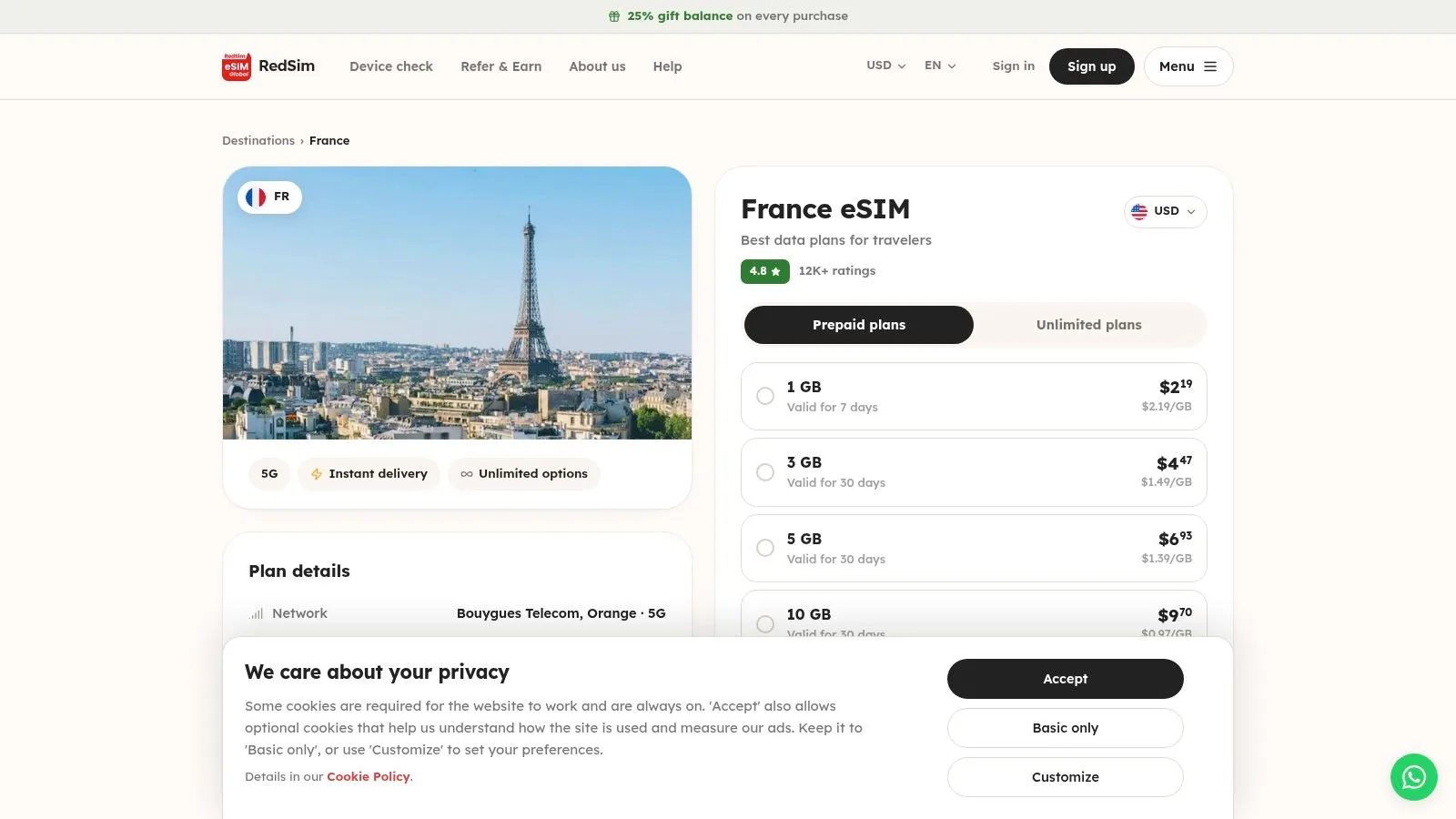
Pricing for the France eSIM runs $2.19 for 1GB over 7 days at the entry tier, rising to $6.93 for 5GB over 30 days and $9.70 for 10GB over 30 days, with an unlimited 7-day option at $19.99 for heavier itineraries. Delivery is instant by email with a QR code, so the plan can be sitting on the phone before departure. The data amount is only half the decision, though. France has four national mobile networks, and the operator behind a plan shapes what the signal feels like once the trip leaves a big city.
Why the Underlying Network Decides the Experience
ARCEP reported for 2024 that more than 99.9% of mobile sites were 4G-capable, according to the ARCEP Telconomics 2025 presentation. Broad 4G is a given across the country. What separates one plan from another is the quality of the operator it rides on, and a plan tied to a weak partner can disappoint on rural roads, in the Alps, or along long rail corridors.
Opensignal gives Orange a Coverage Experience score of 9.3/10, ahead of SFR at 9.1, Bouygues Telecom at 8.8, and Free Mobile at 8.6, in the Opensignal France Mobile Network Experience report. The spread between operators is real, so the network a plan uses matters as much as the gigabytes on the label.
Practical rule: Check which French networks a plan uses and whether hotspot sharing is allowed before paying. A low price per gigabyte counts for little on a patchy signal.
- Best for light use: Maps, messaging, restaurant searches, and train bookings across a long weekend fit the 1GB, 7-day bundle.
- Best for heavy use: Photo uploads, video calls, and tethering a laptop burn through data fast, so the 10GB or unlimited tier avoids mid-trip top-ups.
- Worth checking first: Your phone needs to support eSIM, and data roaming on the home line should stay off.
Travelers who want the wider picture before choosing can review the Europe coverage details and read Simply Tech Today's eSIM explainer for how the technology itself works. For anyone staying inside France, this country plan is the cleanest answer in a search for the best eSIM for France. It concentrates coverage where the trip happens and prices the plan to a single-destination itinerary.
2. Global eSIM
A Paris week followed by a work stop on another continent, then home through a third region: that route crosses borders a France plan cannot reach. Buying a new country eSIM at each stop means repeating checkout, installation, and settings checks at every airport. The multi-continent traveler is the profile that justifies a global product, even at a higher per-gigabyte price.
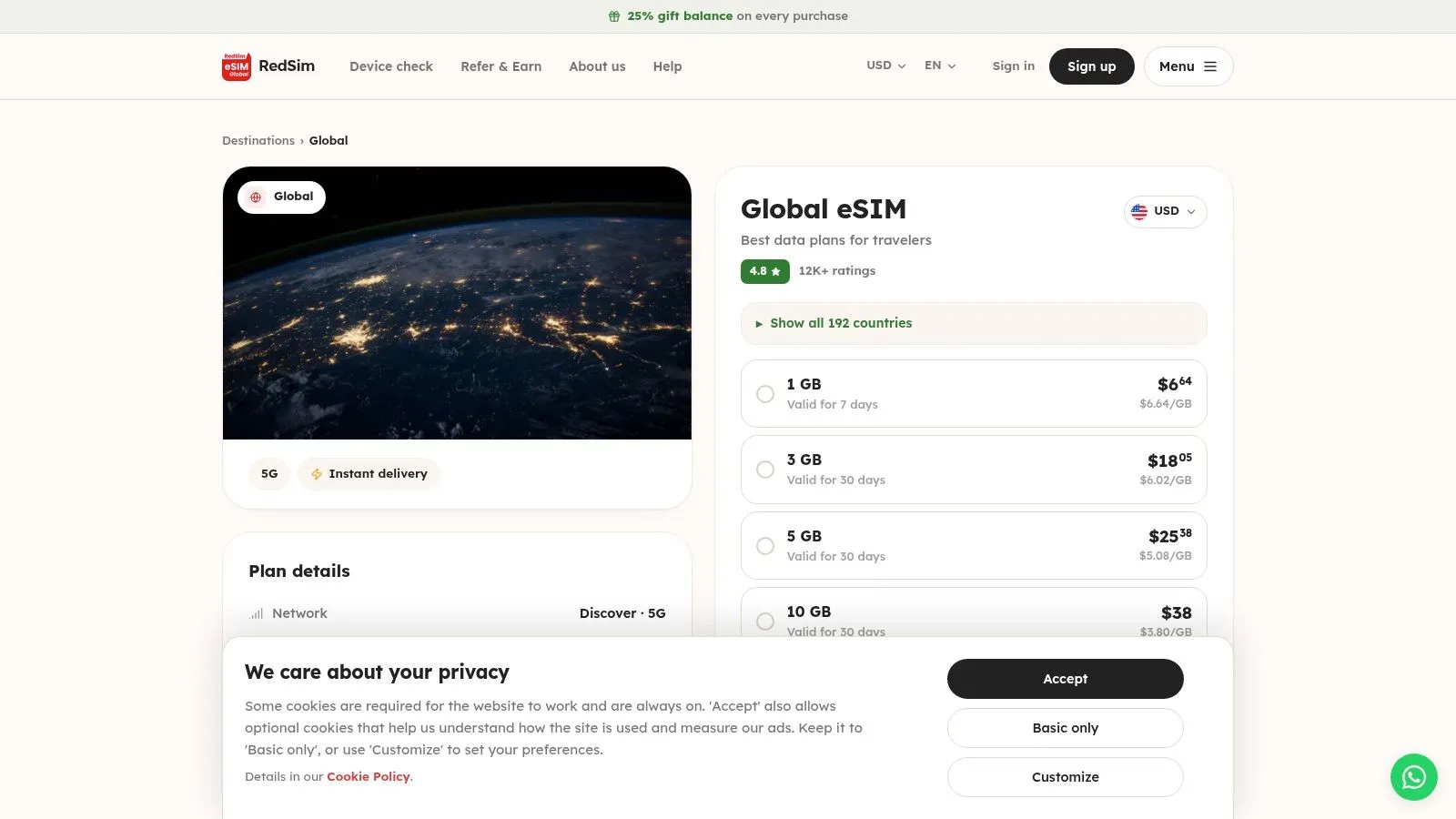
The Global eSIM is prepaid travel data with durations up to 30 days, 5G access, and instant QR delivery. One installation carries across every stop on the route, which removes the repeated setup that country plans demand. Trips running longer than a month hit the 30-day ceiling, and a top-up on the active eSIM adds data without issuing a new QR code.
RedSim also sells regional eSIMs for Europe & UK, Asia, the Middle East, North America, South America, and Africa. A traveler whose route stays inside one continent can pick the regional product and skip paying for worldwide reach.
Where 5G Access Earns Its Keep
French usage has moved fast toward 5G, and business travelers feel the difference first. ARCEP reported 24 million SIM cards activated on 5G networks in the fourth quarter of 2024, representing 29% of all mobile SIM cards in service, in the ARCEP market observatory for the third quarter of 2025. By the third quarter of 2025 that figure rose to 30.2 million active 5G SIM cards.
For a traveler joining video calls from a TGV seat or tethering a laptop in a hotel with weak Wi-Fi, 5G access decides whether the connection holds together. Light users can ignore it. Heavy users should treat 5G inclusion as a buying requirement, and the guide to how an eSIM works and what installation involves covers the basics for first-time buyers.
A global plan trades a higher starting price for zero reinstallation at each border, and that trade pays off only when the itinerary actually crosses several regions.
- Choose it for: Multi-continent routes, frequent flyers, and itineraries that cross regions back to back.
- Skip it for: A single week in Paris, where a country plan costs less for the same data.
- Confirm before buying: Hotspot use, since some travel plans restrict tethering even when phone data works normally.
The honest trade-off is price against convenience. A France-only break has no reason to pay global rates. For a traveler chaining France with stops far beyond Europe, one plan that keeps working beats three separate purchases, three QR codes, and three chances to misconfigure the data line at an airport gate.
3. Japan eSIM
A week in Paris, then two weeks split between Tokyo and Kyoto. Or a work trip routed through both capitals. Long itineraries often pair a European leg with an East Asian one, and for that traveler the France decision only covers half the connectivity plan.
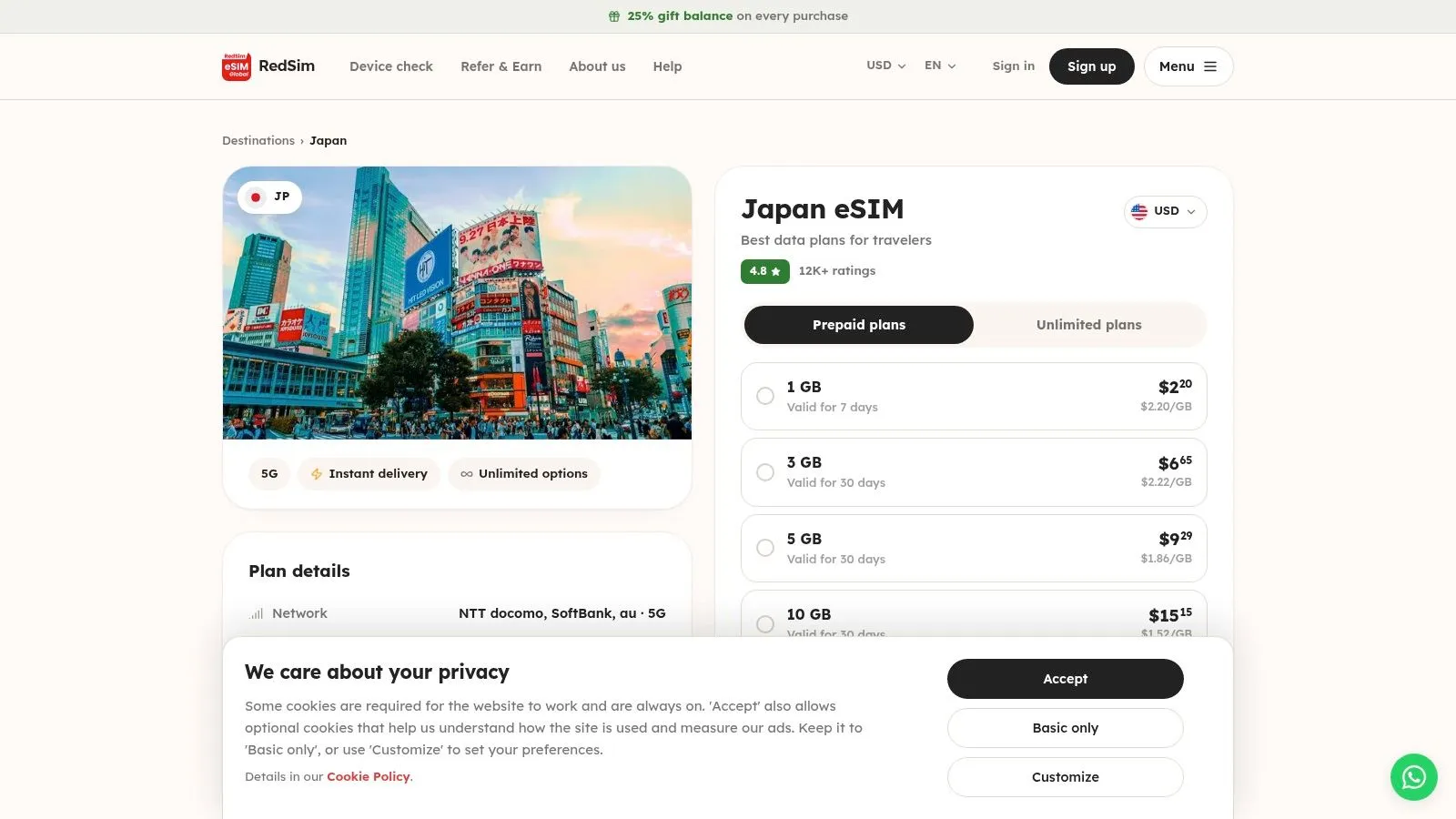
The Japan eSIM starts from $2.20, with prepaid travel data on Japanese partner networks, durations up to 30 days, 5G, and instant QR delivery. Coverage quality follows the local partner network, so the same logic that makes a country plan right for France applies on the second leg: local rates instead of roaming charges on the primary SIM.
Two Countries, One Departure Checklist
A France plus Japan route raises a device question that price comparisons usually skip. A phone can support eSIM data perfectly well while lacking the right band support or VoLTE provisioning for calls in a given country. French operators have announced 2G and 3G shutdown timetables running from the end of March 2026 through 2029, as noted in Orange Travel guidance on visiting France on a budget. That is a projected timetable, and it makes older imported handsets worth a second look before departure.
The checks cost nothing. Update the operating system, verify the exact model's LTE bands for both destinations, and keep the home SIM active for SMS-based banking codes. Travelers weighing alternatives for the Japanese leg can read the Japan eSIM versus pocket Wi-Fi comparison, since a pocket router still suits groups sharing one connection across many devices.
- Fits this plan: Solo and paired travelers who want data on their own phones without carrying extra hardware.
- Fits pocket Wi-Fi instead: Families connecting several devices at once who don't mind charging and returning a unit.
- Applies on both legs: Set the travel eSIM as the cellular data line and switch off roaming on the primary SIM.
For a two-country itinerary, I recommend buying both country plans before departure. The France plan starts at $2.19 and the Japan plan at $2.20, so the combined cost stays low while each leg runs on networks chosen for that destination. It takes slightly more setup than a single global product, but each country gets local pricing and local coverage, which is usually the better bargain for a trip like this.
4. Spain eSIM
The classic southern route pairs France with Spain. A traveler flies into Paris, drifts down through Provence or the Riviera, then continues to Barcelona, Valencia, or Madrid. This is the two-country profile: leg one is already handled, and the question is whether leg two connects the moment the train crosses the border.
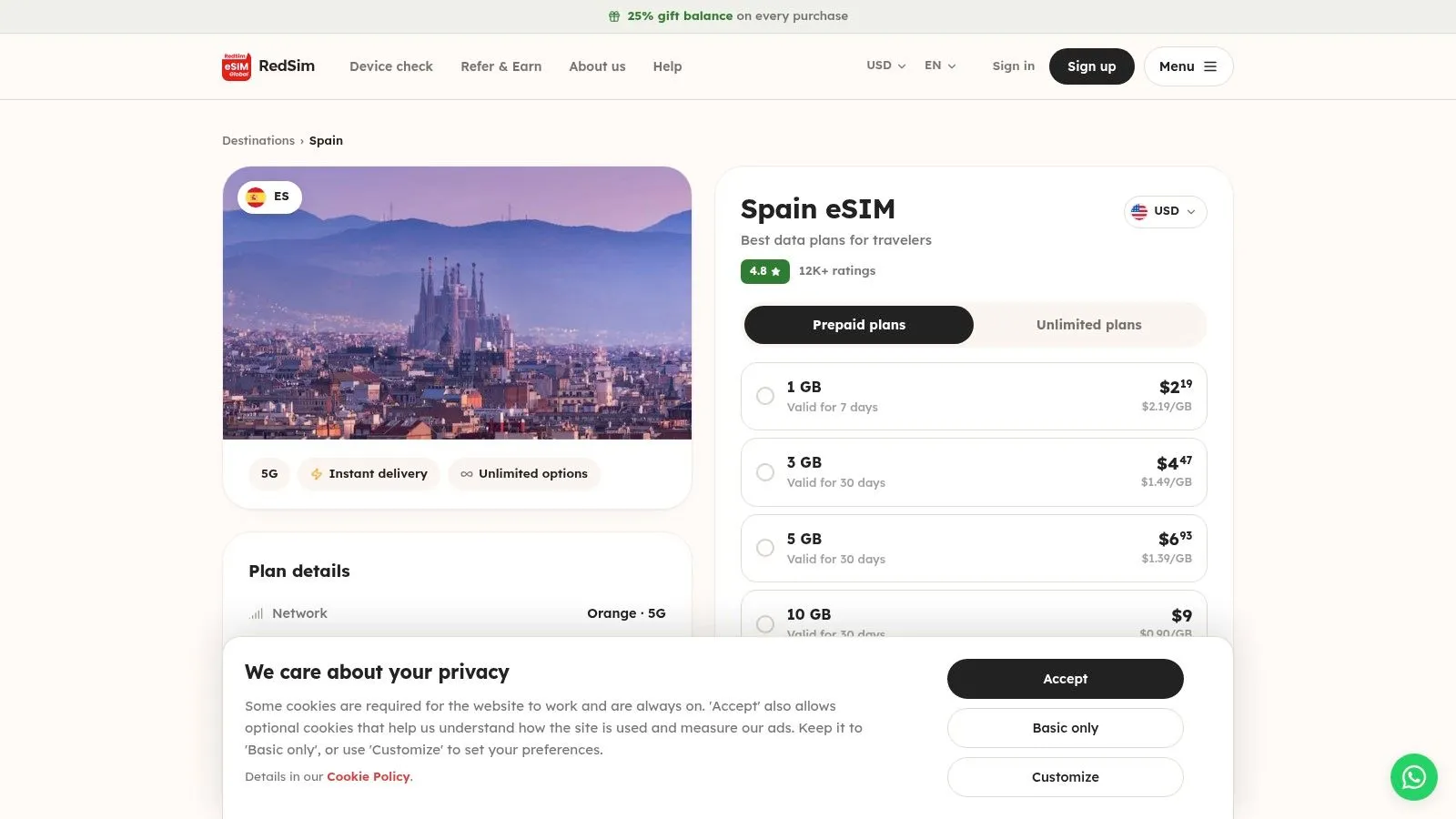
The Spain eSIM keeps that second leg cheap: 1 GB for 7 days at $2.19, 5 GB for 30 days at $6.93 (a tier esim.io prices at $7.30), and an unlimited 7-day plan at $19, all delivered instantly by QR code. For roughly the price of a coffee, the phone arrives in Spain already on a local data plan, and the larger tiers cover stays that run past a week.
When a Second Country Plan Beats a Regional One
Travelers already holding an EU-issued mobile plan are in a different position on this route. EU plans generally work in France under the EU Roam Like at Home framework, subject to fair-use conditions, as explained in the Torum guide to connectivity in France. For them, an extra eSIM may add nothing on a short trip. For visitors arriving from outside the EU, a prepaid plan replaces unpredictable roaming charges with a fixed cost known before departure.
Bundle size matters less than the access behind it. A large data allowance on one weaker partner network can serve a traveler worse than a smaller bundle with better coverage, a point made in Orange Travel advice on SIM cards for France. Route shape settles the rest. Two countries at a relaxed pace favor two country plans. Five countries in ten days favor one regional plan, and the list of European countries covered confirms whether every stop on the itinerary is included.
Border test: If the itinerary crosses into a second country for more than a day trip, price a dedicated plan for that country before assuming a regional bundle is better value.
- Road trips: Check coverage along motorway and coastal routes as well as in the destination cities.
- Train trips: Install the second plan before boarding, so the switch at the border needs no station Wi-Fi.
- Mixed groups: One phone hotspotting for everyone drains a bundle fast, so individual plans usually work out cheaper.
For the France and Spain combination, two country plans are the low-friction answer. The Spanish plan installs alongside the French one in minutes and sits idle until it is needed. If the data runs low mid-trip, a top-up adds more to the active eSIM without issuing a new QR code.
5. Greece eSIM
The final profile is the island hopper who starts in France. Paris and the Riviera come first, then a flight to Athens and ferries out to the Cyclades, where reliable data matters for ferry times, port transfers, and finding a hotel that sits off any main road. Island travel punishes a weak connection more than city travel does.
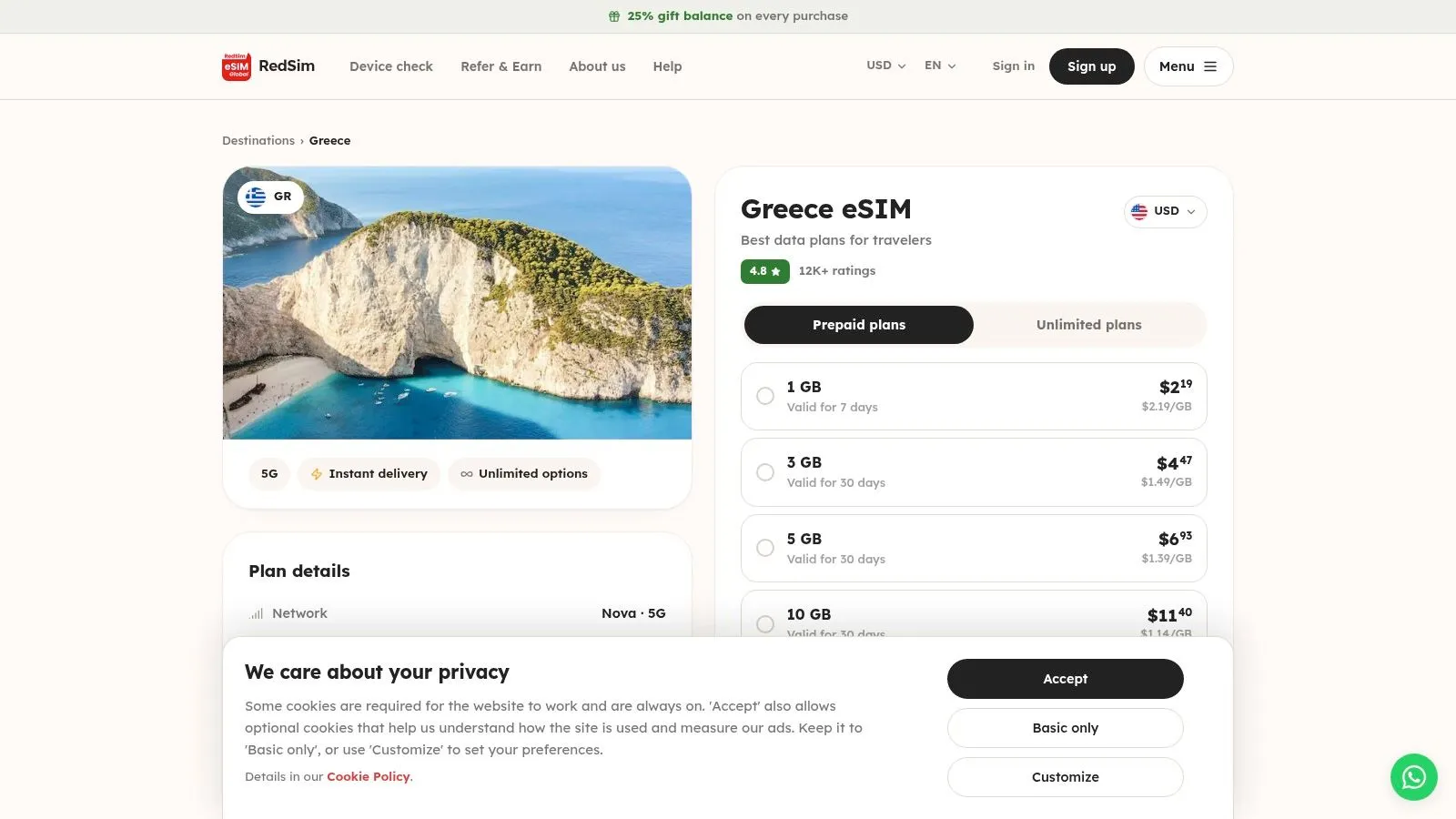
For the Greek leg, the Greece eSIM is the low-cost option. Plans open at $2.19 for the smallest data tier, run up to 30 days on 5G, and the QR code arrives by email the moment checkout clears. Coverage is the variable worth a second look here. Signal can differ between a port town and an inland village, so checking the coverage detail for your specific islands matters more than it does for a single city stay.
Sizing Data for a Two-Part Holiday
A common misread goes like this: a traveler budgets data for maps and ferry schedules, then spends the first evening uploading a day of photos to the cloud and hotspotting a laptop. Navigation and messaging stay light across a whole trip. Photo sync, hotspot work, and streaming in a room with no television worth watching can consume several gigabytes in a week, so a small bundle suits a careful light user and nobody else.
Splitting the trip into two country plans also splits the risk. If the Greek leg runs long or a ferry strike stretches the stay, a top-up lands on the active eSIM without a new QR code or reinstall. Managing both plans in one place helps too, and the RedSim app for multi-country Europe trips handles installation and real-time usage tracking when several profiles sit on one phone.
- Light profile: Maps, ferry apps, messaging, and occasional browsing fit small bundles on both legs.
- Heavy profile: Daily uploads, hotspot sessions, and streaming call for the largest 30-day options from the start.
- Family profile: Separate plans per phone beat one shared hotspot when the group splits up during the day.
For a France then Greece holiday, this plan closes the second half of the route at minimal cost. Travelers weighing the best eSIM for France often find the right answer covers the whole itinerary, not just the first landing.
eSIM Plans for France at a Glance
The right pick depends less on the plan name than on how the trip is shaped. A weekend in Paris needs a sliver of data, while a month working from Lyon demands the top tier. Match the profile first, then the plan.
| Trip profile | Plan that fits | What it costs |
|---|---|---|
| Short city break in Paris | France eSIM, 1 GB | $2.19 for 7 days |
| Two to four weeks in France | France eSIM, 10 GB or 50 GB | $9.70 or $28 for 30 days |
| Daily streaming, hotspot, remote work | France eSIM, unlimited | $19.99 for 7 days |
| France with a Spain or Greece leg | France plan plus a Spain or Greece eSIM | each country plan starts at $2.19 |
| Itinerary that includes Japan | France plan plus the Japan eSIM | Japan starts at $2.20 |
| Multi-continent route | Global eSIM | one install across borders, plans run up to 30 days |
Two details matter when sizing up. The unlimited option only runs 7 days, so a three-week heavy user is better served by the 50 GB tier at $28 than by stacking short unlimited plans back to back. Mid-size data is where the gap against rivals widens: 10 GB for 30 days costs $9.70 where some eSIM stores charge $17, and 5 GB comes in at $6.93 against esim.io's $7.30. For a loop through several neighboring countries, the regional Europe eSIM starts at $2.69 and spares you buying a separate plan at every border.
Matching the Plan to Your Trip
Count the borders on the itinerary and most of the decision is already made. One country means a country plan. Two or more countries in the same region mean a regional eSIM, which switches networks at each crossing without a second installation. Trips spanning several continents are where the Global eSIM earns its place.
A short city break in Paris, Lyon, or Nice rarely needs much data. The France plan starts at $2.19 for 1 GB over 7 days, enough for maps, messaging, and restaurant lookups, while a heavier week fits the 5 GB, 30-day tier at $6.93. Light users can start small and top up on the active eSIM later, since a top-up never requires a new QR code.
France plus one neighbor changes the math less than expected. Two 5 GB country plans, France and Spain, cost $6.93 each, and a single Europe eSIM with 10 GB for 30 days runs $14.25. The totals land within a few cents of each other, and the regional plan keeps working across the border with nothing else to buy. Longer circuits through three or four countries push the same direction: one regional plan beats a stack of single-country ones.
A heavy data user plans around the biggest tier. Daily photo backups, video calls, and hotspot sharing with a laptop point toward the France 50 GB plan at $28 for 30 days or the unlimited 7-day option at $19.99. Starting with headroom beats rationing data through the last week of a trip, and in-app usage tracking shows exactly how fast the allowance is draining.
Ready to land in France already connected? RedSim sells prepaid France, regional, and global eSIM plans, so the plan bought before departure is the one working on arrival.
 Japan
 China