
 Japan

A traveler lands at Narita, turns off airplane mode, and gets no usable data. Maps won't load, the train platform is unclear, and the home carrier's roaming price is buried in a text that hasn't arrived. That stall at the arrivals hall is avoidable with a plan installed before departure. Choosing the best eSIM for Japan comes down to three checks. First, confirm the network carrier and 5G support behind the plan. Second, work out the data tier cost per day against real trip length. Third, confirm hotspot and support options for laptops, partners, and QR failures. Travelers continuing beyond Japan can also compare eSIM plans for Europe as a point of reference, but the Japan decision starts with the itinerary in hand.
1. Japan eSIM
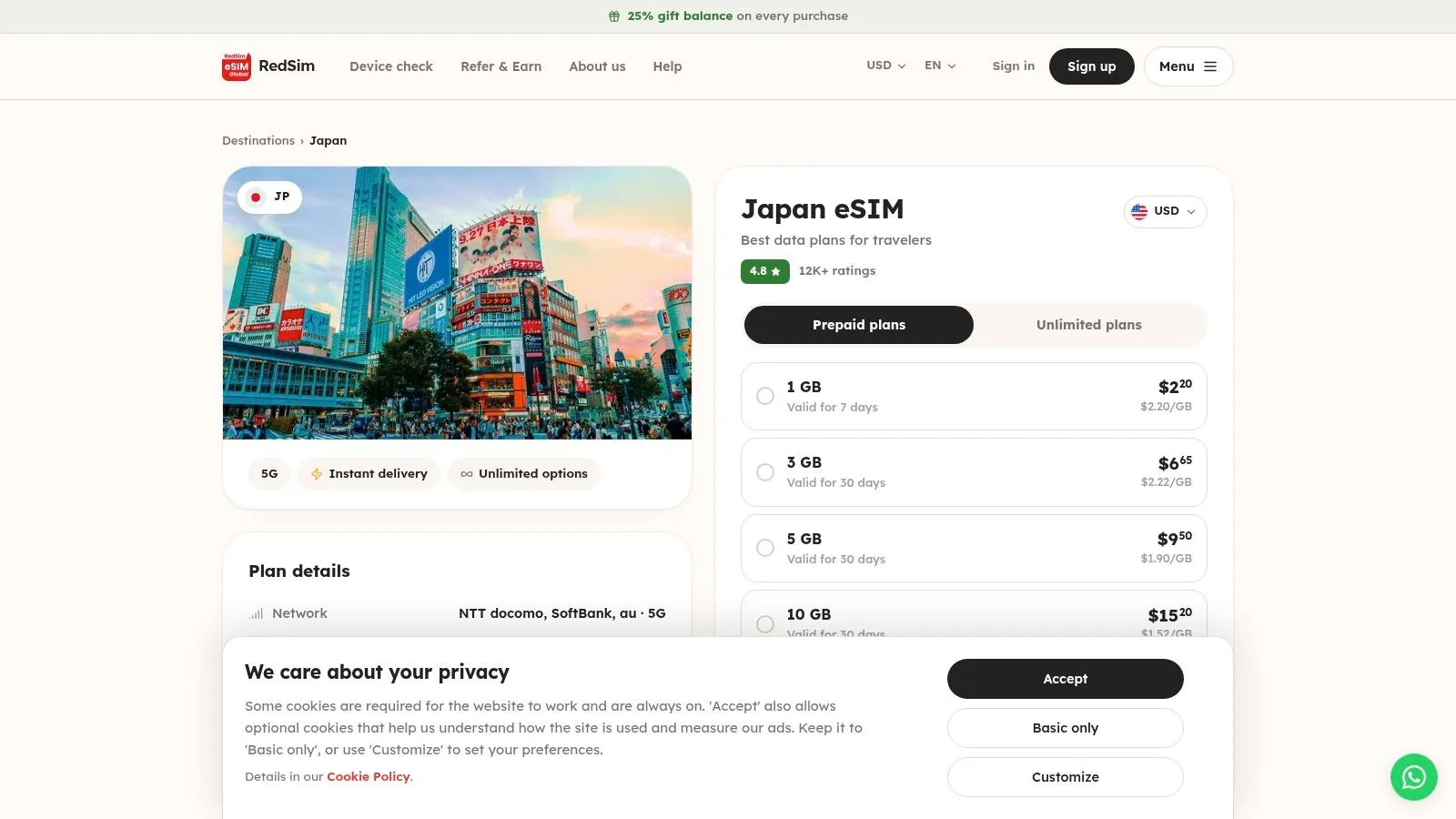
Choose a Japan-only plan for a fixed itinerary that begins and ends in Japan. It fits trips focused on Tokyo, Kyoto, Osaka, and rail travel within the country, without paying for coverage in places you will not visit. The Japan eSIM provides prepaid travel data with instant QR delivery. RedSim's Japan plan starts at $2.20, with 1 GB for 7 days at $2.20.
Pre-installation saves time at busy arrival points. The Japan National Tourism Organization release reported 3,377,800 foreign visitor arrivals in June 2025, a 7.6% increase from June 2024, and 21,518,100 cumulative arrivals for January to June 2025. After landing, you may need to check a train route, confirm a hotel address, or arrange a pickup. Getting online before departure means you can handle those tasks without waiting for airport Wi-Fi or a SIM counter.
Network Carrier Comes Before the 5G Label
Choose a plan based on the underlying Japanese network and its fallback to 4G, not a 5G badge alone. The Ministry of Internal Affairs and Communications press release reported nationwide 5G population coverage of 98.4% at the end of fiscal year 2024, with prefecture coverage ranging from 88.4% to 99.9%. That spread matters on mountain roads, in underground stations, and along island ferry routes. A national average cannot tell you what reception will be like on your specific journey.
Speed figures offer another point of comparison, not a guarantee for every location. The Ookla Speedtest Intelligence report for Japan recorded SoftBank at 62.05 Mbps median download speed across all connection types in Q3 2025, followed by au at 57.85 Mbps. Use those figures as context for city travel, station navigation, translation, and photo uploads. If your itinerary includes rural Honshu, Hokkaido, Shikoku, or Yakushima, save offline maps for each leg before leaving town.
Practical rule: For cities and main rail routes, prioritize a named major network with 4G fallback. For rural legs, download offline maps before you leave the hotel.
Plan around your route, not a countrywide label. Check overnight stops, long train journeys, and day trips outside cities. Save important addresses offline in Japanese and English, especially before heading to hiking areas, onsen, or scenic rail routes where coverage may be less predictable.
Data Tier Math Without Guessing
Start with the number of days you need service, then match the data tier to how you will use your phone. A city break built around maps, messaging, translation, and train apps calls for less data than a work trip with video calls, cloud photo backups, and laptop hotspot use. Confirm the plan's validity before buying. A plan that expires before your return can mean arranging another purchase while travelling.
Use this checklist before you pay:
- Count every connected day: Include arrival and departure days, when you still need maps, transport details, and booking information.
- Separate phone use from laptop use: Hotspot sessions for work can use data faster than navigation and messaging on a phone.
- Pause automatic cloud backups on mobile data: Let photo libraries and app updates wait for hotel Wi-Fi unless your chosen tier covers them.
- Allow for busy travel days: Train journeys can bring more map checks, ticket searches, translation, and entertainment at once.
Compare like-for-like tiers instead of relying on general savings claims. A 5 GB, 30-day plan in Japan costs $9.29 with RedSim compared to GigSky's $9.78, while a 1 GB, 7-day plan costs $2.20 compared to Ubigi's $2.50. Price is only one part of the decision: compare the plan's validity and network access with your itinerary. Review the Japan eSIM app option before departure if you want to manage installation and usage through the app.
Hotspot, Dual SIM, and the Airport QR Problem
Hotspot support determines whether your phone can share its connection with a tablet, laptop, or travel companion's phone. Confirm that tethering is allowed on your selected plan before depending on it for work. Carry a charging cable, since sharing data can drain your phone during a long wait. If your family may split up, each adult should have their own connection. A shared hotspot cannot help someone who is sightseeing elsewhere.
Keep your home SIM active for bank codes and important SMS, but set the Japan line as the default for mobile data. Turn off data roaming on your home line to avoid charges from your regular carrier. Label the lines clearly in your phone settings, such as Home and Japan, so you can confirm the correct one is selected after landing.
If the QR code will not scan at the airport, stop trying under poor light. Connect to stable Wi-Fi, enter the activation details manually if provided, restart the phone, then check that the Japan line is selected for data and roaming is enabled for that line.
Install the eSIM on home Wi-Fi before departure, then activate the data line on arrival according to the plan instructions. Save a screenshot of the QR email and the support contact. Keep a second copy of the QR code on a laptop or a travel companion's phone, since you cannot easily scan a code displayed on your own screen. Resolve installation problems before the flight, while you have time, stable Wi-Fi, and access to check whether your phone is carrier-locked. A locked phone leaves roaming or an airport counter as your fallback.
Who Should and Shouldn't Buy the Japan Plan
Buy a Japan plan for a single-country itinerary, a first trip based in major cities, a business visit with one base, or a family trip where each adult needs an independent connection. It also suits travellers with fixed dates who want to install one plan and use it throughout the trip. For that itinerary, a country-specific plan is a better fit than paying for unused regional or global coverage.
Skip it if your route continues to South Korea, Taiwan, Thailand, or another country and you want one plan across borders. Separate country plans remain an option, but each brings another installation, validity period, and line to manage. If your phone is carrier-locked, do not buy an eSIM until the lock is removed. An eSIM cannot bypass that restriction, even if you are already at the airport.
2. Global eSIM
A route from Tokyo to Seoul and Taipei calls for a different plan from a Japan-only holiday. A Global eSIM gives you prepaid travel data across borders, with 5G, instant QR delivery, and prices from $6.15. For a trip with several country stops, keeping one data plan can mean fewer purchases and fewer changes to manage between flights.
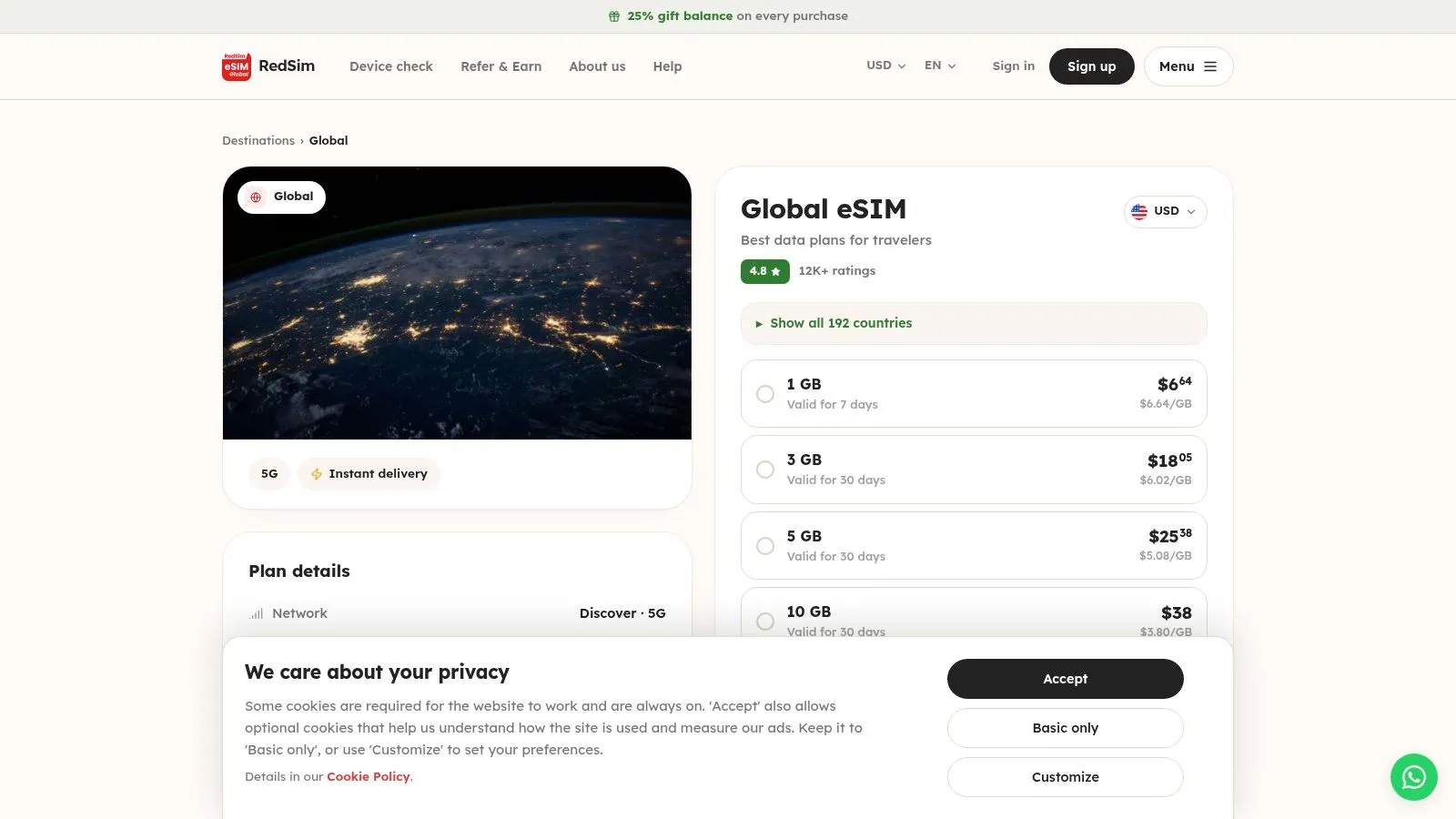
The price is easier to justify when your itinerary crosses borders, includes a longer stay, or has several stops. A fixed week in Tokyo and Kyoto calls for a Japan plan; a consultant with client visits in multiple countries, a student visiting friends abroad, or a family with a stopover may prefer one plan for the route. You avoid arranging a new country plan at every border, though the global option costs more at the starting tier than a Japan-only plan.
Coverage Consistency Across Borders and Within Japan
A global plan is useful only if it gives you a working connection where you travel. In Japan, everyday use depends heavily on 4G availability and automatic network fallback. A Telecoms Tech News report on Japan 5G coverage reported 5G Availability of 38.4% for NTT docomo and 26.5% for SoftBank in Q3 2025, while 4G availability exceeded 97% across leading operators. Expect maps, payments, messaging, and translation to rely on 4G in many places. That is fine when the phone switches networks automatically, without requiring you to hunt through settings.
Daily life in Japan also depends on having a connected phone. The Ministry of Internal Affairs and Communications household survey release reported smartphone ownership at 90.5% of Japanese households in 2024. Train gates, store payments, restaurant bookings, and transit updates all make mobile access useful. If Japan is one brief stop on a longer trip, arrange your data before departure so you are connected when you arrive, rather than sorting out a separate plan at the hotel.
Rural travel needs preparation with either a global or a country plan. A Nomad eSIM guide to rural Japan travel states that KDDI's reported network reaches more than 99.9% of Japan's population but only about 60% of its geographic area. That distinction matters if you are driving across Hokkaido, hiking in the Alps, or visiting islands. Download maps, save hotel addresses, and keep ticket confirmations available offline, regardless of which eSIM you choose.
Validity Windows and Cost Per Day on Longer Routes
For a longer, multi-country trip, compare the plan's validity with your actual dates and route. Slow travel, a business assignment across borders, or a return date that may change can make a single plan easier to manage. If the plan allows top-ups, you can add data without setting up a new eSIM. Travel coordinators may also find one plan type simpler to handle across a team than separate country plans with different expiry dates.
Compare the total cost across the trip, not just the starting price. Two or three country plans may look inexpensive one at a time but cost more together, especially if a stay runs long and you need another purchase. Check current eSIM prices against your full route and calendar, including stopovers when you still need maps, messages, and transport updates.
- Choose global for a multi-country itinerary: One plan can cover the border crossings, when you may have little time to arrange new connectivity.
- Choose global when dates may change: A plan that fits the longer trip can reduce the need to set up another eSIM if flights shift or you add a stop.
- Choose a country plan for one fixed destination: It avoids paying for broader coverage you will not use and leaves more of your budget for data in Japan.
- Check hotspot needs across the route: Work on a laptop can use more data than phone-only browsing, so size the plan for the most demanding part of your trip.
Compatibility Is Model and Region Specific
Check your exact phone before buying. A device sold by a carrier may be SIM-locked, and regional versions of the same model can differ in eSIM or dual SIM support. A Simology guide to internet access for tourists in Japan cites more than 400 eSIM-capable consumer devices in the GSMA tracker in 2026. The model name alone does not confirm that your particular device and regional variant will work.
Before purchase, look in settings for an Add eSIM option and confirm the phone has no carrier restriction. If you need to keep your home line active for calls or bank codes, check that dual SIM operation is supported. Contact your home carrier if the restriction status is unclear. For installation and line-selection steps, follow the guidance in section 1.
Problems can still arise after arrival. See section 1 for the QR-code troubleshooting steps, and save the support contact and order details offline before your first flight. RedSim provides 24/7 WhatsApp and email support, and unused, unactivated eSIMs are refundable in full. If your route changes before departure, that refund gives you a way to change plans. Do not rely on it as a substitute for checking your dates before purchase.
Who Should and Shouldn't Buy the Global Plan
Choose a global plan for a multi-country itinerary, an extended trip with changing dates, work across borders, or group travel where a shared setup is easier to manage. It also suits a route where Japan is one stop among several and you want data to continue after the next flight. The added convenience is worth the higher starting price when you will use coverage in more than one country.
For a fixed Japan-only holiday, choose a country plan that fits your dates and data needs. If a second country is only a possibility, buying a country plan now and deciding later keeps your options open. Before buying any eSIM, confirm that your phone is eSIM-capable and carrier-free.
How the Two RedSim Japan Options Compare on Price, Duration, Network, and Best Use
| Item | Starting Price | Plan Duration | Network Coverage | Best For |
|---|---|---|---|---|
| Japan eSIM | From $2.20 | Not specified | Japan | Travel in Japan |
| Global eSIM | From $6.15 | Not specified | Global coverage | Travel across multiple countries |
Choose by route: the Japan eSIM suits a Japan-only trip, while the Global eSIM is for travel across countries. Compare the listed prices as starting points, then confirm the plan details before buying.
Match Your Trip Type, Then Buy Once
The decision is short. A single-country Japan trip with a fixed itinerary points to the Japan eSIM, with au and SoftBank access, a validity window matched to the stay, and no payment for unused countries. A multi-country route or a longer, shifting trip points to the Global eSIM, with one install across borders and validity that absorbs date changes. Neither option rewards buying at the airport, and neither fixes a locked phone.
Price shouldn't override fit. A cheap tier that expires early, blocks the hotspot a work trip depends on, or runs dry on a long rail day costs more in disruption than it saves at checkout. Size the tier for travel days, hotspot use, and photo backup habits, then stop second guessing. Travelers who split into separate sightseeing groups need independent data per adult, while travelers who stay together can share more carefully.
Run this pre-purchase checklist before paying:
- Confirm eSIM support in settings: Find the Add eSIM option on the exact phone that will travel, not a similar model.
- Confirm the phone is carrier compatible: A restricted phone rejects travel eSIMs, and only the home carrier can remove that restriction.
- Install the QR code before departure: Use stable home Wi-Fi, label the lines, and screenshot the activation details for offline access.
- Check plan duration against trip dates: Count arrival and departure days, plus stopovers where data is still needed.
- Save support before takeoff: Keep the 24/7 WhatsApp support contact and order details stored offline for on-trip issues.
Buy once, install at home, and land connected. That's the whole strategy, and it works for a first trip to Tokyo as well as a multi-country route that starts there.
For a Japan-only trip or a longer route across multiple countries, RedSim offers prepaid eSIM data plans with instant QR delivery, hotspot support, and 24/7 WhatsApp help when setup stalls at the airport. Pick the plan that matches the itinerary, install it before departure, and land in Japan with maps, bookings, and messages already working.


 Portugal