

UK consumers incurred an estimated £539 million in unexpected roaming charges during the preceding year, according to research cited in BBC reporting on Ofcom's roaming proposals. That estimate covered roaming abroad, not just EU trips, but it highlights the problem with UK roaming after Brexit: a working phone connection doesn't necessarily mean an affordable one.
A traveller doesn't have to stream films to trigger a charge. A phone can use mobile data while checking email or syncing photographs, even when its owner hasn't deliberately opened an app. Choosing between a daily rate, a roaming pass and a separate data connection starts with understanding what the contract includes.
Why EU Roaming Stopped Being Free
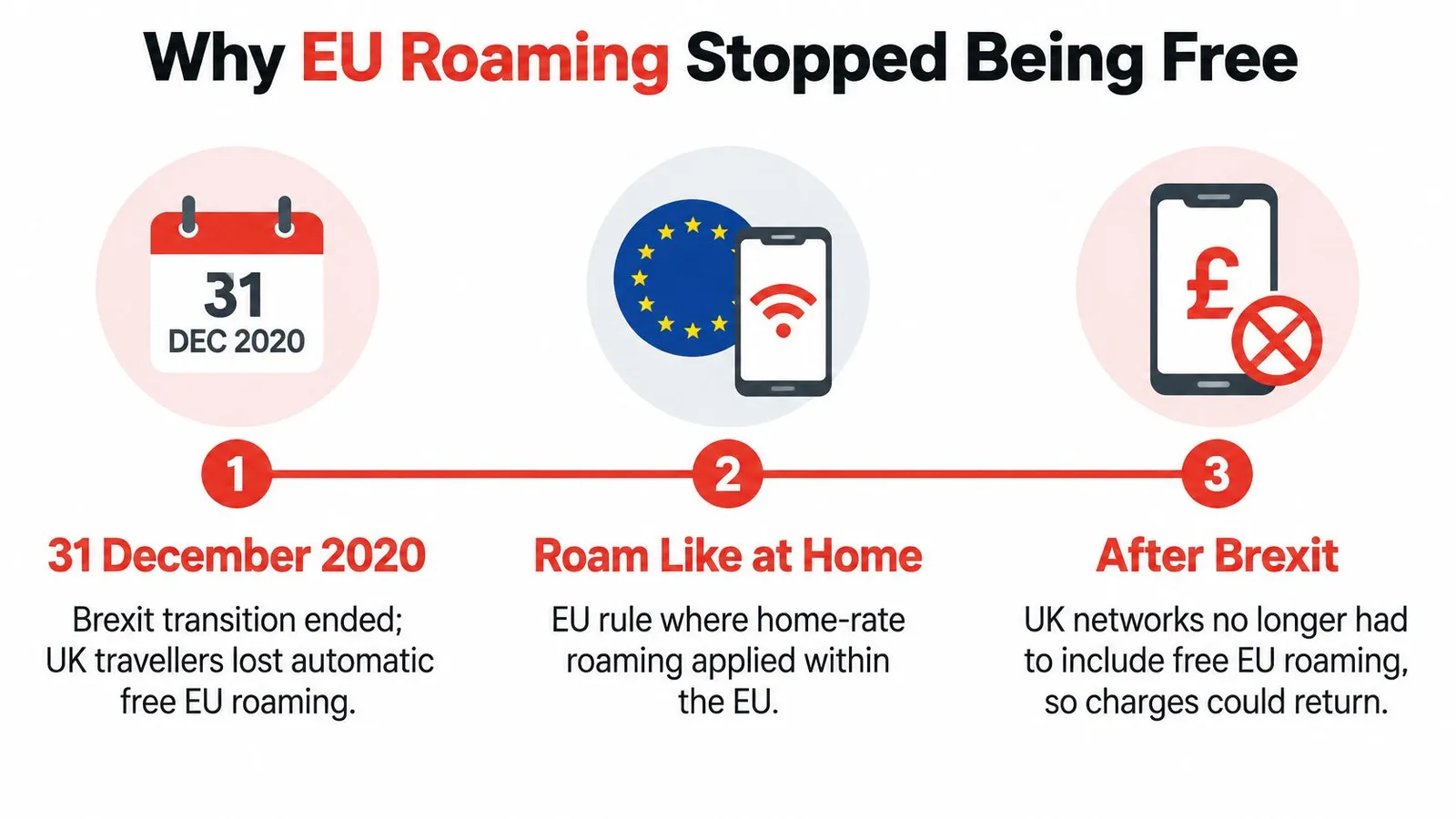
UK travellers lost the automatic legal guarantee of surcharge-free EU roaming when the Brexit transition ended. That didn't mean every network immediately charged every customer. It meant networks could decide whether to keep roaming included or sell it separately.
Under Roam Like at Home, eligible travellers could use their domestic calls, texts and data in EU countries without a separate retail roaming surcharge, subject to fair-use limits. “Free roaming” was convenient shorthand, but customers still paid for their home mobile plan. The benefit was avoiding an additional roaming fee.
What changed for an ordinary holiday
Consider a traveller arriving at a hotel. Before connecting to Wi-Fi, the phone checks email, refreshes a weather app and uploads photographs in the background.
Those activities still use data. Under an inclusive roaming contract, they may come out of the domestic allowance. Under a contract with a daily roaming charge, that same background activity may trigger a fee, depending on the tariff.
The important distinction is permission versus pricing. Brexit allowed operators to change their charges; each operator then decided how to structure its plans. Some customers retained inclusive roaming, while others needed a pass or paid a daily rate.
Europe isn't a single mobile tariff zone
A destination's location on a map doesn't establish its roaming price. The contract's destination list does, and an operator's European roaming zone isn't necessarily identical to the EU.
The same care applies to a separate travel connection. Travellers considering regional data can check European eSIM coverage against every stop on the itinerary, rather than assuming a regional label includes everywhere.
Practical rule: A phone showing a local network name confirms a connection, not the price of using it.
The useful question isn't just whether EU roaming is free. It's whether the traveller's exact contract includes the exact destination, and what happens when the included allowance runs out.
UK Network EU Roaming Charges Compared
The figures below are from Ofcom's September to October 2024 pricing comparison. They show how the listed tariffs differed at that time, rather than providing current quotes. Check your own tariff before buying a pass.
EU roaming charges by UK network (Ofcom, September to October 2024)
| Network | Daily rate | Pass prices | Monthly fair-use limit |
|---|---|---|---|
| EE | £2.47 per day | £25 per month pass | 50GB |
| Vodafone | £2.42 per day | £12 for 8 days; £17 for 15 days | 25GB |
| Three | £2 per day | £5 for 3 days; £12 per week; £24 for 14 days | 12GB |
| O2 | No EU surcharge | No separate pass needed within the included allowance | 25GB |
What each column means
The daily rate is an extra charge for using eligible services on a chargeable roaming day. A pass price covers the period stated. Neither automatically means unlimited data.
The monthly fair-use limit is a separate cap on roaming data. Your allowance abroad may be smaller than your domestic data allowance, and buying a pass does not automatically raise that cap.
O2's “no EU surcharge” entry means no additional roaming charge within the stated allowance. It does not mean an unrestricted overseas data plan.
Pass prices and daily rates answer different questions: the daily rate depends on the number of chargeable days, while a pass covers a set period. The worked examples compare those costs for specific trip lengths.
For a non-EU destination such as Turkey, check the operator's Turkey tariff and destination list before applying any European roaming price. A Europe eSIM comparison can help compare separate data plans, provided the listed coverage includes every stop on your trip.
Worked Examples for Common Trip Lengths
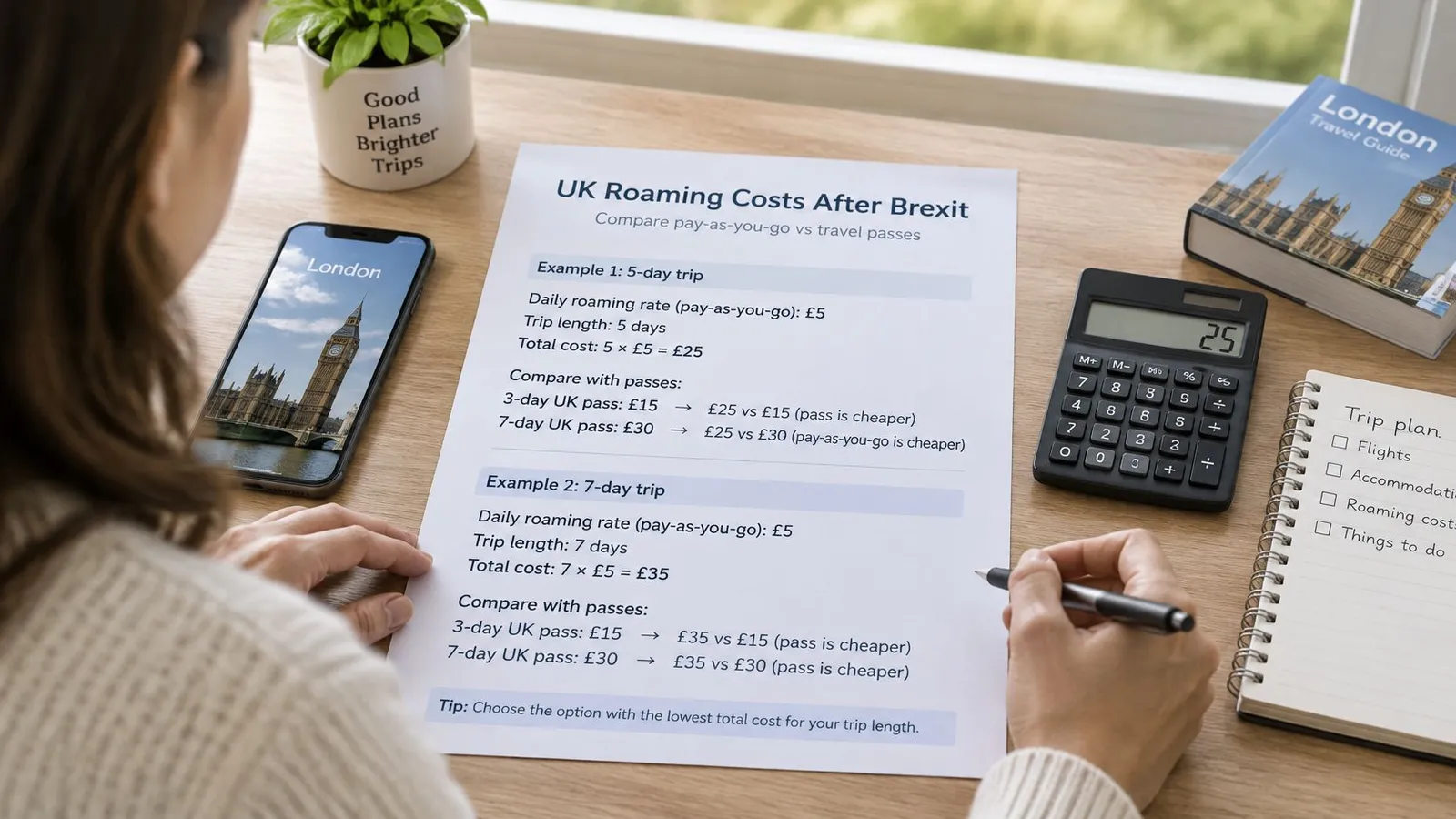
The following calculations are illustrations using the historical rates listed above, not fresh price quotations. They assume roaming is used on every day shown, the destination qualifies and usage remains within the applicable allowance.
The arithmetic behind each result
- EE, seven days: 7 × £2.47 = £17.29. Daily charging costs £7.71 less than the £25 monthly pass.
- Vodafone, eight days: 8 × £2.42 = £19.36. The £12 pass saves £7.36.
- EE, eleven days: 11 × £2.47 = £27.17. The £25 monthly pass saves £2.17.
- Three, fourteen days: 14 × £2 = £28. The £24 pass saves £4.
- Three, seven days: 7 × £2 = £14. The £12 weekly pass saves £2.
- Vodafone, fifteen days: 15 × £2.42 = £36.30. The £17 pass saves £19.30.
Trip cost at the daily rate versus the cheapest pass
| Trip and network | Cheapest pass |
|---|---|
| 7 days, EE | £25 monthly pass; daily total of £17.29 wins |
| 8 days, Vodafone | £12 for 8 days, beating £19.36 daily |
| 11 days, EE | £25 monthly pass, beating £27.17 daily |
| 14 days, Three | £24 for 14 days, beating £28 daily |
| 7 days, Three | £12 weekly pass, beating £14 daily |
| 15 days, Vodafone | £17 for 15 days, beating £36.30 daily |
Count chargeable days, not hotel nights
An arrival day and a departure day can both involve mobile use. A traveller who checks a train timetable after landing and books a taxi before flying home should include both days when estimating costs.
The operator's definition of a charging day also matters. Travellers should establish whether a charge follows a calendar day or another charging period before applying the multiplication.
The lowest pass price isn't necessarily the lowest trip cost. The pass must cover the days when the phone will actually be used.
These examples compare the listed single passes with daily charging. They don't establish whether combining smaller passes is permitted or cheaper under a particular contract.
For a separate data allowance, guidance on choosing the right plan can help match validity and data volume to the itinerary. The result still needs to cover the whole trip, including travel days.
Protections That Limit Your Bill and Where They Fail
A spending safeguard can interrupt an expensive connection, but it doesn't make that connection good value. Stopping further use and controlling the price of use are different protections.
UK government guidance states that operators must prevent continued mobile-data roaming once charges reach £45 per monthly billing period, unless the customer actively chooses to continue spending; this replaced the EU-law reference level of €50.
What the safeguard doesn't settle
The threshold shouldn't be treated as a guaranteed maximum for the entire mobile bill. Different services and separately purchased packages can sit outside the protection described.
- Calls and texts: A mobile-data safeguard may not cover voice calls or SMS charges.
- Special services: Premium or other special-service charges may fall outside its scope.
- Purchased passes: A separately bought roaming pass may not count towards the same control.
- Charge tracking: The safeguard depends on network accounting and notifications functioning correctly.
- Fair-use allowances: A spending control doesn't enlarge the amount of data included in the tariff.
A traveller can therefore purchase a pass, exceed its allowance and still incur additional costs before a relevant spending control intervenes. The correct response is to understand the package, not to assume a stop mechanism makes every type of use safe.
Keeping work traffic separate
For business travel, a simple trip record helps: carrier, destination, selected roaming package, spending control and tethering permission. A laptop connection deserves particular attention because software downloads and cloud synchronisation can use the phone's data without much visible interaction.
A separate data connection can keep that traffic away from the home SIM's roaming account. However, the phone must route mobile data through the chosen connection.
Safety-net check: Keeping a home SIM active for calls doesn't mean it also needs to provide mobile data.
The traveller should also decide what to do if access stops. Approving continued spending without reviewing the tariff can remove the very protection that interrupted the connection. Downloaded tickets, booking details and offline maps provide a useful fallback while the traveller checks the account.
Cheaper Options and How to Choose
Trip length can change which option costs least. Compare the total for the days you need, then check that the allowance covers the trip and every destination.
Ways to get data abroad compared
| Option | Best for | Cost pattern | Main trade-off |
|---|---|---|---|
| Network EU pass (EE, Vodafone, Three) | Short trips with light data | Daily charge or fixed-duration pass | Prices change and fair-use limits apply |
| O2 EU roaming within fair use | Existing customers whose usage fits the allowance | No additional surcharge within the included allowance | Excess usage needs separate checking |
| Local SIM at destination | Long stays | Local prepaid package and any SIM purchase charge | Needs a phone that accepts a different SIM |
| Regional or country eSIM | Trips suited to a prepaid data allowance | Fixed data tiers bought before travel | Requires a compatible phone and suitable coverage |
| Wi-Fi with offline maps and data off | Trips with convenient Wi-Fi access | No mobile-network data charge while data stays off | Limited access while moving |
Match the connection to the itinerary
For a short break, the home network may be simplest if roaming is already included. If it costs extra, compare the total daily charges with the price of the shortest pass that covers the trip. For example, a five-day stay calls for five daily charges, not just a comparison of one day's rate with a pass price.
For a longer stay, compare a local SIM's data allowance and validity with the cost of roaming. Include any SIM purchase charge, and consider whether you need to keep receiving calls or messages on your home number.
Across several countries, a regional eSIM can avoid buying a separate data plan at each border, provided its coverage includes every stop. The Europe eSIM costs $2.69 for 1 GB for 7 days, $10.94 for 5 GB for 30 days, $14.25 for 10 GB for 30 days, or $20.34 for unlimited data for 7 days. These are US-dollar prices for prepaid data. Compare options using the eSIM prices by destination and match the plan duration to your trip.
Installation and practical trade-offs
Check that your phone supports eSIMs before choosing one, and confirm when the plan's validity begins. Installation and the start of the plan's validity may be separate events.
Wi-Fi can reduce mobile-data use. The guide to understanding seamless WiFi roaming explains how devices can connect across participating Wi-Fi networks. A phone may use Wi-Fi while available and mobile data when away from a hotspot, so check which connection is active.
Keeping mobile data off and using Wi-Fi with downloaded maps and documents can avoid mobile-network data charges. The trade-off is that live directions, messages and booking changes may not work between hotspots, and Wi-Fi itself may have a cost.
Steps to Set Up Roaming Before You Fly
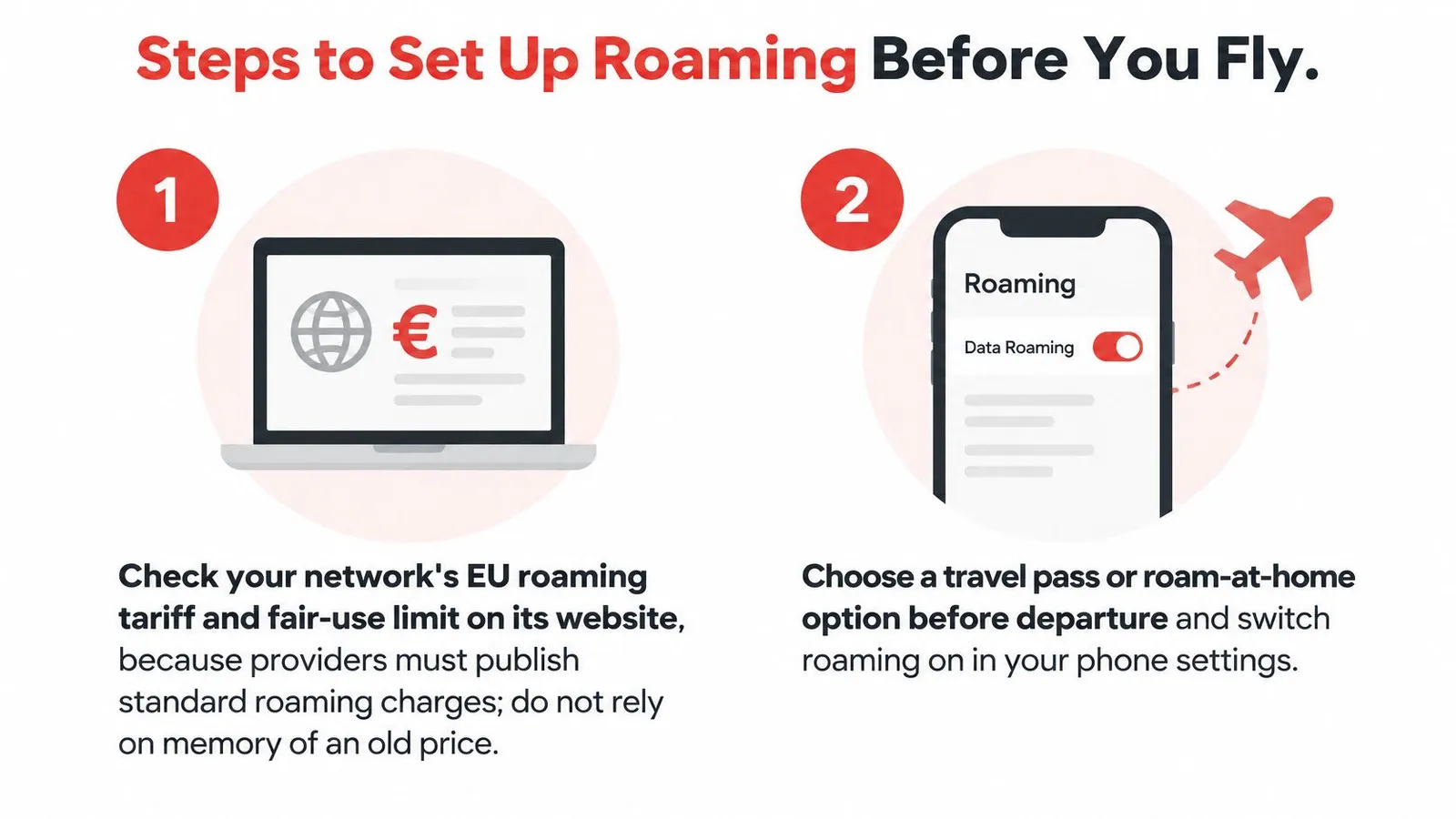
Preparation should happen while a reliable connection is still available. Ofcom's guide to using a mobile abroad explains that providers must publish standard roaming charges and send an automatic notification on entry to another country, including applicable charges, fair-use limits and the duration of temporary offers.
Before departure
Check the exact contract and destination. Open the provider's roaming page while signed into the account, then save the relevant tariff and allowance details. Relying on an old holiday's price can lead to choosing the wrong package.
Select the charging option deliberately. Compare the expected chargeable days with eligible passes, and confirm when a purchased pass starts. Buying a pass without checking activation can leave part of the journey uncovered.
Review account spending controls. Set an appropriate threshold where the provider offers that facility, and establish which services it covers. A default setting shouldn't be assumed to match the traveller's budget.
Separate the home SIM from travel data. When another connection will supply data, disable data roaming on the home SIM and select the intended mobile-data line. Automatic mobile-data switching should also be disabled where available, so the phone doesn't fall back to the wrong SIM.
On arrival
Enable the installed travel line correctly. RedSim requires data roaming on the eSIM line to reach the local network; that setting isn't an extra charge and doesn't affect the home SIM. The eSIM setup guide helps distinguish the travel line's settings from those of the primary SIM.
Read the arrival notification. Compare the stated destination, charges and allowance with the saved tariff before using the home network's roaming service. A signal indicator isn't a substitute for checking the message.
Control background transfers. Pause cloud backups, automatic app updates and large downloads, then use Wi-Fi for those tasks. Keep mobile data off when it isn't needed rather than assuming an idle screen means no activity.
Finally, confirm that the phone shows the intended mobile-data line, that a small connection test works through it and that the arrival information matches the chosen tariff. Keep the purchase confirmation and tariff details available offline in case a setting needs checking later.
RedSim offers prepaid country and regional travel eSIM data, allowing travellers to choose a separate data allowance instead of relying on their home network's roaming tariff. Visit RedSim to check destination coverage and device compatibility, then compare a suitable allowance with the total cost of the home network's roaming option.

 Portugal

 Philippines

 China