 Vietnam
You step off the plane in Vietnam and need data before baggage claim, before the first Grab, before the hotel chat opens. That's where the best eSIM for Vietnam stops being a generic purchase and starts being a trip decision. The right choice depends on how long the stay is, how much data gets burned on maps and messaging, whether one phone has to share with others, and whether the priority is fixed cost or unlimited peace of mind.
Vietnam is a strong eSIM market because the country's connectivity needs are real. More than 17.5 million international visitors arrived in 2024, and most of them came by air, which makes instant activation after landing a practical advantage rather than a nice extra (Vietnam National Authority of Tourism). The seven plans below are set up around how travelers move, use data, and top up. Some are better for a short city break, some fit a longer route, and some make more sense when several people are sharing one connection.
1. RedSim
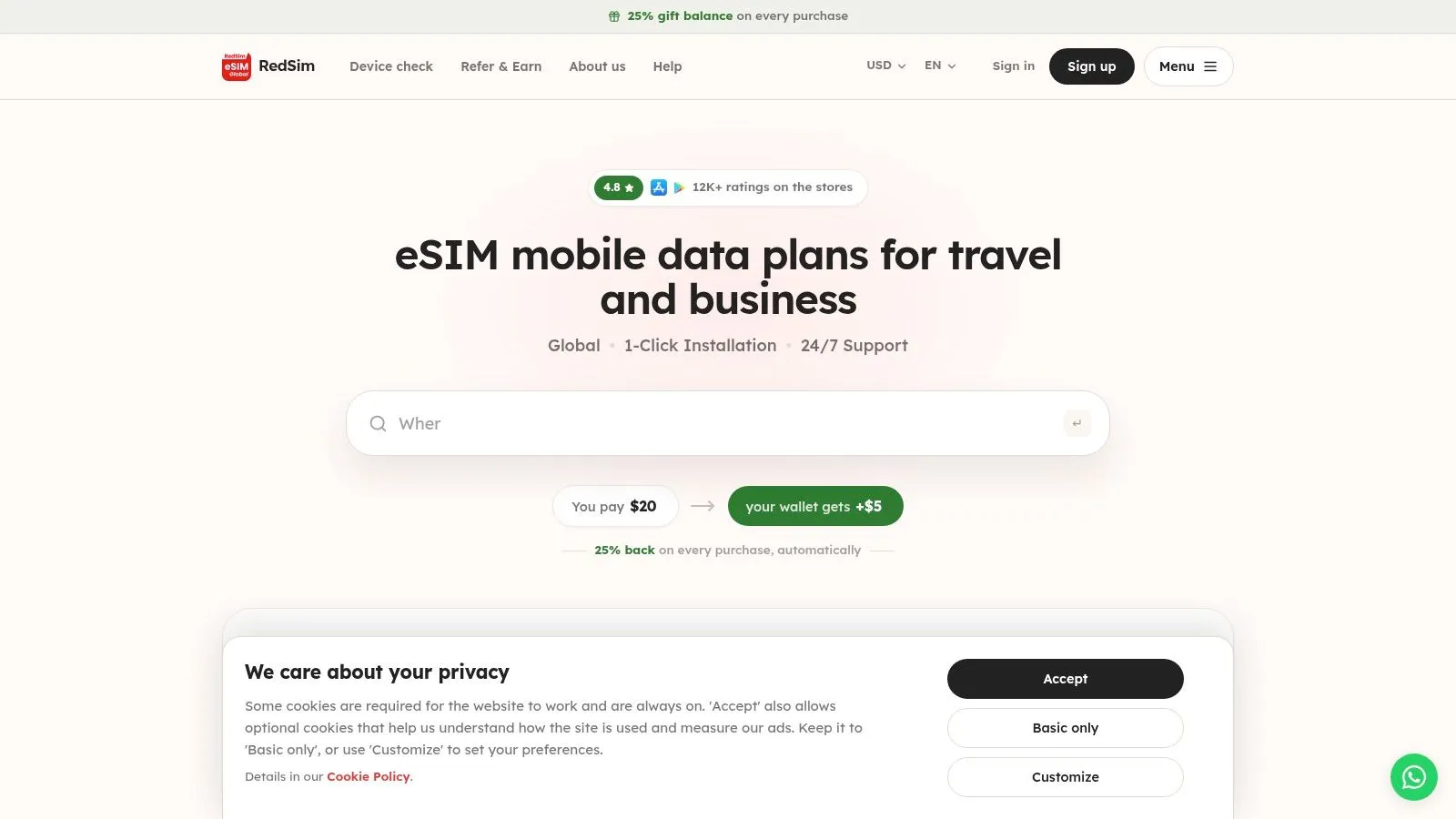
RedSim fits the traveler who wants the trip to start with working data and very little friction. The setup is fast, the plans are simple, and the app makes it easy to keep the same eSIM alive if data runs low mid-trip. That matters in Vietnam, where connectivity isn't just for scrolling. It's for maps, translation, ride-hailing, bookings, and business messages.
Practical rule: if the plan has to support a moving schedule, a family group, or a work trip, the best eSIM is the one that keeps the same profile active and lets the user top up without starting over.
The useful part is how RedSim handles the messy bits. The service sends an instant QR code by email, supports one-click installation in its iOS and Android app, and offers in-app top-ups on an active eSIM without needing a new QR code. It also includes hotspot support, which makes it more flexible for a laptop, tablet, or a second phone. For travelers who hate guessing how much data is left, real-time usage tracking is a real advantage.
RedSim also stands out on support and refund terms. It offers 24/7 human help on WhatsApp, and it refunds uninstalled or unactivated eSIMs in full. The account wallet adds 25% credit on each purchase, which helps if a trip runs long or another destination gets added later. That's a practical fit for people who want predictable costs and fewer surprises.
Good fit for: families sharing data, business travelers, and anyone who prefers top-ups over buying a whole new plan.
RedSim's main limitation is simple. It's a data-only eSIM, so calls and SMS still belong on the home line or an app like WhatsApp. For Vietnam, that's usually fine, but it's still worth saying out loud. The service is built for mobile data first, not for replacing a local number.
RedSim's Vietnam eSIM guide is the place to check current plan options, and the general explainer on what an eSIM is is useful if the device setup needs a quick refresher. The site itself is clear about coverage across 200+ destinations, which helps if Vietnam is only one stop on a longer route.
2. Airalo
Airalo fits travelers who want a familiar marketplace and a clear local network choice. Its Vietnam page shows VNPT-based unlimited-data options, so the decision is simple: pick a plan, install it, and get online without sorting through a lot of variants. That works well on short trips, where the main goal is to land and keep moving.
The setup is straightforward too. Airalo supports in-app purchase, installation, and top-ups, and it lists 24/7 support. For someone who wants a quick buy and a low-friction setup, that matters more than a long feature list. The range of durations also helps if the trip lasts only a few days or stretches closer to a month.
The main trade-off is speed control. Unlimited plans can still be subject to fair-use or network-management rules, so “unlimited” does not mean unlimited speed at all times. That is normal for this kind of plan, but it still affects heavy users who expect home-broadband behavior. Light and moderate use usually fits better.
Use Airalo when: you want a simple unlimited option on a named Vietnamese network, with app-based setup and support.
Airalo's Vietnam page also makes one practical limit clear. It is data-only. That suits travelers who keep their home SIM active for calls and codes, but it will not cover someone who needs a Vietnamese phone number for bookings or local contact. The service works best for people who want predictable activation and do not want to spend time comparing a lot of plan combinations.
For comparison shopping, the reading is simple. Airalo is a safe default for a short stay where unlimited data feels easier than counting gigabytes, and its strength is convenience rather than network experimentation. See the current Vietnam product details on Airalo's Vietnam eSIM page, and compare it with RedSim's Vietnam eSIM plans.
3. Nomad
Nomad is the right fit when network flexibility matters more than brand familiarity. Its Vietnam plans can connect through Vietnamobile, MobiFone, or Vinaphone, and that matters for travelers heading outside the easiest urban corridors. If a route includes a mix of cities, road time, and more remote stops, being able to work with multiple host networks is a real advantage.
Nomad also gives the buyer range. Fixed-data plans go from small buckets to larger ones, and short unlimited options are available too. That makes it easier to choose for a weekend break, a normal one-week trip, or a more data-heavy stay. Hotspot and tethering are supported, so one plan can cover a phone plus a laptop in a pinch.
The downside is mostly about how the service presents itself. In some locales, the site may default to GBP, which can make quick comparison harder than it should be. Some unlimited plans also throttle after a daily high-speed allowance, so heavy users need to check the policy before buying. Those aren't deal-breakers, but they do change the actual value of the plan.
Here's the practical read. Nomad is less about the cheapest sticker price and more about hedging against weak coverage on one network. That's useful for travelers who don't want to be pinned to a single operator choice. It also works for people who want add-on data available without starting a fresh search.
The provider page is best viewed as a network-choice tool rather than just a data-bucket store. That makes it stronger for uncertain itineraries than for someone who only wants the simplest checkout. Details are on Nomad's Vietnam eSIM page, with a comparison note on RedSim's Nomad page.
4. Holafly
Holafly is for the traveler who wants to stop watching the meter. Its Vietnam plans are unlimited for durations from 3 to 30 days, and the product page clearly documents a 1 GB/day hotspot allowance. That makes it one of the easiest unlimited plans to understand in practice, because the sharing rules are spelled out before purchase.
The product feels built for people who want simple behavior under travel stress. There's instant email delivery, 24/7 support, and a straightforward unlimited setup that avoids constant data math. For a trip where maps, messaging, social apps, and a few uploads are enough, that simplicity can be worth more than squeezing every last dollar out of a fixed bucket.
Where Holafly works and where it doesn't
Holafly works well for travelers who want an always-on data plan and don't care about checking gigabytes every afternoon. It also helps when hotspot use is occasional rather than constant, because the 1 GB/day sharing rule is visible and easy to plan around.
It's less ideal for users who need a local number or who expect unlimited data to behave like uncapped broadband. The plan is still data-only, and fair-use policy can reduce speeds temporarily. That means it's better for convenience than for people who expect the line to power a whole remote office.
The clearest way to judge Holafly is by honesty, not hype. The plan is easy to understand, but the user still needs to know how much hotspot sharing will happen and whether a data-only plan is enough for the trip.
That trade-off makes sense for short stays and heavy phone users. It's less compelling for someone counting every dollar or needing a lot of tethering. The current Vietnam offering is on Holafly's Vietnam eSIM page, and the comparison note appears on RedSim's Holafly page.
5. Ubigi
Ubigi is a strong choice for travelers who want a fixed-data plan with a clean activation flow. The Vietnam plans are straightforward, the QR install is simple, and the app makes balance checks and top-ups easy. That combination is useful when the trip is a month long or when the traveler knows roughly how much data the route will eat.
The best reason to look at Ubigi is value. Larger data buckets can make more sense than unlimited plans for people who use maps, chat, hotel bookings, and a bit of browsing without constantly streaming. The plan structure also gives some flexibility on validity, with activation allowed well after purchase and the plan starting on first connection.
That said, Ubigi is not the best fit for buyers who want a clearly named local host network on the product page. The plan pages don't spell that out in the same way some competitors do. For travelers who care more about transparent network routing than about simple purchase flow, that can be a real drawback.
Good use cases for Ubigi
- Longer city stays: a fixed-data bucket can be enough if the phone isn't tethering all day.
- Planned travel windows: the activation flexibility helps when the trip date is known but the install happens earlier.
- Light team use: top-ups in the app make it easier to keep the same eSIM alive without re-installing.
The experience is best when the buyer wants “set it, then forget it” behavior and doesn't need a local phone number. It's a practical data plan, not a voice bundle, and that keeps the purchase simple. See Ubigi's Vietnam plan page for current options, and RedSim's device compatibility guide if the phone setup still needs a check.
6. Saily
Saily makes sense for travelers who want a clean ladder of data tiers and the option to add a US number for calls and SMS. That extra phone-number add-on changes the use case. It's no longer just about data, it's about keeping some voice and texting functionality organized in the same travel setup.
The Vietnam offer is built around fixed-data tiers from 1 GB to 20 GB plus an Unlimited option, and the plan window gives buyers a long activation runway. Tethering is allowed, which keeps the plan useful for a second device or occasional laptop use. The 24/7 chat support also helps when the traveler wants quick answers instead of digging through setup pages.
The obvious trade-off is price on the unlimited side. Saily's Unlimited option costs more than some competitors, so it's not always the cheapest way to buy peace of mind. The site language and currency can also change by locale, which is annoying when a quick comparison is needed. Those are manageable issues, but they matter during checkout.
Best for: travelers who want a simple plan ladder, tethering support, and the option to add voice or SMS through a US number.
Saily is most attractive when the trip needs flexibility without too much planning. A user who wants a 10 GB or 20 GB tier can stay in familiar territory, and the unlimited path is there if the trip turns data-heavy. It's a reasonable middle ground between a pure data plan and a more bundled communications setup.
The strongest case for Saily is convenience with a little extra function. It's still not a local Vietnamese number, but it solves more than one type of trip. Current plans are on Saily's Vietnam eSIM page.
7. Maya Mobile
Maya Mobile fits the traveler who values one eSIM profile across multiple countries. The model is simple. Install once, keep it for future trips, and use it in Vietnam as part of a wider route through Asia or beyond. That's useful when the trip isn't really just Vietnam, but Vietnam plus neighboring stops.
The Vietnam plans are unlimited by duration, with options from 3 to 30 days. Hotspot is included, and auto top-up can keep the line active while Travel Mode is on. For someone who doesn't want to rebuild a setup every time a border changes, that convenience is the main draw.
The trade-off is cost structure. Unlimited plans can be more expensive than fixed-data choices for lighter users, especially if the phone is mostly handling maps and messaging. Maya Mobile is therefore better for people who know they'll use a lot of data or who prefer the simplicity of a daily-rate style plan.
Why Maya Mobile works for route-hoppers
A multi-country traveler wants fewer moving parts. Maya Mobile's install-once model keeps that neat, and the hotspot inclusion helps when a second device needs a quick connection. It's also easier to think about if the itinerary includes nearby countries and the user wants to avoid buying a new eSIM for every border crossing.
The value here is consistency. A single plan profile is easier to manage than three separate ones when the trip keeps changing countries.
Maya Mobile is still data-only, so local voice use isn't part of the package. That's fine for most travelers, but not for someone trying to replace a local Vietnamese line. The current Vietnam details are on Maya Mobile's Vietnam page.
Top 7 eSIMs for Vietnam, Comparison
| Provider | Implementation complexity | Device & resource requirements | Expected outcomes | Ideal use cases | Key advantages |
|---|---|---|---|---|---|
| RedSim | Very low, instant QR + one‑click app install (~2 min) | eSIM‑capable, carrier‑unlocked phone; data‑only; supports tethering | Fast, reliable connectivity in 200+ destinations; real‑time usage and refunds available | Leisure & business travel, digital nomads, families sharing data | Wide coverage, low price points, 25% wallet credit, 24/7 WhatsApp support, in‑app top‑ups |
| Airalo | Low, in‑app purchase/installation/top‑up workflow | eSIM phone; data‑only; shows local MNO on product page (e.g., VNPT) | Simple unlimited options for short trips; subject to fair‑use limits | Short trips needing straightforward unlimited data and known host network | Large marketplace, unlimited plans, clear host partner, 24/7 support |
| Nomad | Low, app/web checkout; activate within 60 days | eSIM device; supports tethering; connects to multiple local networks | Flexible coverage choice and multiple data sizes up to ~50 GB | Trips where network choice matters or varied data needs | Multiple host networks, wide data tiers, add‑on data available |
| Holafly | Very low, instant email delivery; simple activation | eSIM phone; data‑only; documents 1 GB/day hotspot allowance | No‑GB‑tracking convenience; possible temporary throttling under fair use | Travelers who prefer simple unlimited plans with clear hotspot rules | Clear hotspot policy, simple unlimited plans, 24/7 support |
| Ubigi | Low, QR install and in‑app top‑ups; clear validity rules | eSIM device; fixed‑data plans (1–50 GB); up to 6 months to activate | Good value for larger monthly data buckets; straightforward activation | Longer trips needing larger single‑month data packages | Competitive per‑GB pricing for big plans, easy purchase/activation |
| Saily (by Nord) | Low, app based; plans valid up to 180 days to activate | eSIM phone; tethering allowed; optional US number add‑on for calls/SMS | Clear plan ladder and optional voice/SMS via US number; unlimited pricier | Users who want tiered data options plus optional phone number | US number add‑on, clear tiers, tethering support, 24/7 chat |
| Maya Mobile | Low, “install once, use everywhere” model | eSIM device; unlimited daily‑rate plans; works across 165+ countries; hotspot included | Seamless multi‑country coverage and auto top‑ups; may cost more for light users | Multi‑country trips where one eSIM covers several destinations | Reusable eSIM across many countries, flat daily rates, auto top‑up |
Pick the Plan That Matches Your Trip
The best eSIM for Vietnam depends on the actual trip, not the marketing label on the product page. A short city break with light use usually fits a simple fixed-data plan or a straightforward unlimited option. A longer route with frequent hotspot use needs stronger top-up behavior and a closer look at tethering rules. A multi-country itinerary is usually better served by a regional or reusable plan than by stacking separate country eSIMs.
For coverage-sensitive travel, the underlying network matters more than the brand badge. Ookla's H1 2025 measurements ranked Viettel first for overall mobile performance, with a median all-technology download speed of 165.03 Mbps, a median upload speed of 34.2 Mbps, and latency of 34 ms (Ookla). Opensignal's 2025 Vietnam report also gave Viettel the strongest Coverage Experience score at 8.4 out of 10, which is useful when the route goes beyond the easiest city corridors (Opensignal). That doesn't mean every trip needs the same network, but it does mean the host operator deserves real attention.
Before buying, check the activation window, whether top-ups happen inside the app, whether the plan is data-only, and whether hotspot sharing is allowed. Also check the refund terms and any fair-use language if the plan says unlimited. Vietnam's digital environment is strong enough for eSIM to work well, but the phone still has to be network-free, compatible, and set up before departure. The simplest win is to install the eSIM on home Wi-Fi, label the line clearly, and land with data already ready to use.
If the goal is a Vietnam trip with less guesswork and fewer moving parts, RedSim is built for that job. It gives travelers country, regional, and global eSIM options, plus top-ups on the same line and support that's useful when plans change mid-trip. Visit RedSim to check the current Vietnam options and pick the plan that fits the route.

 Japan
Japan