An eSIM can be bought and installed on Wi-Fi in about two minutes before departure, so the traveler is online the moment they land. A physical SIM usually means finding a shop after arrival, swapping plastic, and showing ID in many countries.
That difference matters when a flight arrives late, the airport Wi-Fi is crowded, or the accommodation is difficult to find. A Europe travel sim card decision isn't mainly about chasing the highest headline speed. It's about starting connected, crossing borders without disruption, and knowing whether the home plan already covers the trip.
European travelers have an extra complication: many already receive domestic-price roaming across the EU/EEA. Visitors from outside that zone may need a separate plan, especially when their itinerary includes destinations outside the EU/EEA or when their home allowance has fair-use limits. The right choice depends on the itinerary, device, data habits, and tolerance for airport admin.
| Choice | Best for | Arrival experience | Border experience | Main drawback |
|---|---|---|---|---|
| Home-plan roaming | Travelers whose carrier includes suitable EU/EEA use | Usually immediate | Convenient within covered destinations | Fair-use limits and exclusions |
| Physical SIM | Longer stays in one country | Buy and activate after landing | May require swaps or new local arrangements | Shop time, plastic swapping, and possible ID checks |
| Travel eSIM | Multi-country trips and travelers who want preparation done early | Install before departure, activate on arrival | One regional plan can cover included destinations | Requires a compatible, unlocked device and careful coverage checks |
Start Connected Before You Land
After a long flight, a traveler may need directions, a train platform, a rideshare, or a message to the hotel. The phone shows no usable data. Airport Wi-Fi requests registration, the kiosk is closed, and the local SIM queue is slow. A small connectivity decision then becomes the first problem of the trip.

A travel eSIM moves the work to a better time and place. Buy and install it at home on Wi-Fi in about two minutes through a QR code or 1-click setup in the RedSim app. Check the plan instructions before departure, then activate it on arrival. Validity starts only at first network attachment, so the plan does not begin running while it sits installed on your phone. RedSim's Europe eSIM information covers this setup and arrival workflow.
That timing matters more than a headline speed comparison. You can test the line, save the activation details, and keep the home SIM available for verification messages before leaving. On a multi-country itinerary, one regional plan can also reduce the need to arrange a new connection each time the route crosses a covered border.
A physical SIM puts every step after landing. Find a shop or airport counter, choose a plan, insert the card, wait for registration, and possibly show a passport or identity document. It remains a sensible choice for a longer stay focused on one country, particularly when a local number or in-person help matters. The trade-off is shop time, plastic swapping, and less control over the first hour after arrival.
The landing-day workflow
- Check the device first. Confirm eSIM support and make sure the phone is not tied to a single carrier.
- Install at home. Use Wi-Fi to complete the download and QR-code process.
- Label the lines clearly. Keep the home SIM for calls or verification messages, and select the travel eSIM for mobile data.
- Activate as instructed. Some plans require data roaming on the travel line.
- Prevent surprise charges. Review carrier settings before takeoff, especially data roaming on the home line.
Practical rule: Arrange connectivity before you need directions, not after collecting your suitcase.
A physical SIM prioritizes local purchase and human assistance after arrival. An eSIM prioritizes preparation, early access, and fewer border-to-border interruptions. Home roaming can remove the need for either option, provided the carrier's destinations, allowances, and fair-use terms fit the itinerary.
Understand the European Roaming Baseline
Before buying a Europe travel SIM card, check what your home plan already covers. Since 15 June 2017, the Roam Like at Home regime has removed retail roaming surcharges for calls, SMS, and mobile data across EU Member States. The arrangement also covers the EEA through Iceland, Liechtenstein, and Norway. BEREC's roaming overview explains the regulatory framework.
An eligible home plan can let you use your phone across covered EU/EEA borders at domestic prices. That makes existing roaming the simplest choice for a traveler whose route stays inside the covered zone. It also removes airport shopping, SIM swapping, and setup time after landing.
Check the limits before relying on it. Plans may apply fair-use safeguards, and allowances can differ between calls, texts, and data. The European Commission says the roaming rules have been prolonged until 2032, while wholesale caps and consumer safeguards continue to shape operator terms. The Commission's roaming questions and answers explains how the system works.
When home roaming is enough
Home roaming is a good choice when your carrier confirms:
- Destination inclusion: Every EU/EEA stop appears on the carrier's roaming list.
- Allowance clarity: Your data allowance covers maps, messaging, browsing, and planned media use.
- Fair-use understanding: You know what happens after the roaming allowance runs out.
- Non-EU review: Any stop outside the EU/EEA has its own rates and coverage terms.
A travel eSIM earns its place when the home allowance is small, the itinerary includes countries outside the EU/EEA, or prepaid data gives you clearer spending control. It also suits visitors whose domestic carrier does not participate in the EU arrangement. Buy and install it before departure if you want data ready at landing, rather than spending time at a counter.
The practical test is basic coverage versus complete trip coverage. EU/EEA roaming may cover the first part of a route, while a separate plan handles non-EU stops or data use after fair-use limits apply. “Europe” and “EU/EEA” are different coverage labels, so read the country list before choosing either option.
Physical SIM vs eSIM for Europe Compared
Your choice becomes obvious at the airport. A physical SIM means finding a shop, buying the right package, swapping cards, and sometimes completing registration. An eSIM lets you install the plan before departure, so arrival requires only activation and a connection to the local network. For a border-heavy itinerary, that time difference matters more than a small price variation.
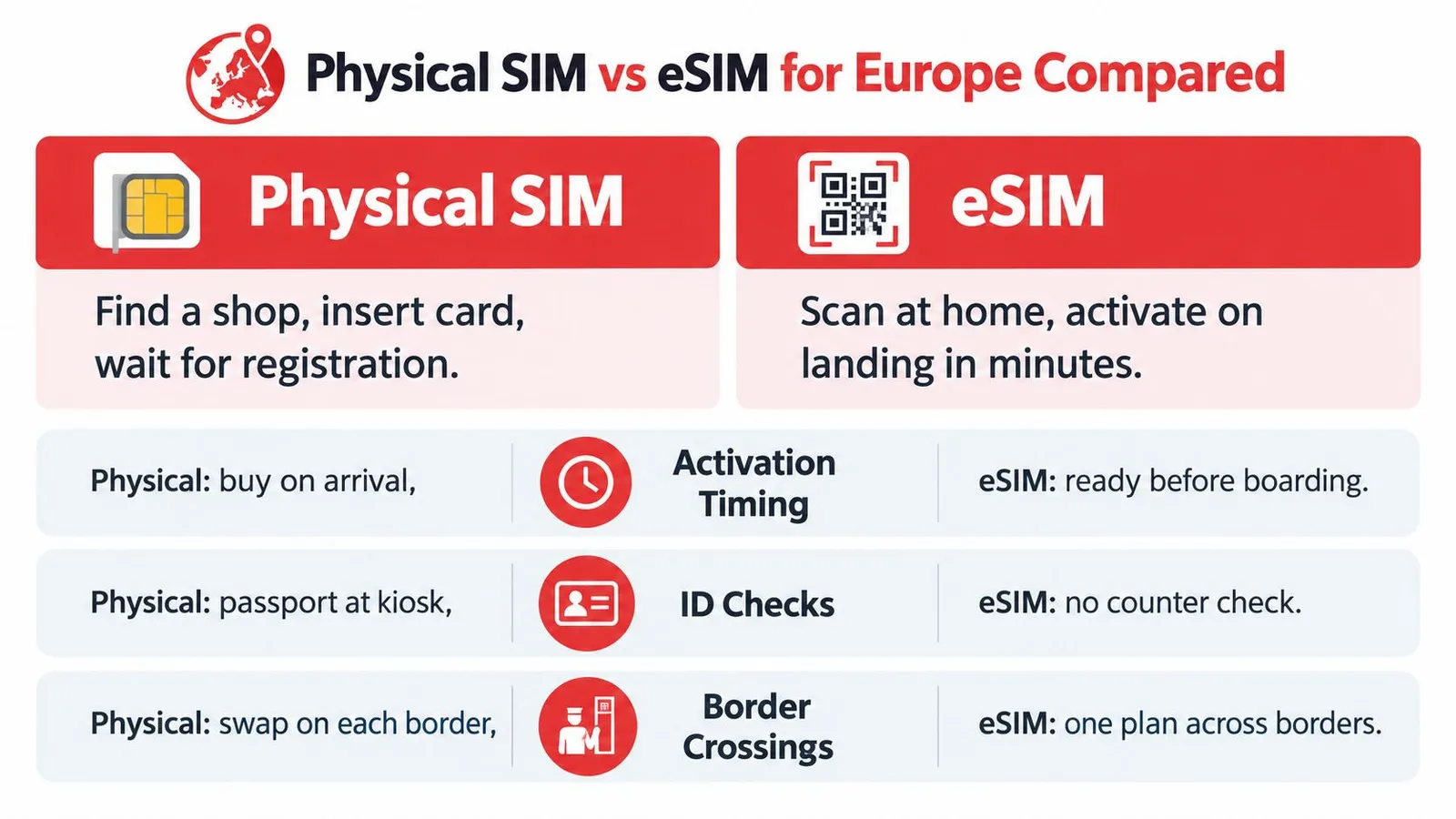
| Decision point | Physical SIM | Travel eSIM |
|---|---|---|
| Activation | Buy at an airport, station, shop, or carrier counter | Install before departure and activate according to instructions |
| Setup time | Complete the purchase and activation after landing | Prepare on Wi-Fi before departure |
| Identification | Many countries may request a passport or national identity card | No retail counter check for digital installation |
| Multiple countries | May require another product or manual network arrangement | One regional plan can work wherever its country list applies |
| Phone number | May include a local number, depending on the product | Often data-focused, so calls may use apps unless the plan says otherwise |
| Support | Face-to-face help may be available at the point of purchase | Digital support depends on the provider's available channels |
| Best fit | A long stay centered on one country | A prepared, multi-country itinerary or immediate arrival access |
A practical comparison puts eSIM preparation at about two minutes, while buying and activating physical SIMs at an airport or station can take roughly 20 to 30 minutes per country. Across a multi-country example, physical arrangements take about 75 minutes, compared with two minutes for eSIM preparation. The Orange travel comparison shows why setup time deserves a place beside price when planning a route.
A physical SIM still wins in specific situations. A local shop can explain the package, replace a faulty card, and sometimes provide a local number. Choose it for an older phone without eSIM support, traditional calling needs, or a long stay focused on one country. The trade-off is repeated counter time whenever the itinerary crosses into another coverage area.
An eSIM suits travelers who want data working at landing and fewer border stops. It also avoids carrying or storing removed plastic cards. Check the device first, then confirm the country list, activation rules, data validity, hotspot permission, and whether the plan is data-only. A clear explanation of eSIM technology helps if the digital format is unfamiliar.
Choose a physical SIM for local service and a phone number. Choose an eSIM for fast activation and movement between covered countries. Before paying, compare the plan's country coverage with your actual route. A regional label means little if one border crossing falls outside its list.
Europe Data Speeds and Real Travel Performance
Your phone may show a strong speed-test result in Paris, yet a video call can still stutter on a cross-border route. Download speed measures throughput. Latency measures how long data takes to travel through the roaming network, and that delay affects calls, remote desktops, and live navigation.
A 2026 Ookla study found median multi-server latency multiples from 1.5x to 30x for travel eSIM brand-and-destination pairs, compared with local users in the same destination and quarter. The Ookla findings summarized by Roami show why latency belongs beside Mbps when you compare plans.
Match performance to the task
- Maps and messaging: These usually handle normal travel-network variation. Download offline maps before leaving cities or entering rural areas.
- Video calls: Stable latency matters more than a spectacular peak download figure. Test the connection before an important meeting.
- Remote desktop: Longer routing paths make every click feel delayed. Business travelers should avoid relying on an untested plan for time-sensitive work.
- Streaming: Throughput matters, but congestion, weak coverage, and high data use can reduce playback quality after a speed test.
- Hotspotting: Your phone and laptop share the connection. Confirm hotspot permission and allow for weaker rural performance.
Independent Europe testing reported roughly 40 to 60 Mbps download in major Western European cities, including Paris, Madrid, Milan, and Munich, on 4G LTE in a benchmark across 15 countries. A separate cross-continental test found Europe-specific travel eSIM speeds commonly in the 22 to 38 Mbps range for some providers. EarthSIM's Europe testing overview shows why urban results do not guarantee the same experience throughout a trip.
Plan around the weakest important segment, not the fastest city result.
A regional eSIM should handle navigation, messaging, browsing, and standard HD streaming. Frequent tethering, large uploads, and uninterrupted calls require closer checks of network partners and hotspot rules. If data feels slow, use RedSim's slow-data troubleshooting guide to check phone settings and network selection before replacing the plan.
How to Choose the Right Europe Plan
Your arrival time should shape the purchase. If you need data immediately after landing, install an eSIM before departure. If you have time to visit a shop and want a local number, a physical SIM can work. Either way, check the countries, activation rules, and roaming allowance before paying. “Europe” is a marketing label, not a standard coverage promise. Travel Tom Tom's Europe SIM coverage discussion shows why destinations need individual verification.
Build the itinerary test
List every overnight stop and border crossing, then compare the list with the provider's coverage page.
- Western EU/EEA route: Your home plan may already cover the trip, making a second plan unnecessary.
- UK or Switzerland included: Confirm both countries directly. They are not automatically included in every Europe plan.
- Balkan route: Check each country separately rather than trusting one regional label.
- One-country stay: A country-specific plan may offer simpler terms and local support.
- Open-ended route: Choose a wider regional plan only when its listed destinations match your route.
Cross-border friction matters. A physical SIM may require a shop visit, stock, ID checks, and a replacement for your home SIM. An eSIM avoids that delay, but only if your phone supports it and the installation works before departure.
Your device must support eSIM, be free from carrier restrictions, and have enough line capacity for your setup. If you want to keep your home number, confirm dual-SIM behavior and disable unwanted roaming on the regular line. Check RedSim's compatible-device guide before purchase.
Match data to behavior
Light use covers maps, messages, transport apps, and occasional searches. Moderate use adds social uploads and regular browsing. Heavy use includes video calls, streaming, cloud work, and hotspot sharing. Match the allowance to your habits, then confirm that top-ups are available if plans change.
Hotspot rules deserve a direct check. One connection can serve several devices, but only when tethering is permitted and coverage holds. Calls and SMS also vary. Data-only service works with WhatsApp and similar apps, but it does not replace a traditional number for every verification or booking. If your home roaming allowance already covers the route, use it and avoid managing a second plan.
Best Choices by Traveler Type
The right Europe travel sim card depends less on a universal ranking and more on who carries the phone, how often the itinerary changes, and whether another device needs the connection.
Leisure travelers
A couple taking trains between covered countries usually benefits from an eSIM installed before departure. The main value is not technical performance. It's the ability to contact accommodation, open maps, and check transport information immediately after landing without visiting a shop.
Travelers whose home carrier already includes sufficient EU/EEA roaming should use that first. Paying for a second plan adds little if the existing allowance covers the route and the trip stays within the applicable fair-use terms.
Business travelers and remote workers
A business traveler should prioritize predictable access, hotspot permission, and support availability. A laptop connection can turn a minor coverage issue into a missed meeting, so a plan with clear tethering rules and a practical troubleshooting path is more important than a flashy speed claim.
A digital nomad may prefer a larger regional allowance or a top-up system. Country-specific plans can be sensible when the work period is concentrated in one destination, while regional coverage is more useful when the schedule includes frequent border crossings.
Families and groups
Families should count connected devices, not just people. One eSIM with hotspot support can serve as a backup for a companion, but sharing drains the host phone's battery and concentrates the risk in one device. Separate low-use plans may offer better resilience when family members split up.
A regional plan from RedSim's Europe Plus eSIM is one option for travelers whose destination list matches its stated 41-country coverage. The provider also offers country and regional structures, so the itinerary still needs to be checked before purchase.
When physical SIM remains reasonable
A physical SIM is a defensible choice for travelers with an incompatible phone, a locked device, or a long stay centered on one country. It can also appeal to someone who wants a local number and prefers face-to-face support. The cost is less about the plastic itself than the time and administrative friction required after arrival.
Smart Buying and Setup Tips
Buy the plan before departure, then verify exactly when its validity starts. Check every destination, save the QR code offline, and keep installation details available if airport Wi-Fi fails. Activation timing matters: an eSIM installed before takeoff can provide data on landing, while a physical SIM usually costs arrival time at a shop, kiosk, or airport counter.
Use this setup order:
- Protect the home line: Disable data roaming on your regular SIM if separate charges are possible.
- Install on Wi-Fi: Download the eSIM before leaving, then activate the travel line as instructed. Keep the home line available for calls only if needed.
- Check hotspot permission: Confirm tethering before connecting a laptop or another phone. One shared connection can drain data and battery quickly.
- Choose a top-up path: An active eSIM with top-ups avoids replacing a working plan and scanning a new QR code during the trip.
- Read refund terms: An unused, unactivated plan may qualify for a full refund. Installation or activation can change the conditions.
- Use secure checkout: Pay through a protected process and confirm that support works through a channel accessible abroad.
The RedSim setup guide covers practical installation steps. RedSim offers country, regional, and global data plans, QR-code delivery, app installation, hotspot support, active-plan top-ups, and 24/7 WhatsApp and email support. Check current terms and prices before paying because offers can change.
Quick Decision Checklist
Choose a Europe travel SIM card by checking the route, activation timing, and the limits of your home plan.
- Does the home plan cover every stop? Confirm EU/EEA access, the data allowance, and fair-use terms before relying on roaming.
- Does the route leave the EU/EEA? Check the UK, Switzerland, Balkan destinations, and every other non-EU stop separately.
- Must the phone work immediately on landing? Install an eSIM before departure. A physical SIM may require time at an airport shop or local kiosk.
- Is the device free of carrier restrictions and eSIM-compatible? Verify this before buying a digital plan.
- Will the traveler cross borders often? Pick a regional plan only when its country list covers the complete itinerary.
- Does the trip require hotspot use? Confirm tethering permission before connecting a laptop or another phone.
- Are calls and SMS important? A data-only eSIM may not provide a local number.
- Could the itinerary change? Check top-up, validity, and refund terms, especially before activation.
- Will support be available on arrival? Confirm that the provider offers digital assistance through a channel you can reach abroad.
The direct recommendation is simple: use home roaming when the carrier clearly covers the trip, choose an eSIM when immediate arrival access and border flexibility matter, and choose a physical SIM when local service in one country outweighs setup convenience. Country coverage matters more than the word “Europe” on the product page.
Before flying, compare the current RedSim Europe eSIM options, verify the countries, install the selected plan on Wi-Fi, and save the instructions offline.
RedSim offers prepaid Europe and Europe Plus eSIM plans with QR delivery, app installation, hotspot support, top-ups, and WhatsApp and email assistance. Check current terms before paying, then visit RedSim to prepare your connection.