
A plane door opens onto a foreign terminal, and a Verizon customer has only a brief moment to decide whether the phone should connect. Maps, messages, bank verification codes, and ride-hailing apps all depend on that choice. Turning roaming on is easy. Understanding what starts a charge is harder.
Verizon International Travel Pass is convenient because it keeps the traveler's existing Verizon line, number, calls, texts, and data working abroad. It also isn't a flat monthly travel plan. It behaves more like a usage-triggered daily roaming entitlement, which makes it useful for short trips but increasingly expensive and restrictive when the phone is used throughout a longer itinerary.
How Verizon International Travel Pass Works
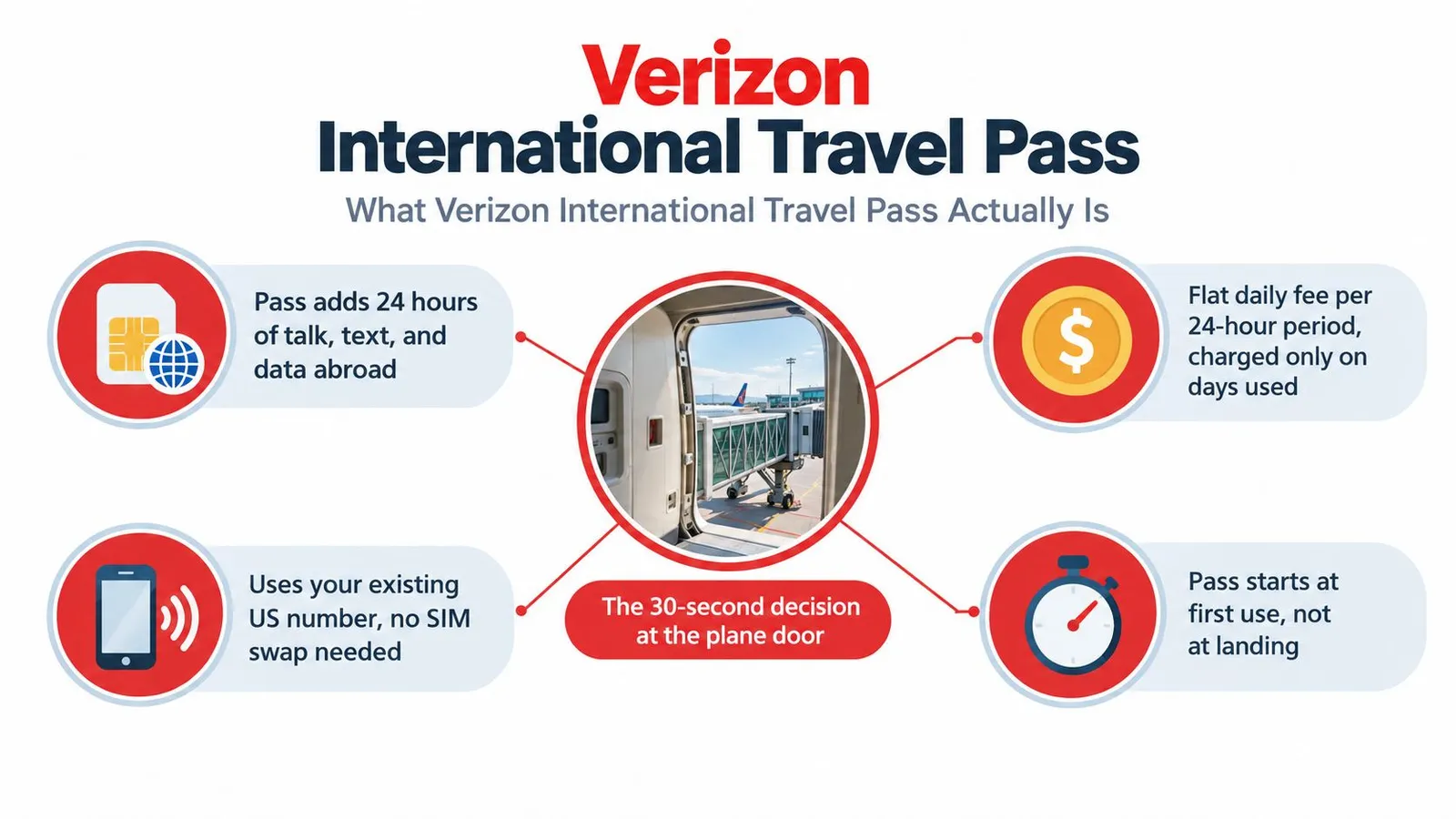
TravelPass is a usage-triggered roaming service, not a monthly international plan. When a Verizon line uses covered cellular service abroad, Verizon can open a paid daily session. The trigger may be cellular data, an SMS, or a phone call. Verizon's TravelPass product information lists $12 per line per day in 210+ countries and destinations, plus $6 per line per day in Canada and Mexico.
That structure matters more than the headline price. Travelers who treat TravelPass like a $12 monthly add-on are surprised when each used day bills separately. A phone that stays on airplane mode and uses Wi-Fi can avoid a cellular session, while a quick map check or background connection may start one. Cost can stack across an itinerary even when the traveler uses the service only for short bursts.
What activates the session
The session starts automatically when the Verizon line uses covered cellular service in an eligible destination. Opening a map, sending a text, or making a call can activate it. No airport code or manual roaming purchase is required, and the traveler keeps the existing Verizon number.
That convenience is TravelPass's strongest argument. A travel eSIM usually requires installation, line selection, and activation, while what an eSIM is and how it works explains the alternative for travelers willing to manage a separate data line. TravelPass removes setup work, but it also gives the traveler less control over accidental cellular use.
The service's terms also depend on the line type. The TravelPass support terms describe a high-speed allowance for eligible prepaid service, while postpaid documentation uses different language about unlimited data. Do not assume every Verizon account receives identical treatment. Check the terms attached to the specific line before departure, especially if the trip involves frequent uploads, streaming, or hotspot use.
TravelPass works well for a short stop, an emergency connection, or a trip where retaining the American number outweighs the lowest data cost. For longer travel, its daily billing and service limits deserve closer scrutiny than the simple promise of connectivity. The right mental model is a daily switch that turns on after use, with every activated day becoming a separate billing event.
How the Daily Session and Pricing Work
The daily fee buys a 24-hour session, not a trip-wide data bucket. Your total depends on the number of days the Verizon line is used abroad, multiplied by the destination rate. Verizon lists $12 per line per day in most covered destinations and $6 per line per day in Canada and Mexico.
That billing trigger matters more than the length of the itinerary. A traveler can spend a week overseas and create only a few charges by keeping the Verizon line on airplane mode and using Wi-Fi. A quick email check over cellular, SMS, or phone call can activate a session for that day.
TravelPass Daily Fee by Device Type
| Device Type | Per-Day Fee (USD) | 7-Day Trip Total |
|---|---|---|
| Smartphone in most covered destinations | $12 | Depends on the number of used sessions |
| Smartphone in Canada or Mexico | $6 | Depends on the number of used sessions |
| Laptop, tablet, or Jetpack hotspot | Destination rate applies per line | Confirm the device rate in My Verizon before departure |
The seven-day total is therefore a usage calculation, not an automatic weekly price. A phone used on two days creates two daily charges, while a phone that stays offline from cellular service can avoid a charge on unused days. The same logic applies separately to each line on the account.
Consider a Sunday-to-Sunday trip. If the traveler uses the phone after landing on Sunday, every subsequent day with cellular activity can create another session, including the return day. The number of hotel nights does not determine the bill. Verizon counts days with qualifying use.
Practical rule: Count each day when the Verizon line may use data, send an SMS, or place a call. Do not budget by nights alone.
TravelPass charges may appear through the normal Verizon billing cycle instead of immediately after use. That delay hides the cost stacking until the next bill, particularly when several family or business lines connect abroad. Each line that activates can generate its own daily fee.
Automatic activation makes arrival easier because the existing line can work without manual setup. It also creates risk when a traveler intends to use Wi-Fi or a separate eSIM. Review the Verizon line in My Verizon before departure, check international roaming settings, and disable roaming on that line if another data line will handle connectivity.
Compare the Prepaid and travel eSIM pricing before leaving. A fixed eSIM purchase makes the expected data cost easier to see, while TravelPass remains a stream of usage-triggered daily charges. For a short trip or occasional connection, that convenience can justify the fee. For several active days or multiple lines, calculate the sessions first, then compare the total with an eSIM.
Coverage, Multi-Country Fees, and the Throttling Trap
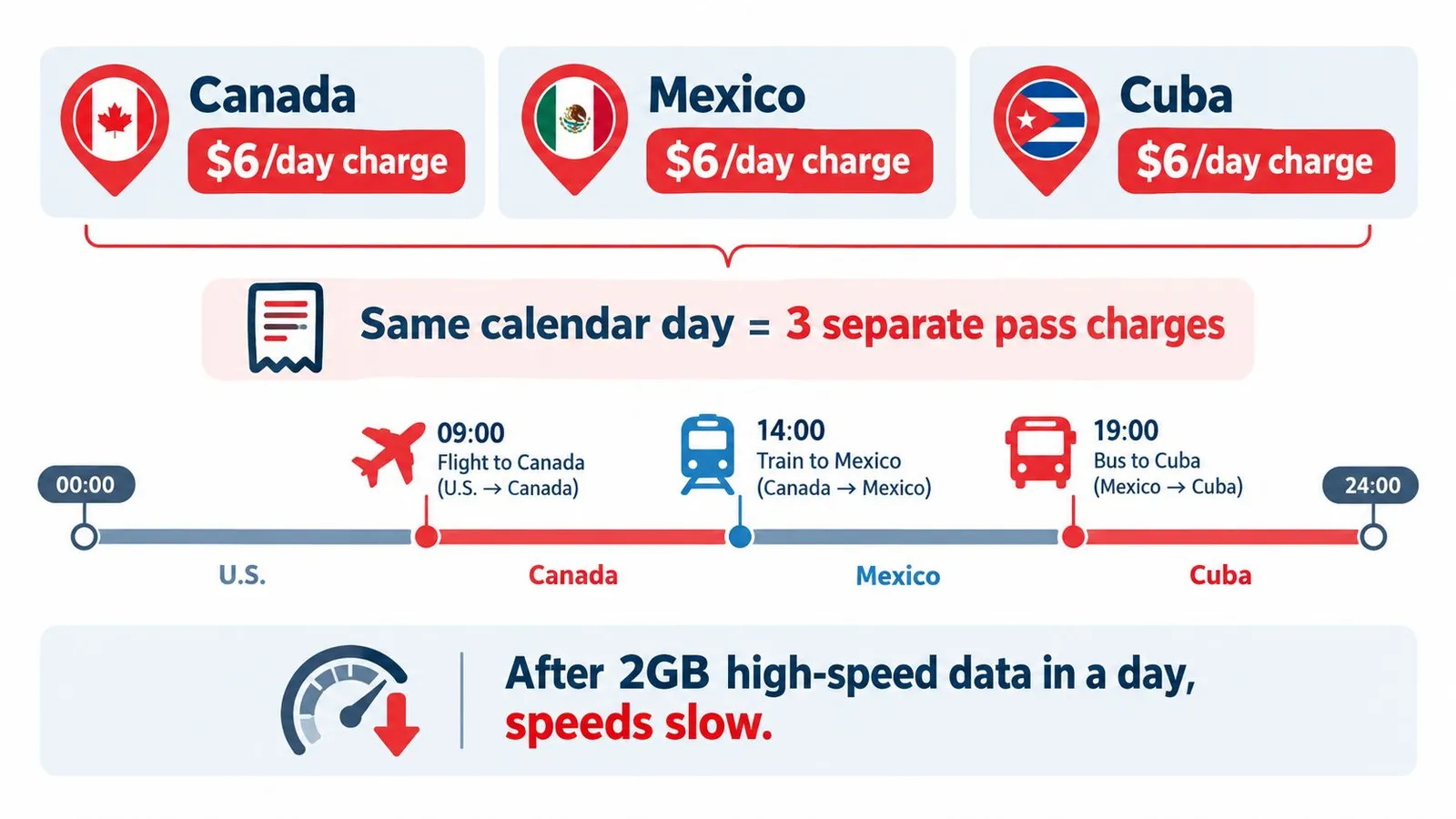
TravelPass becomes harder to budget when a roaming session crosses a national border. Verizon's international support documentation states that moving between countries with different TravelPass fees during the same twenty-four-hour session can trigger both fees.
A single travel day can therefore contain more than one country-specific charge, even though the phone never stopped being used during the original session. That makes TravelPass a usage-triggered daily entitlement, not a fixed travel plan that automatically absorbs every border crossing. Check the fee for each destination on an itinerary that crosses countries by train, bus, car, or aircraft.
The data limit behind “unlimited”
The word unlimited requires careful reading. Verizon's TravelPass frequently asked questions describes a 5 GB of international data per day high-speed threshold for eligible prepaid TravelPass service, after which data is reduced to 3G speeds for the rest of the session. Postpaid terms use unlimited-data language, but roaming must still be enabled, and qualifying use can still start a session automatically.
At 3G speeds, maps and messaging typically remain usable, while video meetings and large uploads degrade sharply. Cloud backups, hotspot use, and frequent media transfers can consume the high-speed allowance quickly, so remote workers should not treat the label unlimited as unlimited high-speed access.
The practical risk is cost stacking plus slower data. An itinerary that combines Canada or Mexico with destinations using the standard $12 daily rate can produce a bill well above a traveler's original one-day assumption. Review every destination's fee before departure, especially when several countries fall within one active session.
For a multi-country itinerary, a regional or global eSIM plan usually gives clearer cost control. The plan can cover the route without adding a separate roaming charge each time the phone crosses a border, while TravelPass remains useful for travelers who prioritize keeping their Verizon number active and want to avoid eSIM setup.
Comparing TravelPass with eSIM Alternatives
TravelPass suits travelers who value number continuity and zero setup. A travel eSIM suits travelers who want prepaid cost control and separation from the domestic carrier line. The right choice depends on whether keeping the Verizon number active matters more than controlling the total data cost.
Price is the clearest dividing line. TravelPass creates a daily entitlement when the Verizon line uses covered service, so the cost depends on how many days become active. It is not a trip-wide data bucket with one fixed price. An eSIM normally provides a fixed allowance or validity period purchased before departure, which makes the package easier to compare with expected usage.
Activation also works differently. TravelPass can start automatically after the Verizon line uses a covered service. An eSIM requires installation, correct line selection, and a compatible phone, but it can be set up before departure. That preparation avoids searching for a local shop after landing and lets the traveler test the data line before leaving.
Verizon TravelPass vs. Popular eSIM Options
| Provider | 7-Day Trip Cost | Activation Speed | Country Coverage | Data Policy |
|---|---|---|---|---|
| Verizon TravelPass | $12 per used day in most covered destinations, $6 in Canada and Mexico | Automatic after covered usage | 210+ countries and destinations | Talk, text, and data during the session, with a 5 GB high-speed threshold for eligible prepaid service |
| Regional travel eSIM | Fixed prepaid price determined by the selected plan | Installed before travel, activated by the traveler | Depends on the regional plan | Fixed allowance or plan-specific policy |
| Local SIM | Depends on the destination and provider | Purchased and installed locally | Usually focused on one country | Provider-specific prepaid allowance |
A seven-day Italy trip shows why the usage-triggered model matters. TravelPass can create a separate charge for each day the Verizon line is used. A regional eSIM is paid for once, then remains available until its allowance or validity period ends. A side-by-side comparison of Verizon TravelPass and eSIM options makes that cost difference easier to assess before departure.
TravelPass keeps the US number attached to the active service, while many travel eSIMs are data-only. A dual-SIM phone can keep the Verizon line available for selected calls or SMS while routing mobile data through the eSIM. The traveler must disable Verizon data roaming and prevent automatic data switching, or the domestic line can still trigger TravelPass usage.
Because the eSIM cost is fixed at purchase, a traveler can compare it with the exact number of expected TravelPass days before leaving, rather than waiting for the Verizon bill. That makes the eSIM easier to budget for family trips, corporate travel, and itineraries where mobile data will be used daily.
A short Canada trip can narrow the price gap because the applicable TravelPass rate is $6 per line per day. A longer route across several countries is harder to justify when each active line can create its own daily entitlement. TravelPass is the better fit when one US number must remain available without extra setup. For data-heavy travel and predictable spending, a regional eSIM is the stronger default.
Matching TravelPass to Different Traveler Types
TravelPass makes sense for a narrow group of travelers. The mistake is treating it as the universal answer for every Verizon customer abroad.
The short business hop
A consultant flying to Toronto for a brief client visit may need the US number to remain reachable and may not want to install a second data line before departure. At the $6 Canada and Mexico rate, TravelPass can be a straightforward choice when the line is used during the visit. The value comes from continuity, not from a low cost per unit of data.
Recommendation: Use TravelPass when a short trip requires the Verizon number and the traveler wants the least possible setup.
The family holiday
A family traveling together creates a different calculation. Every line that uses Verizon cellular service abroad can produce its own session. Four active lines can therefore turn a convenient daily feature into a sizeable recurring charge, especially across a longer vacation.
Children also tend to consume more data than the adults expect. Video, automatic updates, photo backups, and app activity can push eligible prepaid service toward the 5 GB high-speed daily threshold, after which Verizon reduces speeds to 3G. A shared or family-oriented eSIM arrangement gives the group a clearer data budget, though the phone and plan must support hotspot use if the family intends to share one connection.
Recommendation: Use a regional eSIM for family data and keep Verizon roaming off unless a specific line needs carrier calls or texts.
The digital nomad
A nomad moving between Lisbon, Bali, and Mexico City has the worst possible profile for TravelPass. The phone may be active nearly every day, multiple destinations may carry different fees, and the user may depend on high-volume data for work. The daily session model offers convenience but no meaningful trip-wide spending ceiling.
Recommendation: Choose a regional, global, or local eSIM structure and treat Verizon as a secondary number line. TravelPass should be reserved for an isolated day when carrier service is necessary.
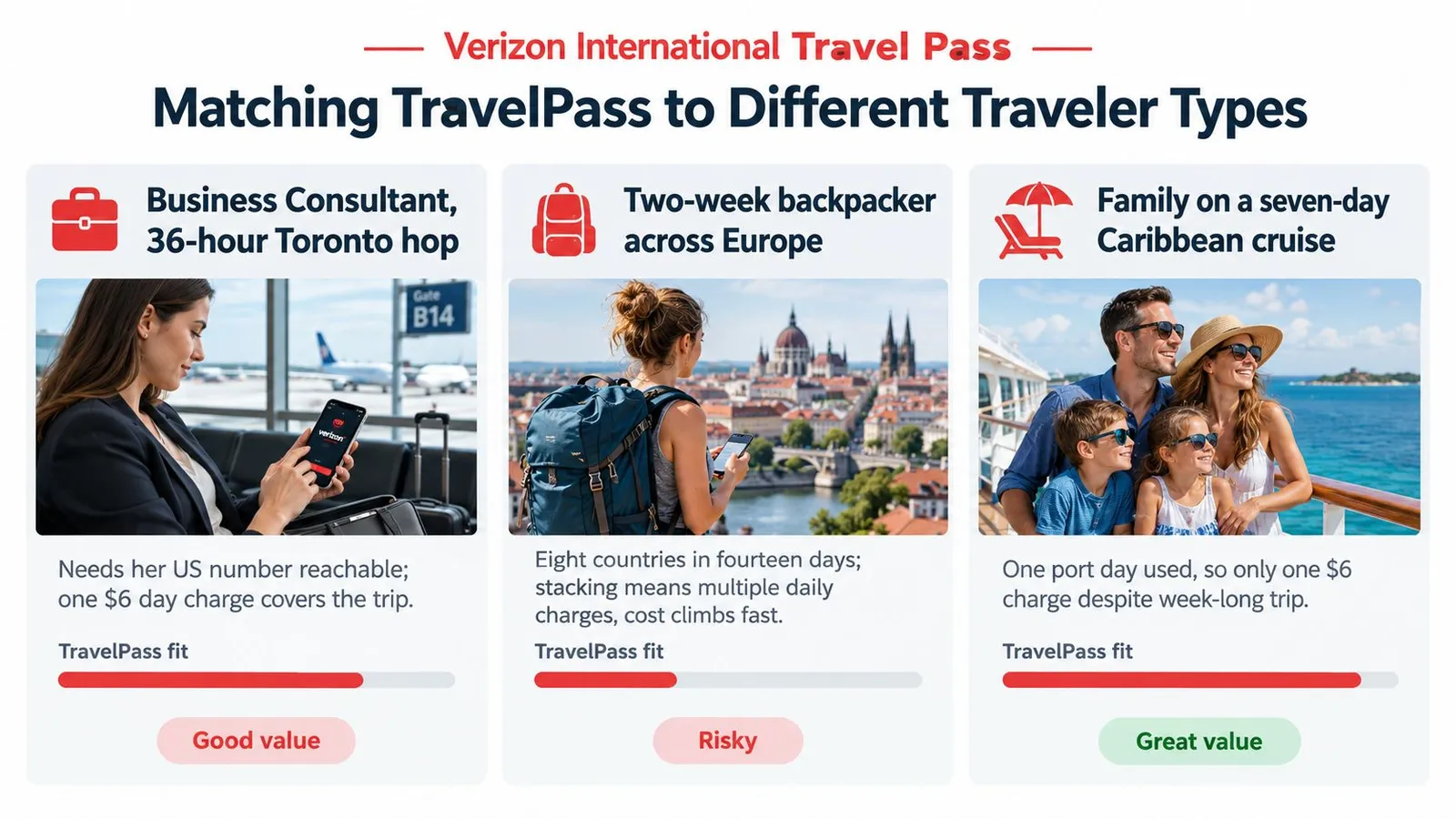
The dividing line is simple. TravelPass is a convenience tool for short, number-sensitive travel. It's a poor foundation for extended travel, heavy data use, or frequent border crossings.
Common Issues and How to Resolve Them
TravelPass problems usually come from one of two sources: the phone didn't register correctly, or the phone used cellular service when the traveler thought it was idle. The service's automatic activation makes both situations more confusing.
The pass doesn't activate after landing
If the phone shows no service, the traveler can toggle airplane mode off and on, restart the device, and confirm that international roaming is enabled for the Verizon line. Manual network selection may help the device register with an available partner network, but the exact option depends on the handset.
The traveler shouldn't repeatedly open apps while testing. Any successful cellular data connection can start a paid session.
An unexpected day appears on the bill
Background activity can be enough to activate roaming. Email synchronization, cloud photo activity, notifications, and automatic app checks may use cellular data without an obvious action on the screen. The safest setup for an eSIM user is to select the travel line for data, disable Verizon data roaming, and turn off automatic cellular data switching where the phone offers that control.
Travelers disputing a charge should open the relevant line in My Verizon, review international usage and billing details, and contact Verizon support through the account's billing or international-services path. The exact menu labels can change, so the account's current interface should take priority over a memorized sequence.
Speeds fall during important work
For eligible prepaid TravelPass service, Verizon documents 5 GB of high-speed international data per day, followed by 3G speeds for the remainder of the session. A traveler who reaches the threshold should stop video-heavy activity, disable hotspot use, and move large downloads to Wi-Fi. Guidance on diagnosing slow travel data is also available in this slow-data support guide.
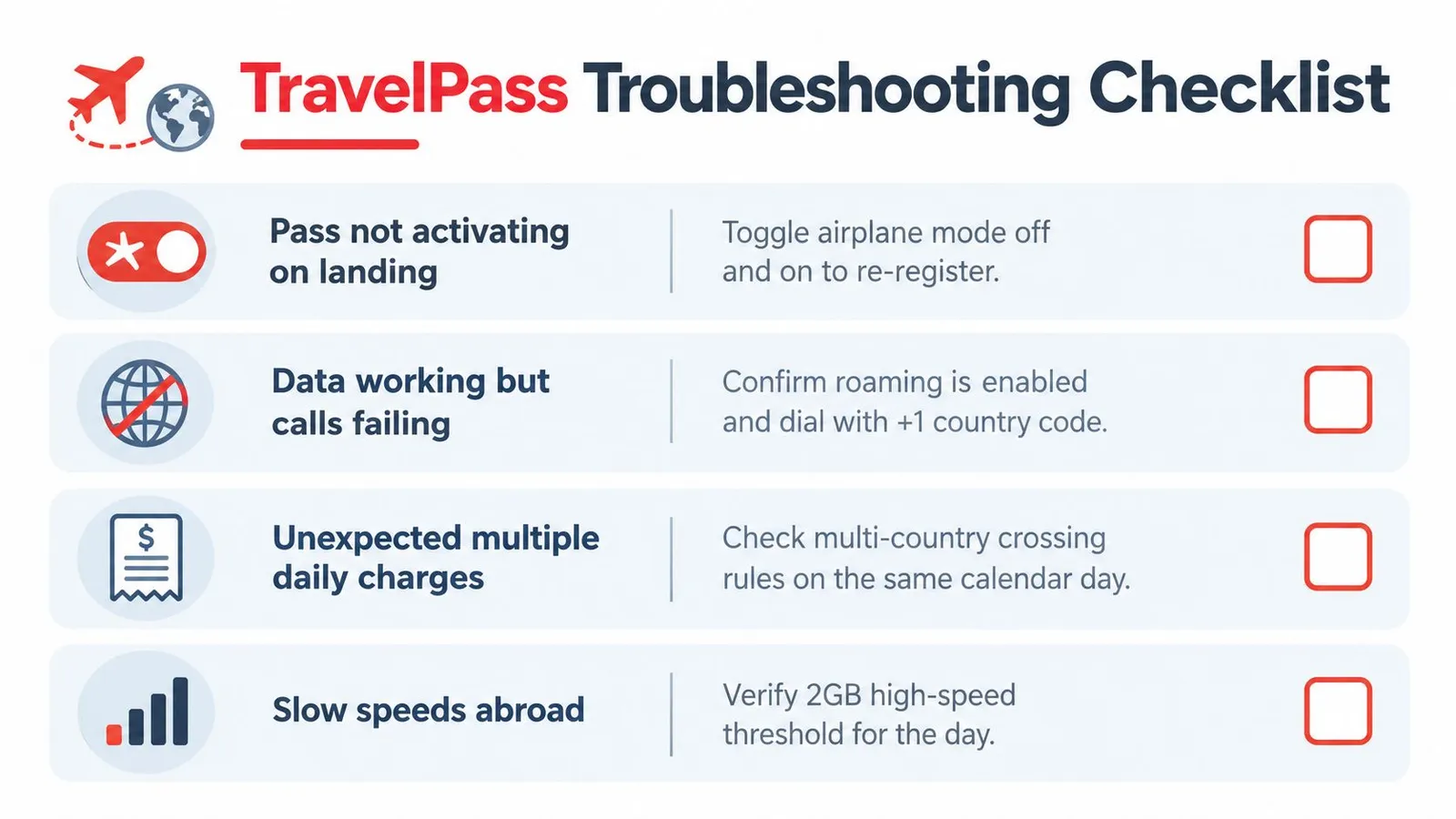
Before departure, the traveler should confirm the destination, identify the line assigned to mobile data, check roaming settings, and decide whether automatic activation is acceptable. A screenshot of the relevant Verizon feature and the phone's SIM settings can make support much easier if a problem appears abroad.
Which Option Is Right for Your Next Trip
The word unlimited shouldn't end the analysis. A daily TravelPass session can include unlimited talk, text, and data in the service's terms, but eligible prepaid users still face a 5 GB high-speed threshold, and every session begins after cellular use. Heavy users should judge the plan by workload, not by the headline label.
Best Option by Traveler Type
| Traveler Type | Recommended Option | Estimated Cost (7-day trip) | Why |
|---|---|---|---|
| Weekend city-break traveler | Regional eSIM | Fixed prepaid plan price | Maps and messages don't require a daily carrier session |
| Two-week European traveler using calls and work data | TravelPass only if number continuity is essential | $12 per used day in most covered destinations | Convenience is strong, but the daily cost and data limit reduce value |
| Frequent business flyer crossing several countries | Global or country-specific eSIMs | Fixed prepaid plan price | Avoids country-fee stacking and separates data from Verizon billing |
| Short Canada or Mexico business trip | TravelPass | $6 per used day | The lower daily rate and existing number can justify the convenience |
For a weekend city break, a regional eSIM is the default recommendation. The traveler can install it before departure, keep Verizon data roaming off, and avoid turning a background sync into a paid carrier session.
The two-week European trip is less clean. TravelPass is defensible when clients, banks, or colleagues must reach the US number and the traveler refuses any setup work. It loses on cost predictability and may lose on heavy data use once the prepaid high-speed threshold is reached. A dual-SIM arrangement offers the practical compromise, Verizon for number continuity and an eSIM for data.
A frequent flyer crossing several countries should avoid making TravelPass the primary data plan. The documented rule allowing different destination fees to stack within one session creates unnecessary billing risk. A regional or global eSIM removes that particular border-crossing problem and gives the traveler a prepaid amount to monitor.
For anyone choosing an eSIM, the purchase terms matter as much as the data allowance. RedSim offers country, regional, and global prepaid data plans with digital delivery, data top-ups, and support for compatible devices. Its stated refund rule is simple: 100% of the money is returned if the eSIM didn't work and support couldn't fix it, or if the plan was never activated and hasn't expired. Validity starts when the eSIM activates, not when it's purchased.
The practical decision is therefore straightforward. Use Verizon International Travel Pass for short, number-sensitive trips where automatic setup matters. Use a prepaid eSIM when the itinerary is longer, data use is heavier, several countries are involved, or predictable spending matters more than keeping every roaming function on the Verizon line.
Travelers who want to avoid usage-triggered roaming can compare RedSim's country, regional, and global eSIM plans, install the selected line before departure, and keep Verizon available only for the services they specifically need. Visit RedSim to review the available travel data options and refund terms before the next international trip.