
 Germany

The plane lands at Frankfurt, the seatbelt sign chimes off, and somewhere between the gate and passport control you open your phone to check the train time. Your home carrier offers a daily roaming pass that costs more than the train ticket itself, and the airport Wi-Fi wants a text message code you can't receive.
That's when a prepaid data plan earns its price. A comparison page for the best eSIM for Germany usually shows three columns: gigabytes, validity days and a 5G logo. It leaves out the two things that decide whether your data works: which German network the plan rides, and what you have to do to activate it.
A cheap plan on the wrong carrier dies in a Black Forest valley. A premium plan that needs a passport video call is no help when you land at 23:00 and want a boarding pass on your screen.
Route and activation decide more than price.
Germany eSIM Prices and Data Plans at a Glance
Price is the first filter, and the Germany eSIM range passes it at every size. The 1 GB, 7-day tier costs $2.19, and $6.93 buys 5 GB across 30 days. Each plan below undercuts the nearest rival of the same data allowance.
| Plan | RedSim price | Rival price | Rival |
|---|---|---|---|
| 1 GB, 7 days | $2.19 | $2.49 | Pocket eSIM |
| 5 GB, 30 days | $6.93 | $7.30 | esim.io |
| 10 GB, 30 days | $11.87 | $12.50 | Ubigi |
| Unlimited, 7 days | $20.34 | $21.34 | esim.io |
Read the table by matching trip length first, then data use. A 7-day plan that expires two days into a three-week stay is a false economy, and a 30-day plan on a four-day city break wastes money the other way. Prices are in US dollars, so a card issued in euros or pounds converts at its own rate. Check the amount in your currency at checkout, not on the statement.
The range runs from 1 to 30 days. That covers a weekend in Berlin and a month of remote work in Hamburg alike, and the daily cost falls fast as the plans get longer.
Rule of thumb: maps and messaging only, take the 1 GB 7-day plan. A month-long stay costs far less per day on the 5 GB or 10 GB 30-day plan than on any unlimited 7-day plan.
The reason is simple arithmetic. An unlimited week is priced for intensity, not duration, so paying that rate for 30 days makes no sense. The reverse holds too: if you're tethering a laptop for five straight days, unlimited is the only plan that won't leave you buying top-ups by day three.
One decision sits above the table. If the route crosses into Austria, Switzerland or Czechia, compare international travel eSIM plans before you commit to a Germany-only plan. A regional plan often costs about the same as a single-country one and removes a second install at the border. Whichever you pick, install it before departure and it goes live when you land.
Which German Networks Your eSIM Should Reach
A train ride from Munich toward Freiburg, a walk above Garmisch, or a village road in rural Bavaria tests something a city break never does. Coverage in Germany is a patchwork of three carriers with different holes in different valleys.

The numbers make the point. The German Federal Network Agency's 2025 annual report puts 4G coverage from at least one operator at 97.53% of the country's area and 5G at more than 93.85%. Yet nearly 14% of the surface area remained a grey spot, where at least one operator had service but not all of them, and the agency's 2025 measurement week logged 2.10% of the country as a complete 4G/5G not-spot.
Read that 14% correctly. A plan tied to a single German network inherits that network's gaps, and the gaps sit in exactly the places people travel for: alpine valleys, forest roads, rail cuttings and the quiet stretches near the eastern border.
An eSIM locked to one carrier has nowhere to go when that carrier drops. An eSIM that can attach to more than one German network re-registers and keeps working, which is the difference between a navigation app that recovers and one that spins.
What Each German Network Delivers
Speeds vary by operator too. In Opensignal's November 2025 Germany report, Telekom led 5G download speed at 173.8 Mbps, ahead of Vodafone at 154.3 Mbps and O2 at 114.5 Mbps. The same report gave Telekom the 5G Coverage Experience award, while O2 kept the overall Coverage Experience award.
| Operator | 5G download speed | Coverage Experience | Best use |
|---|---|---|---|
| Telekom | 173.8 Mbps | Led 5G Coverage Experience | Video calls, large uploads, laptop tethering |
| Vodafone | 154.3 Mbps | No coverage award; second on 5G speed | Fast 5G in cities |
| O2 | 114.5 Mbps | Kept overall Coverage Experience award | Steady service on long or rural routes |
The Best use column is my matching suggestion, built from those measured results. Throughput-heavy work suits a Telekom-backed plan, and broad coverage experience in more locations suits one that can reach O2. The eSIM brand matters far less than the partner network list printed behind it.
Why LTE Fallback Matters More Than a 5G Badge
Germany's combined 4G and 5G mobile-broadband availability is near-complete nationwide, which tells you LTE is the layer doing the heavy lifting for navigation, messaging and app authentication on most of your trip.
Practical rule: leave the phone on automatic network selection with 5G allowed, never 5G-only. Indoors, in a basement restaurant or on a rural road, the handset needs permission to fall back to LTE, and a 5G-only setting turns a usable signal into no signal.
Before buying, confirm the provider names its German partner networks and supports automatic or manual carrier selection. A plan that hides its partners is a plan you can't match to your route.
City-heavy itineraries can chase speed. Routes that leave the cities should chase network switching and dependable LTE instead, because continuity beats peak rate when you're mid-journey. RedSim publishes an eSIM coverage list for Europe that names partner networks country by country, which is the quickest way to see what a Germany plan can attach to.
If the route also touches Austria, Switzerland or Czechia, the Europe & UK eSIM covers Germany and its neighbours in a single install, with 1 GB for 7 days at $2.69.
How Much Data to Buy for Your Trip
Buy a 30-day bundle for a four-day city break and you pay roughly three times the price of a 7-day plan while leaving most of the gigabytes untouched. Duration and allowance are two separate decisions. The allowance is the easier one: match the gigabytes to what each day of the trip involves, and remember the route shapes demand, since long train days and hotel Wi-Fi dead zones pull more data than afternoons spent on foot.
| Trip profile | Typical data use | Suggested plan |
|---|---|---|
| Weekend city break | Maps, messaging and a few calls | 1 GB, 7 days |
| Business trip with laptop hotspot | Video meetings, email and cloud sync | 10 GB, 30 days, or unlimited for 7 days |
| Family sharing a hotspot | Streaming, updates and messaging across devices | Unlimited, 7 days |
| Month-long stay | Steady daily use | 5 GB, 30 days for light use, 10 GB, 30 days for heavier use |
The Germany eSIM catalogue behind these sizes starts at $2.19 for 1 GB over 7 days, so guessing small costs a cheap top-up at worst. The unlimited tier runs for 7 days, which means a two-week family stay needs either a second activation or a fixed 30-day allowance instead.
Where the Data Actually Goes
Hotspot sharing is the line item that breaks a plan. A phone running maps and chat sips data all day; a tethered laptop drains the same allowance in hours, because operating-system updates, video meetings and cloud backup all pull from one pool. A single daily video call across a week can empty a 1 GB plan on its own, and a family's phones sharing one hotspot multiply every background sync.
Signal strength changes how quickly a plan drains while the total stays the same. German LTE leans on low bands for reach and building penetration, while 5G capacity at 3.5 GHz fades faster with distance, so a gigabyte of video costs a gigabyte whether it arrives indoors on LTE or outdoors on 5G. Sizing down because you expect a weaker indoor connection saves nothing; the same consumption arrives slower.
Three controls keep the allowance under your command:
- Switch on usage monitoring the day you install. A weekly glance at remaining data prevents a silent cut-off.
- Pause automatic updates and cloud backup on cellular. Photo backup and OS updates are the two largest hidden drains.
- Set a data warning at 80%. It leaves room to add a top-up before maps stop loading.
Top-ups attach to an active eSIM without a new QR code, so running low never means reinstalling. If two sizes look close, the guide to choosing the right plan settles it in a couple of minutes.
Passport, Calls and Activation Routes Compared
Two products share the label Germany eSIM, and they behave nothing alike at the airport. One can be live before you reach baggage reclaim. The other may need a passport check and a video call with an agent first.
| Route | Identity check | German number and SMS | Best for |
|---|---|---|---|
| Domestic German SIM or eSIM | Passport or accepted ID, sometimes a temporary German address and VideoIdent, PostIdent or in-store check | Usually yes | Residents and long stays |
| International data eSIM | Usually none: no passport scan, video call or address check | Data only, usually no German number or SMS | Short trips and quick arrival |
| Home SIM plus Germany eSIM | Home carrier rules apply | Calls and SMS stay on home number | Keeping your existing number reachable |
German-licensed SIMs and eSIMs require identity verification using a passport or another accepted document, potentially alongside a temporary German address, with methods such as VideoIdent, PostIdent or an in-store check, as how-to-germany.com's eSIM guide explains. International travel eSIMs, by contrast, can generally be installed without a passport scan, a video call or address verification.
Which Route Fits Your Trip
The decision tree is short. Staying several months, needing a German number for a landlord or a job, or wanting domestic customer support points to a domestic plan and its registration steps. Landing at 22:00 on a Friday, travelling for ten days and wanting maps by the taxi rank points to an international data eSIM.
A third pattern catches people who travel often. Keep the home SIM active for calls and verification codes, then assign the Germany eSIM as the mobile-data line. Your bank's SMS still arrives on your usual number, and the data bill stays flat.
Data only means data only. No German number, no conventional SMS, no voice minutes. Plan around that instead of discovering it when a portal asks for a local number.
That limit is worth testing before departure. Log into the apps that matter, check whether any of them insist on texting a code to a local number, and note where a Wi-Fi network will do instead.
For a group, buy one eSIM per phone rather than one shared hotspot for four people. Match each traveller to the right path too, because a colleague flying in for a three-day meeting and a student staying a semester don't need the same registration process. If any of the terms are still fuzzy, the explainer on what an eSIM is separates the chip, the profile and the plan before you spend anything.
Device Checks Before You Buy a German eSIM
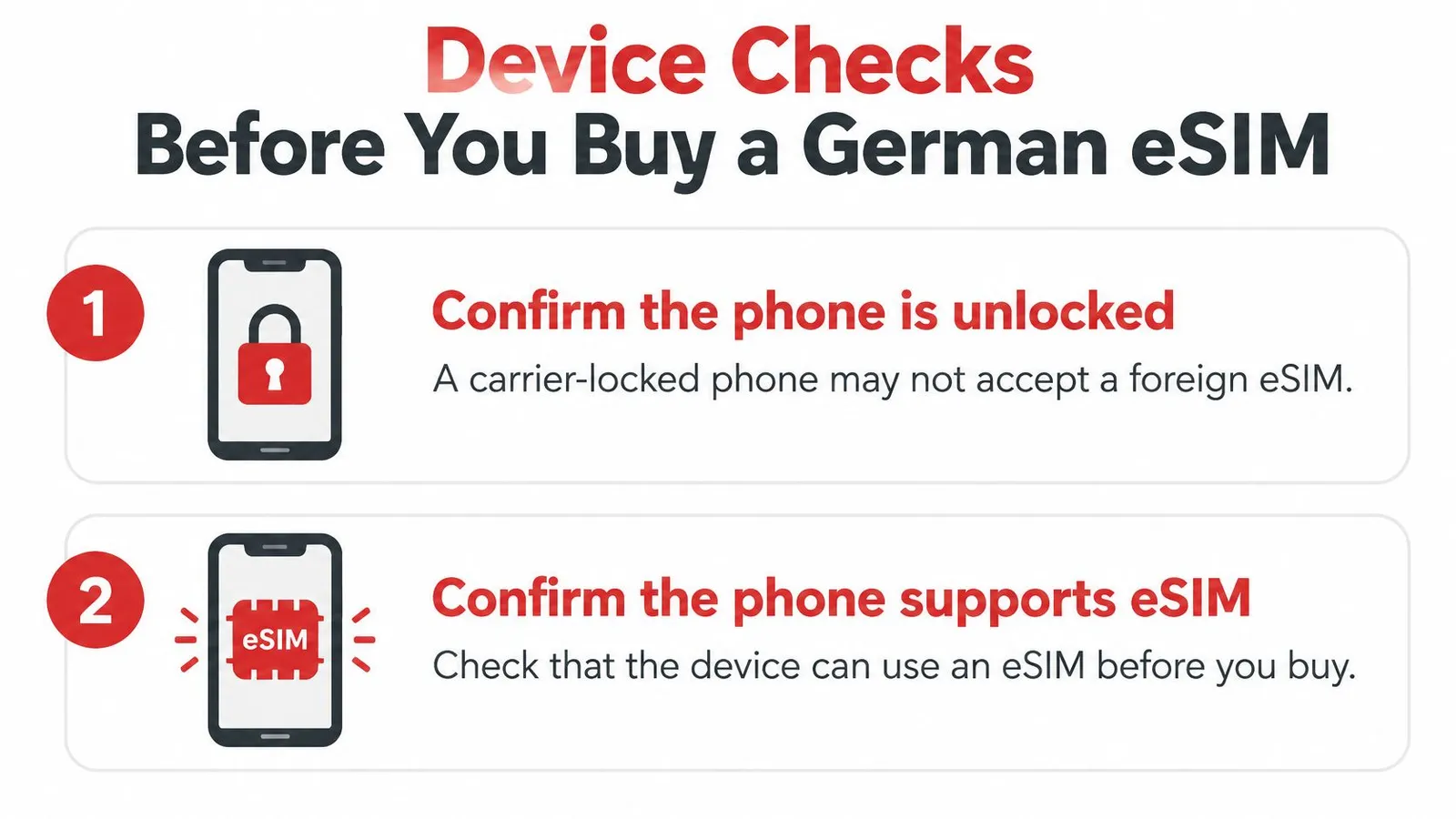
Six checks take about ten minutes and prevent the worst outcome: a paid plan that won't install, or a phone that can't hold the signal it promises. Start with the two that decide everything else.
- Confirm the phone is not carrier-locked. A carrier-restricted handset can refuse a foreign eSIM outright, and no support agent can fix that from a distance. The carrier lock line in the phone's settings answers it, and so does a two-minute call to the carrier.
- Confirm the phone supports eSIM. Most recent flagships do; older and budget models often don't. The settings menu tells you in seconds.
- Check German band support. The low bands carry rural reach and indoor penetration, so a phone missing them shows bars and still crawls in a valley. Compare the handset's band list against the plan's supported bands before paying.
- Check dual SIM. Keeping your home line for calls while the eSIM carries data needs two active lines.
- Enable data roaming on the travel line. An eSIM profile attaches as a roaming profile, and a blocked setting means the plan never connects.
- Confirm hotspot permission. Plans that block tethering fail without any warning, usually after you've bought. If a laptop or tablet will share the connection, check the plan terms first.
The list of compatible devices covers the models that work, including the eSIM-capable iPhone and Android ranges. If a check fails, change the device or contact RedSim support before buying rather than after.
How to Install Your Germany eSIM Before You Land
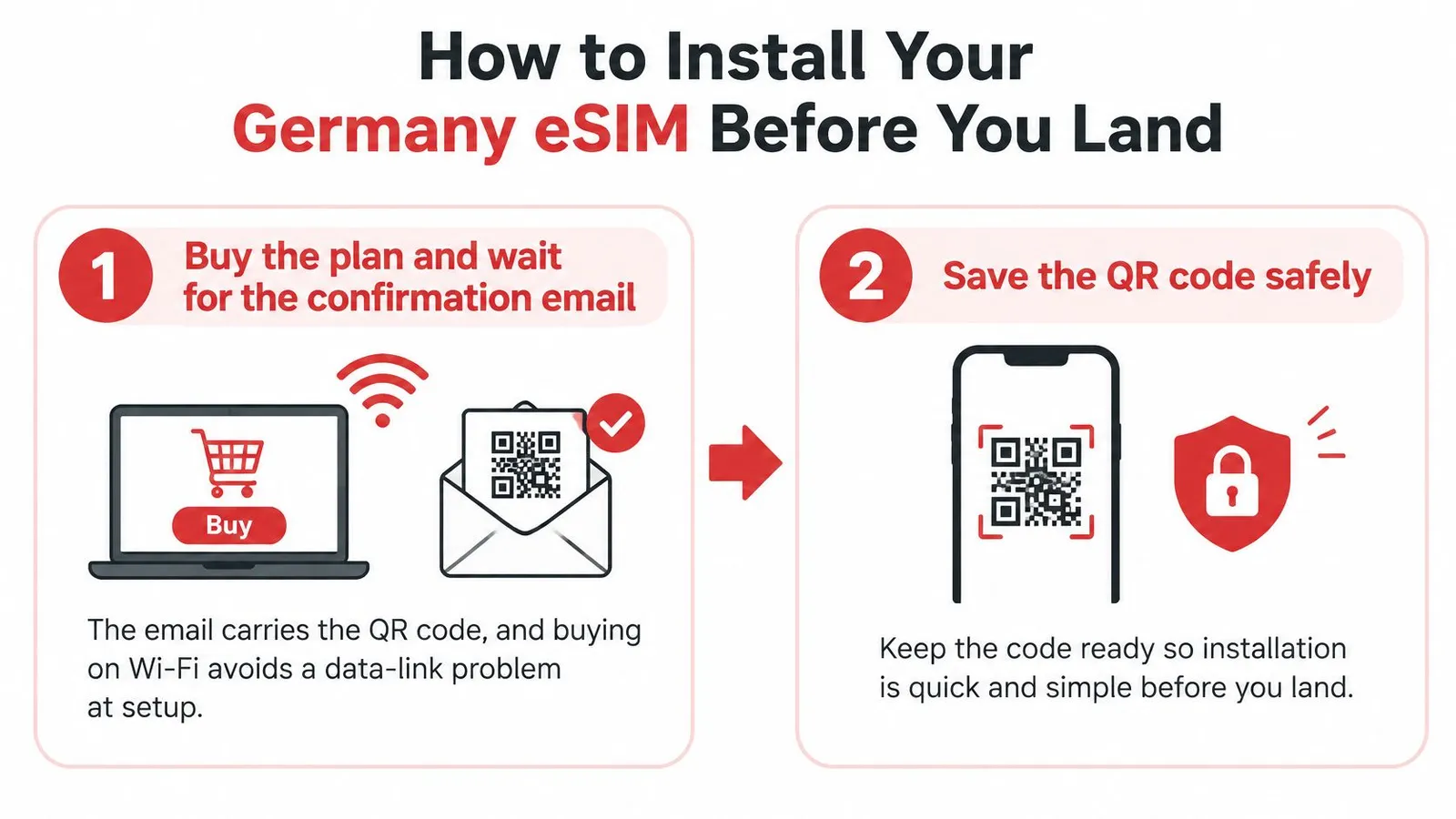
Install at home, on Wi-Fi, with the phone in your hand and nobody queueing behind you. The order below matters, because each step removes one way to get stuck.
- Buy the plan and wait for the confirmation email. It carries the QR code, and buying over Wi-Fi avoids a data problem at the exact moment you need a connection.
- Save a screenshot or print the code. If the install stalls midway, you need the same code again, and a deleted email is a painful way to learn that.
- Add the eSIM in settings. Open the mobile or cellular menu, choose add eSIM, and scan the code. On compatible devices the RedSim app can do the install in a click or two.
- Label the new line Germany. Two anonymous lines in settings is how people delete the wrong one a week later.
- Set the Germany line as the data line and enable roaming on it only. This is the switch that keeps your home SIM out of the roaming charges.
- Leave the home line active for calls. The dual-SIM split covered in the activation section keeps your usual number reachable.
- After landing, wait for the German network name in the status bar. If it doesn't appear within a few minutes, restart the phone or pick the network manually from the carrier list.
Before you tap delete: don't remove the eSIM until the trip ends. Install only once your travel dates are firm, and confirm the current refund terms for unactivated profiles before you activate anything.
Success looks specific. A German carrier name sits in the status bar, the data icon shows activity, and a browser page loads in a couple of seconds.
If the carrier name appears but nothing loads, the data line or the roaming toggle is set wrong, not the plan. The eSIM setup guide walks through the same installation and covers manual network selection for phones that don't pick a carrier automatically.
Confirm Your Plan and Buy Before You Travel
Choose the activation route before choosing the data bundle. Travellers who need mobile data can buy ahead, install the eSIM at home and land ready to connect. A German number changes the decision: use the domestic activation route and allow time for ID verification. If calls and texts can stay on your home line, that extra process adds little value.
For capacity, use the trip profiles in the data section and match the plan to your busiest use case. Hotspot sharing, laptop work and video meetings place you in a higher data tier than maps and messaging. For a route that crosses German borders, a regional plan can prevent a separate purchase in every country.
Once the route and size are settled, buy while you still have reliable internet. Check that the destination, validity period and data allowance at checkout match the plan you selected. That is the final decision point; everything after it is setup.
RedSim's Germany eSIM costs $2.19 for 1 GB over 7 days. It provides instant QR delivery, hotspot support, top-ups on an active eSIM and 24/7 WhatsApp and email help. Visit RedSim to match a plan to your route before you fly.

 Japan


 Portugal